Author: JP4

  • The defense industry and the US government are inextricably linked

    The defense industry and the US government are inextricably linked

    Fresh on the heels of news that the government will take a 10 percent stake in failing chip company Intel, Commerce Secretary Howard Lutnick has floated the possibility of commanding a direct stake in Lockheed Martin and other large defense corporations. Speaking on CNBC, and extolling the “exquisite” proficiency of Lockheed products, he claimed “my Secretary of Defense and Deputy Secretary of Defense are thinking about it.”

    The proposal obviously fulfills a key requirement, which is to appeal to the transactional proclivities of the boss. Donald Trump had greeted the Intel arrangement as a “good deal” criticized only by “stupid people,” and suggested that there will be more such investments. (As is already happening with the injection of Pentagon funds into rare-earth producer MP Materials.)

    The Intel deal at least involved no further investment of taxpayers’ cash, since it involved merely the conversion of Biden-era CHIPS Act bailout money into a stock holding. But it is hard to discern merit in turning weapons production into more of a government-run enterprise. The prospect has certainly excited alarm among free-market partisans. “I don’t really understand why they would want to do this,” Todd Harrison, a senior fellow at the American Enterprise Institute, told Defense News. “This is basically abandoning the free market for national security. This becomes state capitalism, much more in the model of China than in the American tradition.”

    But Harrison and other such complainers miss the point. The free market in national security went away a long time ago; major defense firms already enjoy a symbiotic relationship with Uncle Sam. As Lutnick himself told CNBC, “Lockheed is basically an arm of the US government” deriving 97 percent of its income from government contracts. Much the same applies to the rest of the defense-industrial sector, with sellers and the buyer enjoying a seamless relationship in which a perpetually revolving door spins defense officials into the corporate world, including as lobbyists, and back.

    Close examination indicates that in the US, one branch of the bureaucracy buys weapons from another

    A 2023 report by Senator Elizabeth Warren detailed how the top American defense contractors employed no fewer than 672 former officials, military officers, along with former members of Congress and staffers as board members, lobbyists and senior executives, with Boeing leading the way. A total nationalization of the defense industry could potentially eliminate the current army of lobbyists. Yet, as one longtime critic put it, “I’m not crazy about replacing private sector lobbyists with government official lobbyists. With even more politicians having a finger in the pie, what could possibly go wrong?”

    Though Lutnick would hardly care for the comparison, our system has broad similarities with the way the Soviets ran defense, a system replete with bloated and inefficient enterprises staffed by an army of dependent bureaucrats and workers insulated from competition or failure. It ultimately bankrupted the Soviet economy.

    Close examination indicates that in the US, one branch of the bureaucracy buys weapons from another branch. This arrangement does not allow for failure, since those who lose out in bidding for a particular contract can customarily be assured that they will be compensated next time around. Thus Boeing lost to Lockheed in the competition for the lightweight fighter contract that spawned the ill-famed F-35. But now it is Boeing’s turn as winner of the contract for the next multi-billion US Air Force fighter contract, the F-47. Sometimes the process is short-circuited, as in the case of the Navy’s littoral combat ship (LCS), for which Lockheed and General Dynamics submitted competing designs. Under pressure from the contractors’ congressional offshoot, the Navy bought both rather than picking a winner. The program was beset by gigantic overruns in cost and produced a fleet of ships prone to breakdown and equipped with deficient weapons systems.

    The problem is exacerbated by the domination of our defense industry by an oligopoly of five “prime” contractors – Lockheed Martin, RTX (formerly Raytheon), Boeing, General Dynamics and Northrop-Grumman.   In its present form, the oligopoly was fostered by Clinton’s defense secretary William J. Perry. Following the end of the Cold War, he thought it a fine idea for these corporations to absorb multiple weapons producers – at least 40 at the time – on promises of efficiency and cost-savings.

    The mergers Perry promoted were lubricated with attractive tranches of government cash. As the sorry saga of the Lockheed-General Dynamics LCS program ($100 billion lifetime cost), not to mention the US Army’s Future Combat Systems program supervised by General Dynamics ($20 billion, but nothing actually produced) or the Air Force and Navy’s F-35 deal with Lockheed (years late, multiple shortfalls and a doubled cost) might indicate, these promises remain unfulfilled.

    Meanwhile, unlike the hapless Intel corporation, which lost almost $19 billion last year, the surviving defense giants are extremely profitable. In 2024, Northrop, for example, had an overall operating profit of just over 10 percent; Lockheed, though doing less well than in recent years, still turned in a profit of just over 7 percent, with chief executive James Taiclet taking home more than  $23.8 million in total compensation. Even Boeing, hobbled by spectacularly inept management in recent decades, is back to making money on its defense business.

    Pentagon shortcomings have attracted vehement criticism of late, and there is the threat of competition from the burgeoning tech industry centered in Silicon Valley, where companies large and small are eager to get a slice of the $1 trillion defense budget. The software company Palantir, for example, was founded by entrepreneur Peter Thiel with the express intention, according to his biographer, of bringing “the military-industrial complex back to Silicon Valley, with his own companies at its very center.”

    Last year, Shyam Sankar, Palantir’s chief technology officer, penned “The Defense Reformation,” a trenchant critique of current defense procurement practices, complete with an excoriation of Perry’s rearrangement which, he wrote, had led to a “monopsony”  in which “one entity is the sole buyer of a given product or service,” thus stifling innovation. Highlighting the need for competition, Sankar called for an overhaul of the way the Pentagon does business and demanded the deployment of artificial intelligence (central to Palantir’s business) across the board.

    Pentagon shortcomings have attracted the threat of competition from the burgeoning tech industry

    Yet there are telling signs that the disruptors of Silicon Valley will not bring about significant change to business as usual. The company’s roster is already festooned with a host of former Pentagon officials and politicians, including former congressman and noted China hawk Mike Gallagher, heading its defense business. Meanwhile, Palantir’s sister company Anduril is set to garner a contract enjoined by the “Big, Beautiful Bill” that has been carefully crafted to benefit the Thiel-founded firm – and none other. Buried deep in the bill is a section authorizing border surveillance towers that specifically requires they be “autonomous,” i.e., controlled by AI, a technology for which the company is the sole vendor, thus granting Anduril a profitable monopoly.

    Partisans for further government support and control of the defense business may point to China, where major defense firms are government-owned, as a worthy example of the benefits of such a system. The expanding Chinese military, supplied by giant government-owned firms such as Norinco and Avic, do indeed get glowing reviews on this side of the Pacific, not least from tech industry hawks such as Gallagher and Anduril president Christian Brose. But since China has not fought a war since 1979, we know very little about its actual military abilities. Xi Jinping feels the need regularly to purge his military high command on grounds of corruption, notably including the People’s Liberation Army’s Equipment Development Department, which is responsible for developing weapons and widely cited as a hotbed of graft. The actual performance of Chinese weapons systems is a matter of conjecture and hype. There have been complaints out of Pakistan, a major customer for Chinese hardware, about reliability, including in frigate warships, although the recent Pakistani success in downing French-supplied Indian Rafales with their Chinese J-10 fighters (reportedly thanks to longer-ranged air-to-air missiles) was a significant publicity boost.

    DJI, a privately owned Chinese company, is by far the most successful drone company in the world and has done thumping business supplying both sides in the Ukraine war. Its DJI Mavic 3 drone ($3,500 on Amazon), when suitably adapted, is held in high esteem by Ukrainian and Russian soldiers alike and remains in demand more than three years into the war. Other recent reports out of Ukraine reference a formidable attack drone recently deployed by the Russians, dubbed the V2U by Kyiv. That machine carries an AI chip, the Jetson AGX Orin processor, made by none other than US chip powerhouse Nvidia. That’s private enterprise at work. So, for a real payoff, Lutnick and “his” defense secretary might consider putting more money into Nvidia – or even DJI.

    Andrew Cockburn is Washington editor of Harper’s Magazine. This article was originally published in The Spectator’s September 15, 2025 World edition.

  • I’m the heir to Manhattan

    I’m the heir to Manhattan

    I’m owed around $680 billion. Some 77 acres of downtown Manhattan belong to the Carter family, according to a letter written in 1894. Wall Street, Broadway and One World Trade Center – they all sit on a plot that is, by rights, mine.

    Yet here I am, grumbling about what ought to be in the pages of The Spectator. What went wrong? The story goes something like this. Shortly before independence, a pirate called Robert Edwards was licensed by the British to hunt down Spanish ships. He was so successful that the Crown gave him a slice of Manhattan as a reward. Edwards leased the land for 99 years to two brothers and subsequently died, lost at sea. That lease expired in 1877 and was supposed to be apportioned off to Edwards’s heirs. But that never happened.

    “I simply want to know if the Foreign Office is aware that Mr. Harry Wyndham Carter is, by descent, one of the claimants to the alleged Edwards estate in New York,” wrote Lord Clifton to Sir Edward Grey, then a minister in the British government and later ambassador to America. In the document, which I found in the National Archives in London, Lord Clifton says the estate was then worth about £1 million a year. If Harry had received his 77 acres, his income would have been slightly higher than Cornelius Vanderbilt’s. What Clifton doesn’t say is how exactly my cousin, four times removed, had established that he was the rightful inheritor of the estate. The letter has an air of haste, great swishes of black ink underlining facts and names. The reason for the urgency was that poor cousin Harry was in prison.

    As editor and proprietor of the Kennel Review, a magazine dedicated to dogs, he had managed to rack up some debts. His creditors planned to seize his rare books and some of his dogs from the family home in Kent. Outraged, Harry arrived just before midnight with a posse of around 20 men. They barricaded themselves in the house with “cases of champagne and other materials for conviviality,” according to one newspaper report. As well they might, given Harry was soon to be among the richest men in the world.

    After some time, he appeared at the window with a revolver and asked the bailiffs to remove themselves from his garden. “Now I give you fair warning that if you do not get off my premises when I have told you three times to do so, I will shoot you.” “Three,” he counted down from the top of the house; “two,” the bailiffs watched on, maintaining the blockade; “one.” Cousin Harry managed to clip one of them, ever so lightly, somewhere around the eye, and the man promptly took himself off to the local hospital.

    The police decided to get involved, also surrounding the home but not daring to interrupt the party. The next morning, Harry appeared again at the window and managed to negotiate an end to the siege. He emerged, “accompanied by two women, smoking a cigarette.” So began his sorry persecution at the hands of the British state.

    He was locked up for five years. Apparently, women swooned in the court as the sentence was read out. “It was the one topic of every club, inn parlor and bar,” explained another newspaper report, “the general feeling seemed to be that the sentence was too severe… especially among the fairer sex.” A petition to have his sentence commuted was organized. It was even signed by one of the jurors who had convicted Harry. Meanwhile, my cousin “made enquiries as to the allowance of cigars, wine and whiskey during his incarceration.” His imprisonment was less jolly than he’d hoped. Lord Clifton began campaigning for his release, bringing cases against prison officers for mistreatment. An exoneration and compensation committee was set up in his benefit, but it was no good. He was declared bankrupt while in prison. “Five years of penal servitude have made him wholly mad and he is now a pauper lunatic,” read the papers. On his release, he was sent to an insane asylum.

    Yet somehow he managed to escape. He was convinced that a conspiracy had deprived him of his New York inheritance, a conspiracy that went to the very top of the British state. While on the run, he wrote a letter to Queen Victoria’s private secretary, expressing his frustration in colorful language. “I am fully swindled of liberty and money… The Queen’s life is not worth a penny until she treats me properly and meets my demands.” And then he added some slightly unfortunate bits about potentially shooting the Queen.

    Royal residences across the country were put on high alert. Harry was hunted down – and found having lunch in a restaurant with a young woman. He was sent to Broadmoor Hospital for the criminally insane and, after serving 43 years, died in 1938. And with him went the proof that the Carters are the rightful inheritors of much of New York.

    But Harry wasn’t the only person seeking the Edwards estate. Over the years, thousands have claimed they are the descendants of that British pirate, and thus rightful heirs to his 77 acres of Manhattan. There was the Pennsylvania Association of Edwards Heirs which in the 1990s crowdfunded $1.5 million for a suit to reclaim the land. The courts rejected their case and the association eventually collapsed amid accusations of embezzlement and fraud.

    Historians today say the Edwards estate was a hoax. But of course they would. The great swindle of Harry Wyndham Carter continues to this day. His patient records will be declassified in 2038 and I’m confident that when they are, the world will know that I’m rightfully the heir of Manhattan – and I’ll shoot anyone who disagrees. You can join my posse if you like. I’ll bring the champagne and revolvers.

    This article was originally published in The Spectator’s September 15, 2025 World edition.

  • Beneath the foam of the Pisco Sour cocktail lies a border feud

    Beneath the foam of the Pisco Sour cocktail lies a border feud

    The Pisco Sour is poured by Maria, my business partner’s wife and the quiet boss of a small empire of bars and restaurants. It is served in the living room, the windows cracked open, friends drifting in and out, the kids out of school. It has rained and something in the air has lifted. Then comes the coupe glass: perfectly chilled, capped in silken foam, dots of bitters shaped like a closing parenthesis. I’ve had Pisco Sours before. But this one makes sense.

    In Peru, the drink is practically sacred, served at protests and presidential inaugurations alike

    The ingredients shouldn’t work – harsh grape brandy, raw citrus, egg – but in the glass, they harmonize. Chocolate at the edge, grape in the middle, something like spring itself underneath. Not refreshing in the LaCroix sense, but fecund. Alive. South American, like it’s been filtered through jungle and stone.

    And look at it. No over-the-top garnish, no sugar rim, no pipette of nonsense. Just balance. A drink that could have debuted last week at Brooklyn’s Long Island Bar and sparked a thousand imitators. But it didn’t. The Pisco Sour is a century old, born in a smoky Peruvian saloon during Prohibition, and it’s barely changed since.

    Still, don’t let its understated nature fool you. Beneath that soft foam lies a border feud, a renamed city, embargoes, lawsuits and a cocktail so beloved it became a matter of national identity for two countries, each unwilling to let it go.

    Victor Morris didn’t go to Peru to make cocktails – he went to build a railroad. A Mormon from Salt Lake City with a wooden leg and a gambler’s streak, he landed in the Andes in the early 1900s to work for the Cerro de Pasco Railway. But Lima got under his skin: the climate, the chaos and a local woman kept him there.

    In 1916, he opened Morris’ Bar just off the city center, a wood-paneled refuge for expats dodging Prohibition. He served American classics, but when he swapped pisco for whiskey in a sour, something clicked. Someone – maybe Morris, maybe a young bartender such as Mario Bruijet, who worked at Morris’ – added egg white and bitters and the drink took off. By the 1920s, the Pisco Sour had graduated to hotel bars and high society. Morris didn’t live to see it. He died in 1929, broke and fading. His bar closed. His drink lived on.

    The Pisco Sour didn’t stay in Lima. Like a catchy tune, it drifted – first to Peru’s provinces, then across the border to Chile. And that’s where the trouble began.

    In Chile, the drink got a makeover. Egg white? Optional. Bitters? Passé. The proportions skewed sharper, sweeter – less opera house, more dance hall. It was still a Pisco Sour, but louder, brasher, like a cover band hitting the same notes with more reverb. Chileans loved it. Peruvians squinted.

    The problem wasn’t just style. It was the spirit itself. Pisco, in Peru, is a craft –distilled once, no water added, from eight grape varieties grown in regulated regions. It’s complex, like a wine that’s been to therapy. Chilean pisco, distilled multiple times, is cleaner, punchier and often blended with water to smooth it out. Both are pisco, but they’re cousins, not twins. And when two countries claim the same drink, made with their own spirit, the question becomes: who owns it? Chile answered with geography. In 1936, it renamed a dusty mountain town Pisco Elqui, planting the country’s flag in the name itself. Peru countered with patrimony. Pisco, it argued, was the country’s soul – born in the Port of Pisco, codified by law, etched into its history.

    The fight got petty quickly. In the 1960s, Chile banned Peruvian pisco imports. Peru hit back with trademarks and pride. Both nations declared their own National Pisco Sour Day – Peru’s on the first Saturday in February, Chile’s on May 15. Even today, Peruvian pisco can’t be sold as “pisco” in Chile, and Chilean bottles are snubbed in Peruvian competitions. Pisco Sour is less a cocktail than a liquid border dispute.

    Step into a bar in Lima – Carnaval, La Emolientería – and the Pisco Sour arrives with a touch of ceremony. The bartender moves with quiet precision, shaking until the egg white lifts into a fine, glossy cap. Three drops of bitters land like punctuation and the drink sits there, upright and weightless. It tastes the way Peru feels: elegant, historical, a little wistful.

    In Santiago, it’s a different energy entirely. At places like Chipe Libre, the sour is stripped down – no egg white, no bitters, just lime and pisco on a joyride. It’s bright, fast and a little loud. Gone before you can overthink it.

    Each country pours its own identity into the glass. Peru’s pisco is tightly defined – single distillation, no aging, no dilution, rooted in native grapes such as Quebranta and Italia. The result is earthy, floral and a little stern. Chile’s is looser, broader – grapes like Pedro Ximénez and Muscat, often aged in oak, distilled more than once and brought to proof with water. It’s softer on the edges, a little flashier, often more familiar to drinkers of Cognac or Armagnac. Both drinks are good. But Peru’s carries the weight. It’s the version closest to what Morris might have poured behind his bar a century ago.

    Today, the Pisco Sour is enjoyed everywhere – from beach bars in Valparaíso to rooftop lounges in Tokyo. In Peru it’s practically sacred, served at protests and presidential inaugurations alike. In Chile, it’s more playful – no foam, no ritual, just lime and spirit and heat. The feud between them still simmers, but the drink has outgrown the fight. What matters is that it endures. No garnish, no gimmick, just balance. A drink that can hold a hundred years of history and still feel light in the hand.

    Tonight, it wasn’t a symbol or a battle. It was a coupe glass after the rain, clinked around a living room with the windows cracked. And it tasted like something lifting.

    The Peruvian Pisco Sour


    The classic. Creamy, balanced and defiant.

    – 2 oz Peruvian pisco (La Diablada, acholado style, is my go-to)

    – 1 oz fresh lime juice

    – ¾ oz simple syrup

    – 1 egg white

    – 3 dashes Angostura bitters

    Dry shake (no ice) everything but the bitters for 10 seconds. Then shake again with ice.  Strain into a chilled coupe. Dot the foam with bitters – triangle, always. Sip like you mean it.

    The Chilean Pisco Sour

    Tangier, louder and a little unbuttoned.

    – 2 oz Chilean pisco (try Lapostolle)

    – 1 oz fresh lime or lemon juice

    – 1 oz simple syrup

    – (Optional) ice chips or a cube

    Shake hard with ice and strain into a rocks glass. No egg white. No bitters. Add a lime wheel if you must – but only if you’re drinking it outdoors.

    Cheers to borders, blur and a drink worth arguing over.

    This article was originally published in The Spectator’s September 15, 2025 World edition.

  • Ukraine’s own Wagner Group

    Ukraine’s own Wagner Group

    As peace in Ukraine seems still far and the conflict is witnessing a new escalation of violence, a new breed of private military companies is already emerging, ready for a post-conflict Ukraine. Rooted in a draft legislation “On International Defense Companies” proposed on April 2024, the Ukrainian government aims to channel combat-seasoned veterans into regulated, transparent security firms rather than leave them adrift or, worse, turn them into mercenaries for hire in distant conflicts from the Sahel to the DRC.

    By framing Private Military Companies (PMCs) as legitimate employers under strict oversight, complete with licensing, arms registers and accountability mechanisms, a well-crafted law could both ease demobilisation pains at home and forestall the proliferation of unaccountable fighters abroad. Regulated PMCs could also provide financial stability for former soldiers and create a new revenue stream for Ukraine’s post-war reconstruction budget.

    Moscow has taken notice. Some voices in Russia are already signalling that a condition for any long-term ceasefire could be a ban on Ukrainian PMCs, particularly those operating abroad. The concern is clear: future Ukrainian PMCs are likely to field not just battle-hardened boots on the ground but also elite combat drone operators, especially the frontline drone pilots, skilled intelligence analysts, hackers with cyberwarfare expertise and access to cyber weapons and frontline-experienced medical teams, all for hire.

    In effect, they would form a highly capable force and be a direct competitor to Russia’s Wagner Group, but with even more sophisticated capabilities in modern warfare and, most importantly, being palatable to the West. These PMCs will also capitalize on the combat experience of Ukrainian fighters, turning them into a force multiplier for regular armies worldwide by offering highly sought-after training in battle-tested tactics.

    It is not by chance that at a June 4 news conference in Berlin, President Volodymyr Zelensky signaled he may be open to the creation of private entities in Ukraine, a pointed response to a recent Russian memorandum demanding that Kyiv dismantle all “nationalist formations” and private military companies.

    The danger is that without proper regulation, highly trained and heavily armed veterans could operate abroad in a legal grey zone, behaving more like mercenaries than legitimate private military contractors. History offers a grim preview of what can happen when such forces operate without oversight. Russian veterans returning from the brutal urban combat of the Second Chechen War, many scarred by PTSD, often fell into cycles of addiction or found new purpose in criminal syndicates and mercenary outfits, some enlisted in a little-known outfit at the time, the Wagner Group.

    The modern mercenary landscape abounds with such examples: Colombian ex-soldiers linked to the assassination of Haiti’s president, to former ISIS fighters serving as proxies in the Libyan civil war. Together, these forces blur the line between statecraft and criminality, embedding themselves in the global black market that trades in weapons, narcotics and human trafficking.

    At the same time, the legality, accountability and military utility of PMCs are still highly debated. One certainty is that rogue PMCs have the same corrosive effect on societal cohesion as mercenary groups.

    The urgency is clear: the privatisation of warfare is not slowing down, and mercenaries are increasingly deployed as tools of state influence, operating in a legal grey zone where plausible deniability meets profit. The Wagner Group, now rebranded Africa Corps, keeps client government weak and the security situation in flux, ensuring continued demand for their services while securing access to lucrative natural resources. It’s no coincidence that the group’s chilling motto, “Death is our business,” endures, even after its leader, Yevgeny Prigozhin, perished in a fiery plane crash following his failed coup.

    Today, this privatised model of conflict complicates traditional notions of state-controlled violence. Without clear rules, rogue PMCs can destabilise regions, undermine peacekeeping efforts, and siphon talent from local security forces. Worse, history suggests that mercenaries, driven by profit, are often incentivised to prolong conflicts rather than resolve them. While the societal costs of unaccountable PMCs and mercenaries are borne locally, the consequences ripple globally.

    Yet not all private military firms operate in the shadows. Stringent international standards, accountability and adherence to human rights by PMCs could play a constructive role in regions where states are unable or unwilling to provide security services.

    If Ukraine’s future framework for regulating its veterans succeeds and prevents a mercenary Wild West, it may offer a blueprint for other nations grappling with the aftermath of conflict. The alternative, a world increasingly dominated by shadow armies, risks normalising a privatised form of violence with few checks, vast profits and long-term negative effects on social cohesion.

  • Was the Minneapolis shooting an anti-Catholic hate crime?

    Was the Minneapolis shooting an anti-Catholic hate crime?

    “Don’t just say this is about thoughts and prayers right now,” said Minneapolis Mayor Jacob Frey, standing near the scene of yesterday’s Catholic school shooting in his city. “These kids were literally praying.” I think he was trying to say: “This is no time for empty platitudes” – or something similar. The words sounded horribly glib, though.

    Of course, the killing of children distresses all good people, and Mayor Frey should be forgiven for an emotional outburst. There is something telling, however, about his kneejerk hostility towards the natural religious response to horror; his instinctive rage against the idea of a God who lets evil happen.

    For a certain sort of metropolitan Democrat, Christianity is the impediment to, not the root of, justice. The secular liberal brain is trained to see Roman Catholicism, in particular, as wrong and harmful and needing to be stopped.

    From what we think we know about the unhappy mind of the suspected killer, a boy called Robert Westman who wanted to be a girl called Robin Westman, it seems the same hostility – relatively harmless in a politician such as Frey – turned into something far darker. In an image widely shared on social media, we see what appears to be the machine-gun magazine clip he used to kill two children and injure 17 more. “Where is your God?” is scrawled on the side. Westman, who went on to kill himself, had reportedly attended the Annunciation Catholic School – and his mother attended Mass at the affiliated Annunciation Catholic Church – that he decided to attack.

    FBI Director Kash Patel has said his agency is investigating the shooting as “an act of domestic terrorism and hate-crime targeting Catholics.” Others argue that it is a mistake to confuse nihilism with politics or anti-religious ideology. Westman’s social media scrawlings suggest a warped, manically depressed and insanely incoherent outlook.

    Yet western liberal loathing of Catholicism, which taps into a more traditional American Protestant phobia, has intensified in recent years. Today, mentally-ill people often latch on to that hatred in a violent way. Since May 2020, some 400 Catholic churches have been attacked. “Incidents include arson, statues beheaded, limbs cut, smashed, and painted, gravestones defaced with swastikas and anti-Catholic language and American flags next to them burned, and other destruction and vandalism,” according to the US Conference of Catholic Bishops. In June this year, Bishop Kevin C. Rhoades, the chairman of the conference’s Committee for Religious Liberty, wrote to Congressional leaders urging them to provide more funds for the protection of religious places of worship. Earlier this month, a vandal smashed windows and set fire to the door of the Christ the King Catholic Church in Flint, Michigan.

    Catholics in America don’t expect or demand special protected-community status and no Christian wants to see sacred spaces turned into security zones. But there can be no denying that, as the latest reports suggest that American Catholicism is now entering a period of renewed growth, we are witnessing a concomitant outbreak of virulent anti-Catholicism in the land of the free. It’s an issue that the first American Pope might address in the coming days.

    This is from latest Americano newsletter. To subscribe click here.

  • Taylor and Travis save America

    Taylor and Travis save America

    Elon Musk and Taylor Swift fans rejoice! America’s birthrate is saved!

    News of the engagement between America’s reigning sweetheart, Taylor Swift, and jock, Travis Kelce, can mean only one thing: a millennial marriage boom is upon us. And with it, natalists will hope, an impending baby boom.

    I’m no Swiftie. Nor am I one of those men who’s organized his entire political identity around hating the singer. Still, I can’t deny that I feel uplifted by the jubilation erupting across the nation this afternoon. Why? Because Taylor and Travis are taking a stand against pessimism. America’s permanently heartbroken oldest daughter has escaped her fate (for now). These are people taking the leap! Committing to something! How exciting is that?

    Talking about the birthrate is so passé. Cringe, even. I have no desire to weigh in (and wouldn’t be, had my editor not twisted my arm into writing this piece), even as I acknowledge that it poses a serious problem for the nation’s future. So too does the hesitancy toward marriage and even dating among the young. But any Millennial or Zoomer forced to brave the dating market in recent years knows the battle of the sexes has gone nuclear. An overriding pessimism about the value of relationships, with all their potential for pain and suffering, has metastasized; in heterosexual relationships, a casual two-way hatred of the other sex has also become disturbingly commonplace.

    Enter Travis and Taylor. Their engagement post, which at the time of writing has racked up some 10 million likes, is surprisingly suburban. It looks like an engagement backdrop I’ve scrolled past a thousand times. There is little extravagance in it (excluding the boulder of a diamond). But they’re making a marriage proposal – a daunting prospect – appear attainable, and more than that, mundane. There’s something lovely about that everydayness that shouldn’t be lost on the billions of people who see it.

    Commentators will quickly point out that this engagement is timed eerily close to the announcement of Taylor’s new album, The Life of a Showgirl. Maybe this is all stage-managed opportunism, then. Probably. But everything our celebrity class does is stage-managed opportunism, and this example is at least subversive for how surprising and against-the-current it is. The underlying message: take a chance. Ask her out – if not on your family sports podcast, then at least at the bar. Certainly this is less damaging to the national psyche than, say, the public dissolution of Kim Kardashian and Kanye West’s union.

    Conservatives will quickly claim the Tayvis union as a win for their political camp. But Taylor mastered the art of vague messaging long ago, and as is often the case, there’s something for everyone. With the announcement, Taylor seems to be telling her fans that you can have it all – the marriage and the career (not exactly a New Right talking point). Anyone with an internet connection, which is to say everyone, will recall that she was most recently in the news for the announcement of Life of a Showgirl, on the cover of which she appeared very scantily clad. Contrast this with the image of her today in a walled-off garden wearing a modest dress. You can be a showgirl and a happy fiancée, she seems to be saying. Is this tenable? Will it end in heartbreak? Who knows. But it’s a nice thought.  

    Kelce, whom I suspect can’t read, is certainly marrying up. He’s no slouch, of course. NFL-loving men across the country have had their hearts repeatedly broken by the future Hall of Famer and the Kansas City Chiefs on too many Sundays in recent years. But his fiancée is the biggest star in the world. Perhaps there are valuable lessons here for both sides in the battle of the sexes. Women: take a chance on the idiots. Men: don’t be so afraid of a go-getting woman.

    In addition to celebrating the couple’s big win, we can quietly celebrate the knock-on wins coming our way. Travis, we can only hope, will be thoroughly distracted by the wedding planning. This should hinder his on-field performance, and America therefore may soon be released from the tyranny of the dominant, evil Kansas City Chiefs. Also, this country, allergic to monarchy, doesn’t have royals. So this union will be the closest thing to a royal wedding we have, and everyone loves a good wedding party. 

    Maybe I’ll feel more pessimistic about all this later. It feels likely I will. But who wants to pooh-pooh a couple on their engagement day? Even our petty Gossiper in Chief has caught the cheeriness bug: “I wish them a lot of luck,” Donald Trump said during a Cabinet meeting, “I think he’s a great player. He’s a great guy. And I think she’s a terrific person.” 

    For now, we owe Taylor and Travis. Optimism is back – at least for one day.

  • FIFA president joins Trump for Oval Office kickabout

    Washington, DC

    President Trump had balls on the brain on Friday. At an unannounced stop at the People’s Museum by the White House – where he was checking out the newly refurbished gift shop –  he laid down the gauntlet to DC Mayor Muriel Bowser. “I think the mayor has to get on the ball, because we have a situation, and she’s a nice woman, but I tell you what she’s got to get on the ball,” the President told the press. “I don’t want to see phony numbers.” We are now in the 12th day of Trump’s federal takeover of law and order in the capital. In that time, 719 arrests have been made, 36 of them illegal aliens, according to the White House.

    Next, the President headed over to the Kennedy Center to inspect the ongoing reconstruction efforts. Today’s major announcement was that the draw for the FIFA World Cup would take place there in December. FIFA president Gianni Infantino flew over from Europe for the “announcement” that took place in the Oval Office in the early afternoon. Also present behind the Resolute Desk: Vice President J.D. Vance, World Cup Task Force chief Andrew Giuliani, FIFA senior advisor Carlos Cordeiro and DHS Secretary Kristi Noem. Special government employee Corey Lewandowski was toward the back of the room with other White House officials.

    Infantino presented the President with a novelty-sized ticket to the World Cup Final. He brought the World Cup with him from FIFA HQ, giving it to Trump to hold after pointing out that the last person to lift it was Argentina and Inter Miami superstar Lionel Messi. “Since you are a winner, of course you can touch it,” Infantino said, easily falling into the role of obsequious medieval courtier. “Can I keep it?” Trump asked. He may have been joking – but the original Club World Cup trophy that he presented to Chelsea FC on Infantino’s last visit still sits behind him. 

    The entire Oval Office is very, very gold: the President has taken a number of portraits of past presidents out of storage, hanging them in the office with gold-effect frames. It’s safe to assume that his White House ballroom, when completed, will have a similarly Uday Hussein aesthetic.

    Trump remained focused on his law-and-order efforts. “We haven’t had to bring in the regular military, which we’re willing to do if we have to,” he told the press pool in the Oval. “And after we do this, we’ll go to another location and we’ll make it safe also… Chicago is a mess. And we’ll straighten that one out probably next.” No word yet on his plans to beatify the area around New Jersey’s MetLife Stadium, where the World Cup Final will take place 11 months from now.

    “Do you think America will win?” I asked the President at the end of the session. “I don’t know,” he replied, smirking. “I watch some of those teams go, they go down that field, I don’t know…”

    “Let me ask you,” Trump said, turning to Infantino. “What chance does America have of winning?”

    “Well the home team always has a good chance to win,” the FIFA president replied.

    “See? He’s a good diplomat,” joked Trump. How good, exactly, we shall see: Trump also mentioned how President Putin was hoping to attend the 2026 World Cup. Russia has been suspended from competition since it invaded Ukraine in 2022. Perhaps a lifting of that ban could prove to be a pot-sweetener in their much-vaunted peace negotiations in the weeks ahead.

  • Fresh tracks in ancient territories

    Fresh tracks in ancient territories

    By complete fluke, my delayed shuttle bus rose through the Coast Mountains at dusk. I pressed against the window, outing myself as a tourist amid seasonaires snoozing through another spectacular sunset. Hot pinks and deep purples streaked between towering pines, transforming the outline of snow-capped peaks. I’d crash with local friends for a month, with support from Vail Resorts to explore stories beyond the slopes. Tales of Whistler Kids ski school were already family lore – I’d once visited as a 10-year-old, buzzing to see snow.

    Stuck at Vancouver International, I’d pulled up a chair at Salmon n’ Bannock on the Fly – Canada’s only Indigenous restaurant in an airport. As travelers, how often do we pause to ask whose land we’re actually on? I wasn’t thinking about that in 2000, and neither were my parents as we geared up for our first big ski trip. Flatbreads, wild fish and game dishes made clear I was on unceded First Nations territory. 

    Tourism Whistler/Justa Jeskova

    The mountains I’d flown to ski are sacred. They belong to the Squamish and Lil’wat Nations, whose knowledge and care shape these lands. Building luxury tourism here is complicated, no doubt. But done thoughtfully, tourism can support cultural preservation, benefitting Indigenous communities directly.

    Jet lag had me blinking snowflakes from my eyelashes, beholden to The Bunker café’s 7.30 a.m. opening every day for a week. I acclimated among a revolving cast of resilient mountain-town types, fueling up for another perfect ski day (or a 15-hour bar shift). Baristas balked at $2,500 room rental listings as I shared a maple bacon croissant with Marina, fresh from a three-week Chilean trek (her dry food arrived by horse – Canadians are tough, I was discovering).

    “You see brown bears on your walk home from the bar in summer,” she said. “I just keep walking, fast. Too cold to see ’em now. Too cold to ski! I’m not going up there.”

    SLCC Winter Feast, Squamish Lil’wat Cultural Centre Tourism Whistler/Justa Jeskova

    Bunking in with friends gave me a rare chance to get to know the Whistler Blackcomb behind the brochures. During a long, cold snap (at -15°C/ 5°F, the term hardly seemed adequate), I skipped the mountain to explore the Squamish Lil’wat Cultural Center, one of Vail Resort’s partners. A museum-gallery-café hybrid, it’s filled with carvings and canoes, offering Indigenous-led forest walks, workshops and storytelling. The Audain Art Museum is home to massive Northwest Coast cedar masks, alongside a collection of moody Emily Carr landscapes. I was reminded to swerve any gift shop replicas.  

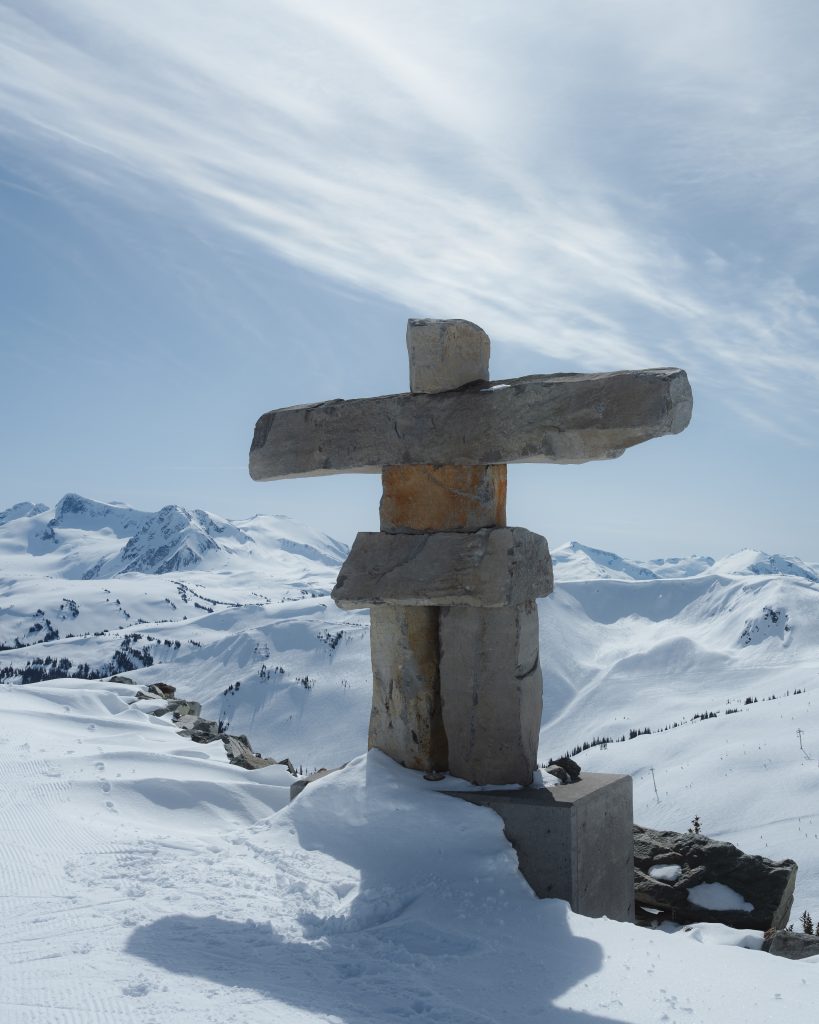
    The resort highlights its roots, offering quiet invitations to reflect – like the Peak 2 Peak gondola, its cabins wrapped in Indigenous art. Dotted between Whistler Village Stroll’s thumping bars and clubs are public installations, towering carved Welcome Figures and First Nation statues depicting nature, strength and legend. More snow-covered carvings peek mythically from the slopes. “The Squamish and Lil’wat Nations have agreements with the resort,” my museum guide said. “There are programs now for revenue sharing, employment and training.”

    Matt Sylvester

    With a new appreciation for the land’s history, I wanted to explore. A trip highlight: Phoebe from Black Tie Ski Rentals pulling up at my friends’ place with three pairs of boots and skis. What luxury, to skip the usual queue in a stuffy rental shop. Owner Todd’s team had dubbed me “aggressive” based on my emailed stats, sparing me the embarrassing shop weigh-in. Village-level exchanges with free swaps make them worth every Canadian dollar, especially in unpredictable conditions.

    Something I’d been wary of: TikTok-famous lift queues snaking through town on peak days. On weekdays in February, I found almost none. On weekends, beating the lines just meant getting out early. Pro tip: avoid “the maze” – the Whistler Gondola entrance – and head straight to the Fitz, Garb or Emerald chair route. While tourists wait, you’ll already be carving first tracks down Raven. That, plus a breakfast roll from Splitz Grill, became my daily ritual (after a quick check of Whistlerpeak.com’s webcams). I skied – and ate – like a local: $12 chicken udon at Samurai Bowl and late-night Fuji Market dashes for half-price sushi.

    The biggest resort in North America, Whistler Blackcomb’s stats justify the hype. More than 200 runs, 8,050 acres of skiable terrain, 16 bowls and three glaciers for me to throw myself down. I found powder-filled chutes and bowls, tree runs spaced just right and wide-open groomers, plus terrain parks to please the pickiest of park rats. 

    Embracing my “aggressive” label, I took the Glacier Express to boot-hike Spanky’s Ladder, and drop into Garnet, Diamond, Ruby and Sapphire Bowls. Some of the most thrilling – and humbling – skiing I’ve done, helped by a hip flask of Baileys. A shift from three weeks of drought and sun to 20+ cm of fresh came fast, conditions swinging from wind-packed and crusty in exposed areas to buttery soft in sheltered bowls.

    At 7:15 a.m. on a freezing Tuesday, I understood why the die-hards keep coming back (and why lock-ins at Irish bars aren’t advised on ski trips in your 30s). Two espressos down, I joined Dawn Patrol – Whistler Heli-Skiing’s grounded-flight backup. That kicked off several packed days organized by Vail, showing me lines I’d never have found solo. There’s quiet magic in slipping away before the village stirs, carving through untouched powder in total silence. My guide pointed out off-the-map runs only locals know, and by 9 a.m., I was buzzing on adrenaline and sugar. Chic Pea’s oven-fresh cinnamon buns were a fine reward for the brutally early start.

    Lunch arrived at Christine’s on Blackcomb, where well-heeled skiers gather for panoramic views, charcuterie boards and rich massaman curry. A local friend jealous of my rather posh itinerary had shared a review: “Order a Bloody Caesar (vodka, clamato juice, Tabasco and celery salt). They used to make you apologize to a turtle if you asked for a plastic straw.” Now, local produce is hauled up the mountain by gondola – a logistical challenge that speaks to their commitment to high-quality sourcing.

    Another elevated experience came via a six-course Winemaker Lunch at Steeps Grill & Wine Bar: beautiful regional bottles, delicate plates and 1,850 vertical meters between punters and a red wine nap (the lift’s there if you lack hubris). Also delicious: Spirit Bear coffees and Ravens Brewing beers on the sunny patio at Raven’s / Sḵewḵ’ / Yecwlào7 – the first Indigenous-inspired restaurant at the Creekside Gondola summit. 

    The Fairmont delivers peak mountain lodge luxury – cozy fireplaces and big panoramic windows. Ski-in/ski-out access sees guests swap skis for hot chocolates by an on-slope fire. The Mallard Lounge has the buzz everyone’s looking for after a day on the hill. Vida Spa’s heated pools, jacuzzis and private barrel saunas are undeniably luxe (I kept it real with a Meadow Park membership). The Gold floor offers a hotel-within-a-hotel setup, with a private concierge and lounge designed for eating cheese in fluffy robes. Fog rolls over the pines as Blackcomb Gin is poured out, infused with cedar tips and Pemberton hops.

    Tourism Whistler/Justa Jeskova

    At the base of Blackcomb, staying here drops you into the center of nightlife that stretches far beyond boot-stomping and Burt Reynolds shots (those rum-and-butterscotch shooters show up everywhere). Evenings aren’t about the usual ski “scene” so much as subcultures – part fur-trim and velvet ropes, part champagne super-soakers, part open-mic night chaos. Vallea Lumina is a sort-of multimedia night walk through an old-growth forest, gently sharing ancestral stories. Fire & Ice features St’át’imc Nation hoop dancers telling the story of Spo7ez, an ancestral village buried by a massive rockslide – said to be triggered by the mythical Thunderbird to restore peace. It’s a powerful reminder of Indigenous values of coexistence. 

    Helicopter tours with Blackcomb Helicopters offer the perspective needed to grasp Whistler’s scale. Every hour in the air is offset by forest preservation on Quadra Island, once earmarked for development. Banking over Whistler Peak, I watched glacier walls glow electric blue. Below, skiers traced threads across vast mountainsides, heading for hidden bowls of powder caches. Our pilot pointed out the Cheakamus Community Forest, co-managed by the Lil’wat and Squamish Nations with the resort. Indigenous knowledge shapes modern conservation, ensuring the land is treated with respect.

    Whistler Blackcomb delivers on every skier’s dream – but its heart lies in the land’s history and the people working hard to honor it.

    Amy’s trip was supported by Vail Resorts. 

    Rates at the Fairmont Chateau Whistler start from $600 per night (7-night minimum) in winter, and $407 per night (2-night minimum) in summer.

    Now is also the best time to lock in the Epic Pass at its lowest price of the year, with expanded access to Verbier and the 4 Vallées, plus the new Epic Friend Tickets for 2025/26 season giving friends of Epic Pass holders major discounts.

    More at: www.epicpass.com | www.fairmont.com/whistler

  • What will happen in Alaska?

    What will happen in Alaska?

    “Alaska,” said the mountaineer Jon Krakauer, “is a place that constantly reminds you of just how small you are in the grand scheme of things.” I doubt somehow that Vladimir Putin and Donald Trump will echo that sentiment when they meet tomorrow in the Last Frontier to carve up the future between themselves – Plumb-Pudding-in-Danger-style. The two leaders will have each traveled some eight hours over their own mighty lands to see each other. It will be a case of today, Ukraine; tomorrow, ze world. 

    Yesterday, the Trump administration went to great lengths to assure nervous European leaders and Ukrainian President Volodymyr Zelensky that Trump would not, in their absence, simply roll over for Putin. There would be “severe consequences” for Russia, said America’s Commander-in-Chief at the Kennedy Center Wednesday morning, if Moscow did not agree to a ceasefire in Ukraine. Trump wants his meeting with Putin to “lay the table” for a trilateral with Zelensky. 

    Zelensky had said that “substantive and productive talks about us, without us, will not work.” So Trump struck an unusually humble note. He said that if tomorrow’s summit “goes OK, we’ll have a quick second one… between President Putin and President Zelensky and myself, if they’d like to have me there.”

    But in European capitals, and among the Atlanticist foreign-policy blob, the anxiety about the Trump-Putin summit goes beyond the possibility of disadvantageous land swaps in the Donbas. The fear is that Putin will cannily offer Trump some groundbreaking energy-and-investment deal, some ice-breaking Arctic Accord that resets US-Russia relations on a better footing. It’s worth noting that Putin will be accompanied by his special envoy Kirill Dmitriev, the head of Russia’s sovereign wealth fund, so we can perhaps expect talk of trillion-dollar schemes to bring the two great nations together.

    Aleksandr Dugin, Putin’s right-wing philosopher, who lost his daughter to a car bomb in 2022, said yesterday on X: “The real success of Alaska will be if Trump and Putin don’t mention Ukraine at all. There are so many other important issues.”

    Dugin, who sees Russia’s role in the world as being the defender of Christian values against Satanic forces, added that the “Deep State” – by which he means the forces of western liberal internationalism – “now controls Trump too openly and too brutally. But Trump doesn’t like to be controlled. So Alaska is the opportunity to restore the balance.”

    This is almost certainly how Putin will approach tomorrow’s negotiations. He will praise Trump for being strong enough to resist the NATO warmongers in his midst and bold enough to begin a new divinely ordained alliance between “Daddy Trump” and Mother Russia. 

    It is, of course, wildly unrealistic to expect Trump and Putin to not mention Ukraine. Trump wants the three-way meeting in order to make good on his campaign promise to achieve peace. How on Earth that might work is another matter. The Times of London yesterday reported that the compromise on offer was for a Russian-style occupation of Ukrainian land modeled on Israel’s occupation of the West Bank (because, er, look at how happily that region is getting along). The White House said the Times’s scoop was “total fake news and sloppy reporting… Nothing of the sort was discussed with anyone at any point.” Clearly, however, Trump’s special envoy Steve Witkoff, who visited Moscow last week, agreed something with Russian officials before the Alaska summit was announced. The question for tomorrow is: will we find out what?

  • Candace Owens: on the Macron lawsuit, anti-Semitism and Trump

    Candace Owens: on the Macron lawsuit, anti-Semitism and Trump

    Candace Owens joined Freddy Gray on the Americano show last Friday to discuss her recent lawsuit with the Macrons, Trump’s intervention, the Epstein Files and accusations of anti-Semitism.

    Here are some highlights from their conversation.

    Why did Macron and his wife sue Candace Owens?

    Freddy Gray: Candace is being sued or threatened with legal action by the Macrons, Emmanuel and Brigitte Macron, the President and First Lady of France. Because, Candace, you believe that Brigitte Macron is a man. Why do you think the Macrons are choosing to sue you?

    Candace Owens: Because they were trying to stop the story. I think it was an effective PR strategy. They had been suing and harassing the journalists that had initially brought this story forth to the French public for years, and then they lost their defamation suit against the two journalists, Amandine Roy, Natasha Roy. And that was pretty explosive news. So I think that they then filed suit against me and knowing that it would drive potentially the most media traffic to kind of say, “Oh no, but it still isn’t true at all. I know we lost this defamation case in our home turf, but we’re now going to try it in America,” just to kind of signal to the press that they’re not lying.

    FG: If you wanted the story to go away, this is not a very sensible strategy.

    CO: Yeah, actually if you look at the history of them as a couple, they haven’t been very good at PR… I do think it was poor advice. I think their advisors made the wrong decision, and we saw this even recently, the disaster of their PR when Brigitte was caught assaulting Macron on the plane. I mean, they lied, they forcefully lied, and then they essentially disappeared. The story the very next day from the French press. So they’re used to having that kind of power.

    FG: It’s that clip that makes me think you’re wrong, because I’m pretty sure she punches like a girl. I mean, men don’t hit like that.

    How did the theory start?

    CO: The Daily Mail ran a headline, and Emmanuel Macron was on camera saying it’s not true, and freaking out about these rumors and saying how hurtful they were. And I thought that was odd. I said, “What could possibly be going on in France that the President is having to lower himself to respond to such a ridiculous rumor?” And when I was reading this article, I was sort of interested in the dog that wasn’t barking, which is that the Daily Mail didn’t do a good job of instantly debunking it. Obviously, tons of photos could debunk this… It wasn’t a deep internet web conspiracy. It was actually French journalists that were on the left who loved Brigitte Macron and wanted to celebrate her by doing their due diligence and telling the story of Brigitte Macron. These were feminists… They felt that they were being threatened by the Élysée Palace. They were asking basic questions, asking for pictures and feeling like they had done something wrong. And they were essentially being told that the only person that could get them what they were looking for was a woman named Mimi Marchand, who at that moment was running communications for the Macron couple. Mimi Marchand has since been charged with forging documents… So it was very organic how this story took off in France. People just trying to figure out like, hey, can we get some photos of you? There’s 30 years of your life that seem to be missing?

    FG: It is definitely strange that nobody seems to be able to find a lot of evidence about Brigitte Macron’s upbringing. But what occurs to me – I’ve watched the series – I know the journalist you speak to, Xavier Poussard. He uses a facial recognition app to say that these images of Brigitte Macron’s brother must be her. There’s a sort of 80 percent likelihood. That strikes me as not necessarily reliable, and also the fact that, you know, siblings can look very, very alike. So the fact that Brigitte Macron’s brother looks a lot like her is not quite that surprising, is it?

    CO: No, it’s not surprising at all. And you’re correct. This is not a 100 percent technology… What’s more compelling is that this brother of hers is missing. At this point you would have to have a terrible relationship with your brother if you wouldn’t just come out before you had to sue anyone and say, “Hi, it’s me, I’m Jean Trogneux. I love my sister very much. I’m a private person, but this is getting ridiculous.” Or even her children, right? Her children could release photos of them being raised by her growing up. But I don’t care how angry you are at your parents, at a certain level, you’d go, “Guys, this is getting ridiculous. Here’s me and my mom.” We’re just like, hey, 30 years of your life is missing. It’s getting a little uncomfortable with how many people in your orbit have been arrested for pedophilia. You’ve lied – objective lies – you told the press at the beginning of your relationship. Don’t forget, when he first ran for president, the public told the media he was 17. Now we’ve got them down to 15. And the truth is that he was actually 14 when he was in that play where she says she saw him perform. But it’s not helping the media story that they lie. From the very beginning they presented it as if Brigitte was this really irresistible, sexy teacher, when when they actually got evidence of what she looked like when she was teaching Macron. She looks homely. It’s definitely not a very attractive teacher that was wearing skirts. It looks like a male that’s in the middle of a transition, to be honest with you.

    FG: I’ve listened to what Xavier and you said about that. And it does sound a bit like Xavier was sort of just angry at the media for the way that they manicured her image. But that’s what happens with powerful and important people. Their images are always being manicured, and often they manicure themselves.

    CO: Which is totally fine. It’s every piece of the Brigitte Macron story that has required so many lies. And yeah, they they did that, perhaps because they didn’t want people to realize that something really strange happened at that school. And it doesn’t help that when Emmanuel Macron entered office, they got to work trying to lower the age of consent to 13. It doesn’t help that Emmanuel Macron’s mother worked in her career assisting transgendered people in getting identities. The person that’s dressing Brigitte Macron that works with LVMH and Louis Vuitton specializes in androgynous dressing, trans people and of getting models that are trans. There’s so many other elements that are just peculiar. I want people to also know that before we published the first episode, we were in touch with Brigitte’s team. We said, “Look, we’re not interested in spreading conspiracies. Answer these basic questions. Could you produce some photos of your living for 30 years? Did you live as Jean-Michel? Have you ever lived as a person named Veronique?” And they forcefully declined to answer any of those questions.

    French pedophilia?

    FG: I think you’re sort of insinuating that the real scandal behind this is a kind of pedophilic elite in France.

    CO: I believe that’s been a problem that’s happened in Paris for a very long time.

    Owens mentioned Sigmund Freud, Richard Duhamel, Richard Trumbull, Eric Moretti and André Gide as examples of French pedophilia.

    FG: Well, like me, you’re a Catholic. You’re a recent convert to Catholicism. And I know from my French Catholic family that there is this obsessive hatred in France of the French government and the secular French government and the French left, and this assumption that they are satanic somehow or Satanic driven. Is that something you think you’ve latched on to?

    CO: Well, no, I was not aware of French politics. I got into this quite organically. I don’t follow French politics. I don’t speak French… The idea that there are is an orbit of people who could commit crimes and then have the audacity to sue people for writing books or sue people that are talking about it. It offends me. It offends my senses as a Christian and as a mother. And I felt that it was very important for the world to kind of look and go, what’s going on in France? … It definitely wasn’t driven by some idea of a satanic panic happening in France.

    Trump tells Candace to stop saying Brigitte is a man

    FG: The Donald Trump story. He leant on you himself to stop talking about the Brigitte Macron story.

    CO: Yeah. Back in February, Macron was in the White House ostensibly to discuss Russia and Ukraine. I was contacted by the White House and told that he took Trump to the side and wanted me to stop talking about Brigitte. And the person who relayed this to me before Trump called me the next day, said that it was a contingency on the Ukraine-Russia conversation, which is ridiculous. When Trump called me the next day. He basically said he was very surprised. But Macron took him aside and asked if he could get me to stop talking about Brigitte. I said to him that I would not speak about Brigitte for a few months while he was looking for a signature on some document pertaining to the EU. But then certainly, of course, I would speak about it months later, which is exactly what I did.

    The Candace-Trump fallout

    FG: You were a keen supporter. He was a fan of you. And then it seems you’ve completely fallen out and largely over Gaza. Am I correct in saying that?

    CO: You are correct in saying that. What’s happening in Gaza, to me is just a moment of are you a human? Are you not a human? And also the Epstein fumble as well – the gaslighting of the Epstein case. To effectively gaslight your supporters and say, why? Why are we still talking about Jeffrey Epstein? What do you mean, why aren’t we still talking about Jeffrey Epstein if there’s been a blackmail ring, and politicians are supporting things because they have been blackmailed. I’ve been very disappointed in him.

    FG: The Wall Street Journal is reporting that he’s in the files that he sent this card, this bawdy card, to Jeffrey at birthday card to Jeffrey Epstein.

    CO: I don’t buy the birthday card because Trump immediately came out and said, this is not true and sued. In May when Pam Bondi sat down for a meeting and said, you’re actually in these files, he never debunked that. Do I believe that Donald Trump was on Epstein Island? No. Do we know that he parted with Epstein in his youth? Yes, we know that… The bigger point is that he he could have come to his supporters and said, “look, I’m very surprised to hear this. I have nothing to do with anything that happened on that island.” He could have gotten ahead of it. When you choose to gaslight the public, you have become exactly what you knew that we hated when we sent you into DC.

    Do you ever think you’re a conspiracy theorist, Candace?

    FG: Do you ever feel that you’ve maybe taken crazy pills and you’ve become a conspiracy theorist?

    CO: Absolutely not. The Macron story is one of the most fascinating stories ever. And in a sane world, I would be given a Pulitzer.

    Owens responds to accusations of being anti-Semitic

    FG: There’s a lot of suspicion of you that you have gone from that criticism of Israel into full-on Jew-hatred. How do you respond to that allegation of anti-Semitism?

    CO: It’s nonsense to say that I have hatred for Jews. I worked for Prager University. It is a literal Zionist enterprise that is run by an IDF intelligence. I then worked for the Daily Wire, which is run by Ben Shapiro. Prior to that, I worked in private equity for two Jews in New York for four years. And I almost married a Jew, actually, while I was in New York… I’m the same girl who stood up to Black Lives Matter. I don’t care about your identity. I know when people are calling people racist because they are trying to stop the conversation. They said, “You’re a self-hating black.” I know exactly what’s happening when you start using your identity as a shield, and it just doesn’t work with me. What’s happening in Gaza is atrocious.

    FG: Well, you married a self-hating Brit instead. Not self-hating, sorry. I meant to say you married a Brit. Let me say that again. I don’t know whether your husband’s self-hating. I’m self-hating.