Every year the State Department is required to produce a report on the human rights situation in every country in the world. The report card for the UK came this week. While otherwise fairly anodyne, the US was painfully scathing about Britain’s record on free speech.
Unsurprisingly, the State Department was unhappy about the Online Safety Act’s long-arm provisions affecting US websites, abortion protest laws and strict contempt rules (which last year forced the New Yorker to take the drastic step of geoblocking an important and informative article about the Lucy Letby case). It was particularly caustic about the fallout from Southport, where it did not mince its words. It stated, citing widespread arrests and prosecutions for online comments, that “censorship of ordinary Britons was increasingly routine, often targeted at political speech.” Ouch.
Every instinct of this government will be to face down the State Department
Admittedly this appraisal bears strong marks of a Trump administration finger discreetly placed on the scale. Secretary of State Marco Rubio has long seen State Department bureaucracy as too “woke” and progressive in its approach to human rights abroad: reportedly the order has gone out to backpedal equality and diversity issues and emphasize traditional freedoms instead. Furthermore, the Trump government’s own free speech record at home is far from spotless: witness its fairly heavy-handed attempts to browbeat universities, broadcasters and others to toe its line.
Nevertheless, this is something we’d be very foolish to ignore. The first point is that, biased or not, the State Department is correct. Britain, or at least the establishment in charge of it, shows worrying signs of seeing free speech as a distraction to be sidelined rather than a value to be pursued. True, the whirlwind state descent on social media following the Southport riots, and the stern warnings from police and others to avoid controversial comment, may not have been secretly ordered from Downing Street in the manner of some Central American dictatorship. But an unprecedented and vicious clampdown it still was, even if it reflected no more than tacit agreement among the great, the good and the courts that something drastic had to be done to stop people speaking out of turn.
There were plenty of other things that could have been highlighted in the report, and which would have been an entirely fair cop. Even if the total suppression by injunction of discussion over the Afghan refugee crisis came too late, there were always the 30-plus people a day arrested for social media posts, regular police interventions to silence speakers who might cause offense, and so on.
Secondly, it’s important that we should take note of how others see us. The slow but steady erosion since about 1990 of Brits’ right to speak their minds without state interference has passed many by in the UK who are not free speech enthusiasts. And not entirely surprisingly: gradual political change often presents itself as a fait accompli to a population when it is too late to do much about it.
But all this has not escaped foreigners. Britons should be worried that their country, once seen as a beacon of free speech in an increasingly authoritarian Europe, should now be seen as a serious backslider. Particularly so where this is by the US, a country which retains an instinctive affection for the UK arising out of shared history and culture. No doubt Uncle Sam would, in its own interests, like to discreetly detach Britain diplomatically from Europe; nevertheless, Brits ignore this at their peril.
Thirdly, all this should remind Britons that it is in their interest to keep the free speech issue from hurting their international reputation further. At the moment they are not doing this. They do not endear themselves to an increasingly online world community when they place large swaths of the internet off-limits to those without VPNs as a result of the Online Safety Act. The UK government’s stern orders earlier this week to websites to preserve online free speech or else will deceive no one and will be seen as the reputation management measure it is.
Still less will they win friends when OFCOM, a UK government agency, writes threatening letters on official notepaper to US websites with no connection with the UK at all such as 4Chan, gab.ai and Kiwifarms. Earlier this year it did just this, demanding promises to comply with UK law and to fill in all sorts of OFCOM paperwork, and menacing them with enormous fines if they did not. (They politely told it to go fish, but by then the damage was done.)
Every instinct of the British government will be to face down the State Department and carry on referring to keeping the UK internet safe. But it would do well to bear in mind that foreigners can sometimes be right and that taking steps to keep them onside, even at the cost of a little pride, can reap big dividends. This is one such occasion.
Freddy Gray: Candace is being sued or threatened with legal action by the Macrons, Emmanuel and Brigitte Macron, the President and First Lady of France. Because, Candace, you believe that Brigitte Macron is a man. Why do you think the Macrons are choosing to sue you?
Candace Owens: Because they were trying to stop the story. I think it was an effective PR strategy. They had been suing and harassing the journalists that had initially brought this story forth to the French public for years, and then they lost their defamation suit against the two journalists, Amandine Roy, Natasha Roy. And that was pretty explosive news. So I think that they then filed suit against me and knowing that it would drive potentially the most media traffic to kind of say, “Oh no, but it still isn’t true at all. I know we lost this defamation case in our home turf, but we’re now going to try it in America,” just to kind of signal to the press that they’re not lying.
FG: If you wanted the story to go away, this is not a very sensible strategy.
CO: Yeah, actually if you look at the history of them as a couple, they haven’t been very good at PR… I do think it was poor advice. I think their advisors made the wrong decision, and we saw this even recently, the disaster of their PR when Brigitte was caught assaulting Macron on the plane. I mean, they lied, they forcefully lied, and then they essentially disappeared. The story the very next day from the French press. So they’re used to having that kind of power.
FG: It’s that clip that makes me think you’re wrong, because I’m pretty sure she punches like a girl. I mean, men don’t hit like that.
How did the theory start?
CO: The Daily Mailran a headline, and Emmanuel Macron was on camera saying it’s not true, and freaking out about these rumors and saying how hurtful they were. And I thought that was odd. I said, “What could possibly be going on in France that the President is having to lower himself to respond to such a ridiculous rumor?” And when I was reading this article, I was sort of interested in the dog that wasn’t barking, which is that the Daily Mail didn’t do a good job of instantly debunking it. Obviously, tons of photos could debunk this… It wasn’t a deep internet web conspiracy. It was actually French journalists that were on the left who loved Brigitte Macron and wanted to celebrate her by doing their due diligence and telling the story of Brigitte Macron. These were feminists… They felt that they were being threatened by the Élysée Palace. They were asking basic questions, asking for pictures and feeling like they had done something wrong. And they were essentially being told that the only person that could get them what they were looking for was a woman named Mimi Marchand, who at that moment was running communications for the Macron couple. Mimi Marchand has since been charged with forging documents… So it was very organic how this story took off in France. People just trying to figure out like, hey, can we get some photos of you? There’s 30 years of your life that seem to be missing?
FG: It is definitely strange that nobody seems to be able to find a lot of evidence about Brigitte Macron’s upbringing. But what occurs to me – I’ve watched the series – I know the journalist you speak to, Xavier Poussard. He uses a facial recognition app to say that these images of Brigitte Macron’s brother must be her. There’s a sort of 80 percent likelihood. That strikes me as not necessarily reliable, and also the fact that, you know, siblings can look very, very alike. So the fact that Brigitte Macron’s brother looks a lot like her is not quite that surprising, is it?
CO: No, it’s not surprising at all. And you’re correct. This is not a 100 percent technology… What’s more compelling is that this brother of hers is missing. At this point you would have to have a terrible relationship with your brother if you wouldn’t just come out before you had to sue anyone and say, “Hi, it’s me, I’m Jean Trogneux. I love my sister very much. I’m a private person, but this is getting ridiculous.” Or even her children, right? Her children could release photos of them being raised by her growing up. But I don’t care how angry you are at your parents, at a certain level, you’d go, “Guys, this is getting ridiculous. Here’s me and my mom.” We’re just like, hey, 30 years of your life is missing. It’s getting a little uncomfortable with how many people in your orbit have been arrested for pedophilia. You’ve lied – objective lies – you told the press at the beginning of your relationship. Don’t forget, when he first ran for president, the public told the media he was 17. Now we’ve got them down to 15. And the truth is that he was actually 14 when he was in that play where she says she saw him perform. But it’s not helping the media story that they lie. From the very beginning they presented it as if Brigitte was this really irresistible, sexy teacher, when when they actually got evidence of what she looked like when she was teaching Macron. She looks homely. It’s definitely not a very attractive teacher that was wearing skirts. It looks like a male that’s in the middle of a transition, to be honest with you.
FG: I’ve listened to what Xavier and you said about that. And it does sound a bit like Xavier was sort of just angry at the media for the way that they manicured her image. But that’s what happens with powerful and important people. Their images are always being manicured, and often they manicure themselves.
CO: Which is totally fine. It’s every piece of the Brigitte Macron story that has required so many lies. And yeah, they they did that, perhaps because they didn’t want people to realize that something really strange happened at that school. And it doesn’t help that when Emmanuel Macron entered office, they got to work trying to lower the age of consent to 13. It doesn’t help that Emmanuel Macron’s mother worked in her career assisting transgendered people in getting identities. The person that’s dressing Brigitte Macron that works with LVMH and Louis Vuitton specializes in androgynous dressing, trans people and of getting models that are trans. There’s so many other elements that are just peculiar. I want people to also know that before we published the first episode, we were in touch with Brigitte’s team. We said, “Look, we’re not interested in spreading conspiracies. Answer these basic questions. Could you produce some photos of your living for 30 years? Did you live as Jean-Michel? Have you ever lived as a person named Veronique?” And they forcefully declined to answer any of those questions.
French pedophilia?
FG: I think you’re sort of insinuating that the real scandal behind this is a kind of pedophilic elite in France.
CO: I believe that’s been a problem that’s happened in Paris for a very long time.
Owens mentioned Sigmund Freud, Richard Duhamel, Richard Trumbull, Eric Moretti and André Gide as examples of French pedophilia.
FG: Well, like me, you’re a Catholic. You’re a recent convert to Catholicism. And I know from my French Catholic family that there is this obsessive hatred in France of the French government and the secular French government and the French left, and this assumption that they are satanic somehow or Satanic driven. Is that something you think you’ve latched on to?
CO: Well, no, I was not aware of French politics. I got into this quite organically. I don’t follow French politics. I don’t speak French… The idea that there are is an orbit of people who could commit crimes and then have the audacity to sue people for writing books or sue people that are talking about it. It offends me. It offends my senses as a Christian and as a mother. And I felt that it was very important for the world to kind of look and go, what’s going on in France? … It definitely wasn’t driven by some idea of a satanic panic happening in France.
Trump tells Candace to stop saying Brigitte is a man
FG: The Donald Trump story. He leant on you himself to stop talking about the Brigitte Macron story.
CO: Yeah. Back in February, Macron was in the White House ostensibly to discuss Russia and Ukraine. I was contacted by the White House and told that he took Trump to the side and wanted me to stop talking about Brigitte. And the person who relayed this to me before Trump called me the next day, said that it was a contingency on the Ukraine-Russia conversation, which is ridiculous. When Trump called me the next day. He basically said he was very surprised. But Macron took him aside and asked if he could get me to stop talking about Brigitte. I said to him that I would not speak about Brigitte for a few months while he was looking for a signature on some document pertaining to the EU. But then certainly, of course, I would speak about it months later, which is exactly what I did.
The Candace-Trump fallout
FG: You were a keen supporter. He was a fan of you. And then it seems you’ve completely fallen out and largely over Gaza. Am I correct in saying that?
CO: You are correct in saying that. What’s happening in Gaza, to me is just a moment of are you a human? Are you not a human? And also the Epstein fumble as well – the gaslighting of the Epstein case. To effectively gaslight your supporters and say, why? Why are we still talking about Jeffrey Epstein? What do you mean, why aren’t we still talking about Jeffrey Epstein if there’s been a blackmail ring, and politicians are supporting things because they have been blackmailed. I’ve been very disappointed in him.
FG: The Wall Street Journal is reporting that he’s in the files that he sent this card, this bawdy card, to Jeffrey at birthday card to Jeffrey Epstein.
CO: I don’t buy the birthday card because Trump immediately came out and said, this is not true and sued. In May when Pam Bondi sat down for a meeting and said, you’re actually in these files, he never debunked that. Do I believe that Donald Trump was on Epstein Island? No. Do we know that he parted with Epstein in his youth? Yes, we know that… The bigger point is that he he could have come to his supporters and said, “look, I’m very surprised to hear this. I have nothing to do with anything that happened on that island.” He could have gotten ahead of it. When you choose to gaslight the public, you have become exactly what you knew that we hated when we sent you into DC.
Do you ever think you’re a conspiracy theorist, Candace?
FG: Do you ever feel that you’ve maybe taken crazy pills and you’ve become a conspiracy theorist?
CO: Absolutely not. The Macron story is one of the most fascinating stories ever. And in a sane world, I would be given a Pulitzer.
Owens responds to accusations of being anti-Semitic
FG: There’s a lot of suspicion of you that you have gone from that criticism of Israel into full-on Jew-hatred. How do you respond to that allegation of anti-Semitism?
CO: It’s nonsense to say that I have hatred for Jews. I worked for Prager University. It is a literal Zionist enterprise that is run by an IDF intelligence. I then worked for the Daily Wire, which is run by Ben Shapiro. Prior to that, I worked in private equity for two Jews in New York for four years. And I almost married a Jew, actually, while I was in New York… I’m the same girl who stood up to Black Lives Matter. I don’t care about your identity. I know when people are calling people racist because they are trying to stop the conversation. They said, “You’re a self-hating black.” I know exactly what’s happening when you start using your identity as a shield, and it just doesn’t work with me. What’s happening in Gaza is atrocious.
FG: Well, you married a self-hating Brit instead. Not self-hating, sorry. I meant to say you married a Brit. Let me say that again. I don’t know whether your husband’s self-hating. I’m self-hating.
Oh, to be a 19th-century Parisienne! A creature like no other, she arose “like Venus from the waters of the Seine,” as one fanciful journalist put it, “the supreme fruit of civilization.” An elegant arbiter of taste, she could be seen attending plays, concerts and exhibitions, or walking along Haussmann’s airy boulevards. By the time of the Third Republic, she did not need blue blood, so long as she had thoughts on paintings, poetry and music. To a city recovering from the horrors of the Franco-Prussian War and the Paris Commune, which left thousands dead and monuments ravaged, she was a symbol of a brighter future.
Artists flocked to paint the Parisienne (and expat wannabes), who in turn welcomed the opportunity to commission status-boosting likenesses. By the late 1860s, portraiture was gaining respect in France as a serious genre. The boldest painters freely combined neoclassical portrait conventions with aspects of the avant-garde Realist movement (and, later, Impressionism), but it was a delicate game for both artist and patron. A dull portrait was just that, but take too many risks, and the sitter might appear vulgar or attention-seeking, the ultimate faux-pas.
Enter John Singer Sargent, the painter Henry James described as “cultivated to his fingertips.” Who better to capture the Parisienne’s charms? The ultimate cosmopolitan, he was born to American parents in Florence and raised all over Europe. In 1874, aged 18, he settled in Paris to train at the studio of portraitist Carolus-Duran, and later at the competitive École des Beaux-Arts. A prodigious draughtsman and colorist, he was also well-read, fluent in four languages, a gifted pianist and, above all, très discret. He could entertain and impress his sophisticated female subjects between sittings, without worrying their husbands.
But he was nobody’s court painter. A visionary, he sought beauty in the strange, the exotic and the extreme – his childhood friend Vernon Lee noted his preference for “the bizarre and outlandish” – more than any patron’s approval. Before claiming his spot as a modern old master, he was bound to end up in hot water.
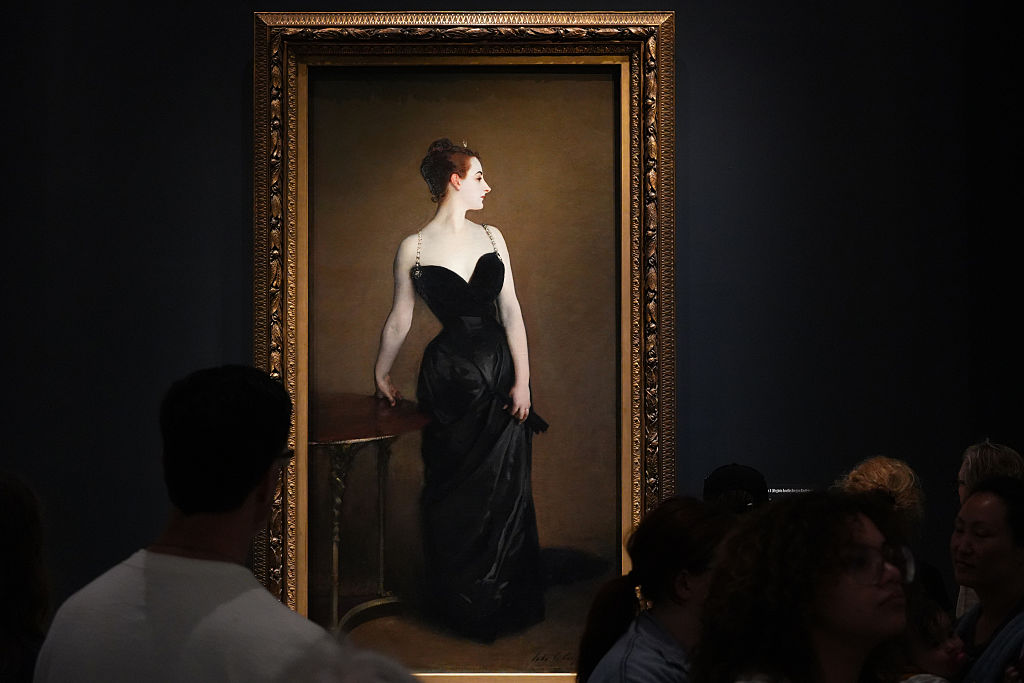
“Sargent and Paris,” an exhibition at the Metropolitan Museum that soon travels to the Musée d’Orsay, accompanied by a book of essays, tells the fascinating story of his swift rise to the top of the French art world to his blazing exit ten years later, when he moved to London in the heat of a scandal ignited by the display of Madame X at the 1884 Paris Salon – a highly criticized portrait of the preening socialite Virginie Gautreau, dressed in a revealing black gown with a single jeweled strap falling off her shoulder. Displaying around 100 works from the first decade of his career, including dozens of early landscapes and travel scenes, the exhibition proves that the “curious intentions and strange refinement” one perplexed art critic saw in Madame X should really have come as no surprise at all.
Take his oil sketch (c. 1879) of an orchestra rehearsing at the Cirque d’Hiver indoor amphitheater. The conductor, Jules-Étienne Pasdeloup, was known for his adventurous programs that championed modern composers such as Gabriel Fauré. Sargent’s experimental painting is equally adventurous, with bold cropping and a peculiar vantage point from the upper seats. With abbreviated brushstrokes, he shows the players, instruments and sheet music disintegrating into abstract shapes as they are swept into the curves of the amphitheater. Three whimsically dressed circus clowns appear in the foreground, one turning his head in profile, revealing a face covered in white makeup with a smear of red paint across his mouth.
“Strange refinements” abound in his travel paintings, too. We see a study of the head and neck of Rosina Ferrara, his favorite model in Capri, shown in profile with a resolute stare, like the face on a medallion or cameo, or an illustration in an ethnographic study. She reappears in Among the Olive Trees – Capri (1879), standing in a complex pose in a field with her back to the viewer and head turned to the right, her arms intertwined around the branches of an olive tree. In The Spanish Dance (c. 1879–82), an evocative nighttime scene, two female dancers perform deep backbends with their arms raised and faces obscured, while a third leans forward, twisting to reach one arm to the ground.
His early portraits are similarly daring. In his 1879 painting of the red-haired Marie Buloz Pailleron, he places her in a windswept park, combining the genres of landscape and portraiture while using loose, Impressionist-style brushwork and light colors. The dramatic red-on-red composition of Dr. Pozzi at Home (1881) is just as radical, capturing the eminent surgeon and art collector Samuel Jean de Pozzi not in a professional setting, but rather an informal, domestic one. The doctor sports a bright red robe and stands amongst red velvet curtains and a red carpet, redolent of paintings of Catholic cardinals (or indeed Jonathan Yeo’s 2024 portrait of King Charles).
Dr. Pozzi, interestingly enough, was rumored to have been the lover of the aforementioned Virginie Gautreau, née Avegno. Born to French Créole parents in New Orleans, her mother came from a family of rich plantation owners, while her father, a Confederate general, died from wounds sustained during the Civil War. In 1867, aged eight, she was whisked away to Paris by her mother, who hatched a plan for her to enter high society. It worked, sort of: in 1878, a 19-year-old Virginie married the much older businessman Pierre Gautreau, whose fortune came from importing guano fertilizer from Peru. But she struggled to shake off her origins and be accepted as a true Parisienne.
The city’s papers chronicled her active social life and highly cultivated appearance, labeling her a “professional beauty,” but also an “American.” According to art critic Theodore Child, she “carried to unparalleled perfection the art of maquillage, enamelling, and of eccentricity in costume and coiffure.” Her efforts at self-fashioning earned both admiration and ridicule; the Russian emigré painter Marie Bashkirtseff confessed in her diaries that she looked “horrible in daylight because she uses too much makeup . . . but at night she is truly very beautiful.”
Sargent, for one, was enamored. He produced more studies of Gautreau than he did for any other portrait. We see pencil sketches capturing her unusual profile, which featured a long, upward-swooping nose and artificially lined eyebrows. In letters, Sargent expressed his delight and frustration in trying to record her “unpaintable beauty,” including the peculiar “lavender or chlorate-of-potash-lozenge” color of her made-up skin.
Both artist and subject were thrilled with the final picture, with Gautreau declaring it a “masterpiece.” Neither expected a “great ruckus,” as one observer remembered. Though exhibited under the title Madame ***, to preserve her anonymity, Gautreau’s profile and red hair were easily identifiable by Salon-goers, and she was immediately ridiculed for her vanity. Not only was she accused of looking both artificial and decomposed, but also indecent, as if her dress were about to fall off. (Post-Salon, Sargent repainted her jeweled strap in its proper place.) Her contorted pose, meanwhile, seemed to suggestively echo that of the sirens carved into the legs of the wooden table beside her.
The controversy briefly scared off Sargent’s patrons and perhaps hastened his decision to move to London. But they soon came running back. Sargent, for his part, always stood by Madame X, his American Parisienne, now a crown jewel of the Met’s collection. When the artist sold it to the museum in 1916, he declared in a letter to the director, “I suppose it’s the best thing I’ve done.”
And what of Gautreau?
After her initial distress – she and her mother came to Sargent’s studio “bathed in tears” – she seems to have taken the incident in her stride. A couple of weeks after the opening of the Salon, she was spotted at the theater in a dress with “a bodice held on the shoulders by diamond bracelets.”
Ann Coulter, an American author, lawyer and conservative media pundit, joined Freddy Gray on the Americano podcast last Friday to discuss why she backs the UK’s Reform party, why she supports Trump in his second term, what’s really going on with the Epstein files and more.
Here are some highlights from their conversation.
Why don’t politicians follow through on illegal immigration promises?
Ann Coulter:Americans have been voting not to give illegals benefits, to deport them, to make sure they can’t vote, for now almost half a century, and the politicians will never give it to us. That was what was so striking about Boris Johnson and Donald Trump. Oh my gosh, they really seemed to mean it. At least with Trump, every single rally for 18 months, the chant was, “build the wall,” the signs “build the wall,” their etchings “build the wall” and he gets it (the presidency). And he doesn’t build the wall.
Freddy Gray: What do you think is the real factor there? Is it the economy? Is it that businesses just have that way of pressuring? I mean, I think with what’s now called the Boris wave of the huge influx of immigration during Boris Johnson’s premiership, really, it was pressure from the Treasury to make sure that wages are suppressed because everyone was worried about Covid and so on. Is that the real driving factor?
AC: Well, there are at least two driving factors. For the Republicans, it’s the donors. They want the cheap labor, which it’s worth pointing out as the as the cliché goes, cheap labor is only cheap for the employer. It’s the middle class that are subsidizing the rich’s poor labor or cheap labor. They are nannies. They are cooks. They are, you know, farm workers because they accept massive amounts of welfare, which leads to the other special interest group supporting illegal immigration, and that’s the entire Democratic Party, because illegals are accepting so much social welfare. Which party do they vote for and their kids can vote in? I mean, now the number of anchor babies who are of voting age is probably 20 million.
On the future of the UK
FG: You’ve been spending some time with Reform. What do you like about them in particular?
FG: You think they will make good on their promises? Because quite often we see these parties, when they get into power, they can’t actually make good on.
AC: Yeah. To take two little examples, Boris Johnson and first-term Donald Trump. That was stunning. It’s been happening in the US for 20 years. It’s been a bigger issue for us, I think. And states, I mean, this was back in the early 70s. Texas voted to have no free public education for illegals, and the Supreme Court, very left wing, overturned it. And that’s when Justice Brennan, incidentally, made up the concept of anchor babies. The court never ruled on it. No legislature has passed it.
FG: Please explain what an anchor baby is.
AC: An illegal pregnant Mexican runs across the border and drops a baby. The baby is allegedly an American citizen. No court has ever found that. No legislature. It was just dropped in a footnote of this Justice Brennan opinion. Maybe that’s a side note, but it’s a big, big problem in some hospitals along the border. 80 percent of the babies born are born to illegal aliens. El Chapo. You’ve heard of him? The big, massive drug lord? When his wife got pregnant, she’d run across to San Diego and drop a baby. They’re all American citizens. I’ll just give you one more. I think it was Sinaloa cartel. The cartels are just monstrous. I don’t want to hear about, you know, Hamas throwing rocks and dropping a few bombs. The cartels are beheading people. They are beheading Americans. They are committing heinous, hideous crimes.
Ann’s disappointment with the first Trump administration
FG: I think it is fair to say you were disappointed, even fuming, about about the first Trump administration, which was funny because at one point you were pretty much the only American who supported him.
AC: Yes! Oh, before he got in, I was worried… I was still yelling at him for some things. I guess, it was like March. He wasn’t hiring the right people during the transition. That was a bad sign. It was February or March. I showed up in the Oval Office, and like I say, I never told anyone this, but he told people. I just stood at the resolute desk, haranguing him, hectoring him. I was not the first one to use the F- word, but once it got used… Well it was about, you’re not keeping your promises; you’re you’re not building the wall; you’ve done nothing on the wall; you’re only pushing for tax cuts. The moment when he got really angry, which I think really speaks in his favor, was when I said, “You’re governing like Jeb Bush.”
FG: The Big, Beautiful Bill upsets fiscal conservatives, but it does give a lot of money to the border. I think it’s probably a mixed bag for people of a conservative disposition. What would you say?
AC: Yes. I mean, overall, but I can’t blame Trump alone for this. It’s hard to cut anything. You know, a good motto is, “There are a lot of bad Republicans. There are no good Democrats.” So I kind of hate my party. I’m totally with Elon. If they could cut government by 90 percent, the world would be a better place. They’re mostly useless bureaucrats spending their days trying to make our lives worse. First – and I should say I’m not against tax cuts; I think they’re good and important – it’s just that that’s all we’ve ever gotten from the Republican Party. And what was special and different about Trump was he seemed to care about middle America and working class America. He was going to bring back manufacturing. No more stupid wars. The whole America first and mostly immigration, immigration, immigration. So when he blows off those three unusual and important parts of his campaign and does what a Bush would have done. Yes. It was a little disappointing.
FG: We’re almost 200 days into Trump’s second term. How many marks out of ten would you give Trump in his second terms?
AC: I guess nine. He gets one taken away for not releasing the Epstein stuff.
Epstein, Israel, Saudi Arabia?
FG: Why won’t he release it? Is it because there is evidence of him?
AC: I think he has donors who are involved. Yeah. And also a favored country in the US. I’ve been following it since 2006. I spent part of my time in Palm Beach, where the whole story broke and the Palm Beach Police were great. National media did not cover it… We were thinking maybe it was like a concierge operation where he runs the sex shop for for rich guys like the private clubs, but that doesn’t make any sense. He would have done it free. I mean, I’m trying to answer the question of where he got his money. He was getting a lot of money. Coincidentally, all the ones he was getting money from are gigantic Israel supporters. All of them. Some foreign country has to be behind it. So you basically get down to, “Is it Saudi Arabia, or is it Israel?”
AC: Totally pro-tariffs. I’m with Trump on it. It needs to be fair, and we have been giving it away. That’s one thing, just for years and years and years, and I’m sick of the free-traders. We’ve been trying your way for 50 years. Manufacturing has been wiped out. We used to have, like, 20 million people working in manufacturing. I think when I wrote Adios America, or maybe it was in Trump We Trust, I don’t know, we were down to like 11 million. The working class and the middle class has been suffering enormously. And I noticed Wall Street is doing quite well. So how about let’s try not having this – what is called free trade. And I think Trump is right. It’s unfair trade.
America’s two most powerful men are visiting Britain this summer. After Donald Trump’s trip to Scotland last month, his Vice President is expected shortly in the Cotswolds. Both men share an interest in the UK – but for different reasons. Trump’s ties are ancestral; Vance’s passion is more intellectual. “What’s going on with Reform?” he asked Peter Mandelson at a recent function. His choice of England as a vacation destination reflects an engagement in this country’s politics.
Among Vance’s friends and contacts are several prominent British academics. They include Blue Labour founder Maurice Glasman, who corresponded with Vance over email, and James Orr, with whom Vance bonded in 2019 after converting to Catholicism. Shortly after his election to the Senate in January 2023, he came to London and was keen to meet with prominent conservatives. As Vice President, he has shown an eagerness to use his office to engage in UK domestic issues.
The best example of this was his Munich Security Conference speech in February. Here he attacked successive British governments for ignoring voter concerns on migration and free speech. He demonstrated too a level of familiarity with specific UK case studies – including a man in Bournemouth convicted for praying outside an abortion clinic. Vance has subsequently weighed in on different European issues, calling the continent the “cradle of Western civilization.”
Vance is willing and able to use his status to shape the dynamics of the UK-US relationship and, potentially, the future of British conservatism
All this is to say that Vance is willing and able to use his status to shape the dynamics of the UK-US relationship and, potentially, the future of British conservatism. Right-to-life groups in this country were ecstatic when Vance raised the little-known-case of the Bournemouth abortion clinic. The vice presidency might have once been dismissed as “not worth a bucket of warm piss” – but J.D. Vance has shown that it affords a bully pulpit with considerable clout in the social media age.
Prominent figures in both Reform and the Conservative party are clearly aware of this dynamic. Allies of the Vice President have already met with senior members of Nigel Farage’s party. The Clacton MP, who made little comment about Trump’s Scotland visit, was this week willing to publicly indulge talk of a meeting with Vance when interviewed on LBC. Other engagements are expected with other leading conservative personalities of interest.
Such engagements are timely, given Vance’s status as the Intellectual-in-Chief of this White House. For now, he remains the second most powerful in the United States – but all that could change very shortly. The race for 2028 is set to begin in earnest in about 18 months’ time and Vance is in prime position to succeed Trump as the Republican nominee. Much as how Thatcher and Reagan first met in 1975, an engagement with Vance this summer could prove most fruitful in four years’ time.
This week, US Vice President J.D. Vance leveled a blistering critique at Europe, accusing it of “committing civilizational suicide,” and Germany in particular of bringing about its own demise, saying:
“If you have a country like Germany, where you have another few million immigrants come in from countries that are totally culturally incompatible with Germany, then it doesn’t matter what I think about Europe… Germany will have killed itself, and I hope they don’t do that, because I love Germany and I want Germany to thrive.”
While some dismissed his remarks as yet another post-Munich Security Conference jab, Vance insisted his concerns for Germany were sincere. And he seems to have a point.
While the US watches these developments from afar, the German mainstream media continues to push the narrative that the country needs 400,000 “skilled workers” annually. This is despite the fact that nearly four million able-bodied people of working age already receive benefits, almost half of whom are non-German citizens. When you include those with German passports who were born overseas, the number rises to around 64 percent. So, where did it all go wrong for Germany on migration and refugee policy?
It began with the Gastarbeiter (“guest workers”) invited during the post-war economic boom under Chancellor Konrad Adenauer and his minister for economic affairs (and future Chancellor) Ludwig Erhard. Starting in 1955, Germany recruited labour from Greece, Italy, Spain, and Turkey. What began with 300,000 workers in the 1960s ballooned to 2.6 million by 1973. The introduction of family reunification turned these guests into permanent residents. Although there were efforts to curb immigration and encourage return migration as late as the 1990s, they met with little success. Germany is simply a nicer place to live than Turkey, even if Germans of Turkish origin set off fireworks to celebrate Erdogan’s election victories.
The floodgates were fully thrown open in 2015 by then-Chancellor Angela Merkel, when she allowed Syrian migrants to enter Europe. Millions of asylum seekers and economic migrants made their way across Europe with little to no vetting. Even though the Syrian civil war has come to an end, almost none want to return home, and a combination of family reunion and lax borders means that asylum seekers keep coming in large numbers.
In contrast to the Netherlands and Denmark, Germany has not produced a comprehensive recent cost-benefit analysis of migration. No official lifetime cost estimates exist. Yet the consequences are increasingly visible: rising violent crime, public schools where students of migrant backgrounds make up 42 percent of the pupils (with some schools reaching 90 percent), cultural fragmentation, and an overburdened welfare and healthcare system. Even Germany’s once-abundant tax revenues are no longer enough. A €172 billion (approximately $119 billion) budget shortfall looms, worsened by promises such as a special pension for mothers. Meanwhile, the government is floating the idea of a “Boomer-Soli,” a new tax on “big pensions” above €1,000 ($1,158) per month.
The warning lights are flashing, but the government continues to kick the can down the road. Painful, necessary reforms to the welfare state, pensions, and immigration policy are endlessly postponed or even ignored.
Instead, policymakers debate introducing migrant quotas in public schools, some of which already serve only halal food and have reportedly abandoned Christmas celebrations in favor of mandatory Ramadan events.
Meanwhile, thousands of individuals in Germany have faced lawsuits for sharing memes, voicing criticism, or insulting politicians. Most of these cases were brought by politicians from the left: the Green party, the Free democrats (FDP) and the Social Democratic party (SPD). In one case, a pensioner was subjected to a police search and later sentenced simply for sharing a meme. A journalist from a right-wing populist publication received a suspended prison sentence and a fine for posting an image of former Interior Minister Nancy Faeser edited so that she was holding a sign that read: “I hate freedom of speech.”
Economically, things look equally bleak. After a disastrous trade deal between the EU and the Trump administration, Germany’s once-mighty automotive industry faces another blow amid already collapsing revenues. Even the unions seem more focused on climate activism and class struggle than job security. Well-paid industrial jobs, they hope, will be preserved by the “green economy.” Some hope.
After five years without significant economic growth, any rational politician should be deeply alarmed. Instead, Chancellor Friedrich Merz touts vague promises that 61 companies are ready to invest €631 billion ($730 billion) in Germany. He seems to hold the misguided view that subsidies alone can salvage what remains of Germany’s crumbling economic model.
It is a sobering reality when the Vice President of a foreign country appears more concerned with Germany’s future and problems than its own political class.
“It was a heavy week,” sighs Thomas Straker, explaining why he recently ended up on a drip in New York. He’s been nicknamed Britain’s “bad boy chef,” and his fans love him. He owns two restaurants in Notting Hill and has 2.6 million Instagram followers: not far off Nigella. Another restaurant is coming in Manhattan, so he has been spending a lot of time there. “Post-service, out late, every night” he says.
Straker Industries has many divisions: he runs a YouTube channel, has a butter range and is about to launch his own olive oil. On the day we meet, I spot him sauntering down Golborne Road towards his restaurant Acre for our interview. He’s wearing a “Game Eater” cap and a T-shirt with his own name on it, tucked into his Adidas tracksuit pants. He’s a mere 40 minutes late. “I dragged myself to Pilates this morning,” he tells me. He likes to get his top off in his videos.
He has an air of Withnail – lazy hair, hazy eyes, serrated cheekbones – and he stalks similar parts of London. Straker is that evergreen currency: Notting Hill swank, updated for 2025, and it still has much going for it. He stops to say “hey” to a babe a couple of times during the interview.
Straker has a completely normal background for a Notting Hill celebrity but an abnormal one for a popular chef these days. He grew up shooting and foraging in Herefordshire, and his father was the second-in-command of the SAS and deputy director of NATO Special Forces in Afghanistan.
A misspent youth did not land him at Sandhurst, but at cookery school. He worked afterwards at the Dorchester and Heston Blumenthal’s Dinner, and then became the private chef to Sir Leonard Blavatnik, the third richest man in the UK. “When Covid came around,” he says, “I saw more food videos come up and thought I should try to do that. I was working in the States for a family of five. It didn’t take me all day to make breakfast, lunch and dinner, so I made good use of my afternoons.” Two years later, he had become so popular on social media that he was able to open his first restaurant, Straker’s.
Straker’s kitchen burnt down earlier this year. On the first weekend of May he woke up to 200 missed calls. It’s “not been particularly fun the past few months,” he says. “You suddenly go from a very comfortable, high-turnover business to a zero-turnover business… It’s been incredibly stressful financially.” The restaurant reopened at the end of June. It is difficult to book a table, given how busy it is.
We eat in Acre, his new brunch and lunch restaurant. He orders an iced matcha with agave honey for himself, and some pan con tomate ($8) for both of us –”I literally had this twice yesterday,” he says. Acre is meant to be more casual, more affordable, more in keeping with the post-Covid desire for expediency and comfort than Straker’s. “You want to make it affordable as possible for your customers, but we’re ultimately running a business,” he says. “But this is definitely an accessible way to come and have some good food. It’s not dirt cheap because we’re not using shit products, but we’ll be doing cod here instead of sea bass over there.”
A teenage girl having brunch with her father comes over to our table. She’s doing her GCSE art project, and they’ve been asked to paint a building. She painted Straker’s because she loves his videos so much, and she shows it to him. He smiles: “Top grades for you! Let’s buy it off you!”
He then tells me about the olive oil he’s got coming out: “So I was in Soho at 3 a.m. the day before I ran the London marathon… I got carried away.” That evening, he met a man from Puglia who insisted he made the best olive oil around, and that he would send Straker a bottle. “I was amazed it arrived,” Straker said. It was good, and now you’ll be able to buy Thomas Straker’s “Donna Franca” olive oil this autumn.
Po-faced restaurant industry types are suspicious of him. A couple of chefs have bad-mouthed him to me over the past few months. The popular Instagram page “SluttyCheff” went viral with a satirical account of working as a woman in Straker’s kitchen: “Thank you guys… for welcoming me with such massive muscle-y open arms.” In 2023, he posted a picture of himself with the chefs at his restaurant: all eight were white men, and he got in trouble for it in the papers. I ask him if he thinks he’s been unfairly treated. There’s a long pause. “I’m thinking about what I want to say and what I should say.”
At the time, he expressed some regret over it and says now that he was “scapegoated for an industry-wide thing. But that’s in the past… I’m having a good run. That is only down to how hard I work with my team, how hard they work. Everyone has an equal opportunity in the business.”
He’s often accused of just riding the coattails of online hype. “If people want to be like ‘Oh he’s not a chef, he’s an Instagram chef,’ they can fucking say what they want,” he says. “Open your fucking restaurant, whatever. I’m doing my own thing. It did piss me off for a bit, but now I’m just level. I know what I’m doing… I don’t feel unfairly treated. It always comes around in the end.”
You get a sense that the world might be bending towards Thomas Straker. Jonathan Nunn, who edits the left-wing food magazine Vittles, recently posted about how he respects Straker for not trying to hide how posh he is. “Thomas Straker is just repeatedly posting pics hanging out with David Cameron or cradling Boris Johnson’s baby.” When Straker isn’t in London, he spends time at Carole Bamford’s Daylesford estate, producing online content from the Cotswolds.
America now beckons. He is taking over a site formerly overseen by Keith McNally (another enfant terrible of the restaurant world) and they’re “just about to go into building work.” I wonder what America will make of him. They tend to love posh Brits, less so gobby ones. Oasis didn’t travel well across the Atlantic; Hugh Grant did. It will be interesting to see how Straker lands. In spirit, he is both Grant and the Gallaghers.
When I ask what he gets up to in New York, he shows me a tattoo of a naked lady on his shoulder, done for him by a guy called “Bang Bang.” He grins like a teenager. Being Thomas Straker looks like fun.
When Donald Trump won a second term in the White House last November the response in Europe was one of barely disguised horror. “The European Union must stand close together and act in a united manner,” declared Germany’s Chancellor Olaf Scholz.
Emmanuel Macron posted a message on X: “The question we, as Europeans, must ask ourselves is, are we ready to defend the interests of Europeans?” The president of France got his answer on Sunday evening. No. The trade deal agreed between Ursula von der Leyen, the EU Commission president, and Donald Trump has not gone down well in much of Europe.
Scholz’s successor, Friedrich Merz forecast that Germany’s economy would suffer “significant” damage because of the deal. EU exports will have a tariff of 15 percent, which is superior to the customs duties before Trump’s re-election, but much lower than his threatened 30 percent tariff. Additionally, von der Leyen has promised the bloc will purchase energy worth $750 billion from the United States and make $600 billion in additional investments. According to Hungary’s Viktor Orban: “This is not an agreement… Donald Trump ate von der Leyen for breakfast.”
The most strident criticism of the deal came from France, where in a rare display of unity the terms of the agreement were savaged across the political spectrum.
Prime Minister Francois Bayrou said that “it is a dark day when an alliance of free peoples, united to assert their values and defend their interests, resigns itself to submission.”
Trade minister Laurent Saint-Martin described the deal as unbalanced and said the government should not accept “what happened yesterday because that would be accepting that Europe is not an economic power.”
It was telling that Saint-Martin said “Europe” and not “France.” For centrists like Saint-Martin – he was one of the first to join Macron’s fledging En Marcheparty in 2016 – France and the EU are indistinguishable.
Macron’s predecessor (and mentor), Francois Hollande once accused him of “believing in nothing and having no conviction.” That is not true. Macron has one unshakeable conviction, and that is the EU.
It is why he won’t let Brexit go, taking every opportunity to savage Britain’s decision to leave the bloc. Twice during his recent state visit he went on the attack. Britons were “sold a lie” over Brexit he said at one point, adding on another occasion that the country “was stronger when part of the EU.”
As yet there has been no response the Elysee to von der Leyen’s trade deal. Perhaps Macron is still working out how best to spin the fact that Britain’s tariff rate with the USA is 10 percent.
Marine Le Pen lost little time in pointing this out, posting on X that the EU “has obtained worse conditions than the United Kingdom.” The leader of the National Rally described the deal as “a political, economic and moral fiasco” and said that that “this form of globalization, which denies and destroys sovereignty, has been outdated for many years.”
The majority of the French agree with her. In an interview with the BBC in 2018, Macron admitted that if given the choice his people would probably follow Britain out of the EU. This is one reason why he has been so determined to make life difficult for post-Brexit Britain: pour encourager les autres.
Macron’s strategy has been partially successful. A poll last year revealed that 62 percent of the French are opposed to Frexit. The bad news for the president is that 69 percent of them have a bad opinion of the EU.
The poll was conducted a month before the European elections, which resulted in a resounding victory for Le Pen’s Eurosceptic party and a humiliating defeat for Macron’s Europhile movement.
When Le Pen reached the second round of the 2017 presidential election it was with a promise to quit the EU. Two years later she abandoned that position and vowed to reform the bloc from within. Her party won’t return to Frexit, but it will increase its Euroskepticism between now and the 2027 election. The same goes for the hard-left’s Jean-Luc Melenchon, who loathes Brussels as much as Le Pen. Bruno Retailleau, the leader of the center-right Republicans, is also a long-standing critic of the EU’s ambition and voted against the EU Constitution in France’s 2005 referendum. That result, he said in a 2020 interview, along with Brexit, “have shown one and the same thing: Europeans do not want a federal Europe.”
Across France, enmity towards the EU has strengthened in the last year. The Mercosur trade deal agreed with South America in December is widely unpopular and France’s failure to control its borders is blamed on Brussels.
The French are demoralized and angrier than ever with their ruling elite. A citizens’ collective called “Bloquons tout!” (Block everything) is using social media to mobilize people for a day of protest on September 10. “Boycott, disobedience, and solidarity” is their rallying cry and they are urging people to take to the streets across France.
Will it achieve anything? Probably not. After all, what’s the point of protesting in Paris when all the big decisions about France’s future are made in Brussels.
“I’m having financial problems,” a long-ago ex-girlfriend desperately messaged me some years after our third breakup, before tossing a convoluted word salad trying to make a case that I should give her money. I refused and told her that although I felt very sorry for her, it would be better for both of us if we had no further contact. Fortunately, we haven’t. As President Trump cuts America’s ties with the United Nations Educational, Scientific and Cultural Organization for the third time, this would seem to be the best approach.
UNESCO was founded in 1945 to advance the cause of international peace through intellectual and cultural programs under the auspices of the newly created United Nations. Anyone familiar with the history of the world over the last eighty years can tell you how well that has gone, but the United States was long foundational to UNESCO’s work, at times contributing as much as 25 percent of its annual budget. This was certainly generous for an organization that claims 194 member states and twelve associate members, especially considering what UNESCO has done with the funds.
Announcing the U.S. withdrawal last week, State Department spokeswoman Tammy Bruce said “continued involvement in UNESCO is not in the national interest” of the US because “UNESCO works to advance divisive social and cultural causes and maintains an outsized focus on the UN’s Sustainable Development Goals, a globalist, ideological agenda for international development at odds with our America First foreign policy.”
In addition to the relationship yet again no longer working out for us, Bruce added that “UNESCO’s decision to admit the ‘State of Palestine’ as a Member State is highly problematic, contrary to US policy, and contributed to the proliferation of anti-Israel rhetoric within the organization.” Indeed, at UNESCO’s most recent executive board meeting in April, three of its agenda’s eleven “program issues” dwelled on Israel, which the organization has described as “occupied Palestine” or “the occupied Arab territories,” while referring to Jewish holy sites as “Palestinian World Heritage sites.”
A UNESCO initiative discouragingly titled “Transforming MENtalities” seeks to “change mindsets and policies by…shedding light on how to successfully engage men and boys for gender equality” and blames “patriarchal masculinities” for playing “an important role in driving conflict and insecurity worldwide.” American parents might be forgiven for not wanting UN bureaucrats to tell them how to raise their sons in any circumstances, particularly at their expense, but one of this initiative’s “cornerstone” projects, released last November, is a report called “The Gender Equality Quest in Video Games,” which laments that women are underrepresented among video-game characters and video-game-industry professionals.
Along with that pressing issue, UNESCO’s “Anti-Racism Toolkit” recommends governments acknowledge “structural racism” in their societies and implement “systemic changes” to address it. The recommended ways of doing so would appear to be unlawful across American institutions today. In a direct swipe at the US, which remains UNESCO’s highest contributor of funds, the Anti-Racism Toolkit claims that measures taken in response to Black Lives Matter and George Floyd are “limited” and require UNESCO’s sage help to expand. No thanks.
Bruce’s statement concluded that “continued US participation in international organizations will focus on advancing American interests with clarity and conviction.” This has long been true. Ronald Reagan took the US out of UNESCO in 1984, citing corruption, mismanagement, outsized Soviet influence, and general anti-American bias, including a developing world plan to license journalists that seemed likely to censor international news coverage by American media. George W. Bush reentered the organization two decades later as a gesture toward restoring multilateralism in foreign relations but also as a cultural adjunct in the war on terrorism, and – yes – amid emotional assurances that UNESCO had changed. Trump pulled out again in 2018 over the Israel issue, only for a sorrowful Joe Biden to woo positive world opinion in 2023 by pledging to rejoin and pay over $600 million in supposedly outstanding dues accrued after Trump’s withdrawal. Some men send flowers.
Our current breakup with UNESCO will not take effect until December 31, 2026, giving its meddlesome minders ample time to try to crawl back with more empty promises and false assurances that they have changed and will finally treat us right. But for the Trump administration, and all future US leaders, it would probably be best if we had no further contact.