Category: Europe

  • The ghost of Epstein will haunt Trump’s UK visit

    The ghost of Epstein will haunt Trump’s UK visit

    When King Charles hosts Donald Trump for the state banquet at Windsor Castle next week, the dignitaries should know better than to mention Jeffrey Epstein. Inevitably, however, Epstein’s ghost will hang over proceedings, the pedo-Banquo at the feast.

    The royal family will entertain the President, though the Duke of York will (surely?) stay away. He no longer works for the crown and everyone knows why. Trump, meanwhile, will still be batting away suggestions that in 2003 he contributed a puerile drawing to Epstein’s 50th “birthday book” – a strange compilation of messages for the sex criminal, lovingly assembled by Ghislaine Maxwell.

    Then there’s Lord Mandelson, His Majesty’s Ambassador to the United States, who is supposed to accompany Trump for some of the trip. The Prince of Darkness apparently features prominently in the soppy-yet-pervy birthday book, which Democrats on the House Oversight Committee have cunningly released online. “Wherever he is in the world, he remains my best pal!” Mandelson allegedly scribbled, alongside an image of himself in a bathrobe sitting opposite the fully dressed rapist.

    “Petie,” as Epstein called him, has long said he regrets ever having met the financier. “It’s an albatross around my neck,” he said this week, referring to the fact that he apparently continued the friendship after Epstein was imprisoned for a child-sex offense in 2008. But expressions of regret won’t stop the attacks coming.

    On Tuesday night, in the wake of the birthday book bombshell, the Telegraph reported that, in 2010, Epstein helped Mandelson broker a £1 billion ($1.35 billion) deal for the sale of a UK-taxpayer owned business, Sempra Commodities, to JP Morgan. “Something is really wrong here,” says Sarah Ransome, one of Epstein’s British accusers. “Peter Mandelson should not be ambassador. He needs to be fired.” Sensing opportunity, the Tory leader Kemi Badendoch used Prime Minister’s Questions to attack Keir Starmer for Mandelson’s Epstein association. “That is a disgrace,” she said.

    How long can Britain’s ambassador last? In the coming days, the details of Mandelson’s bond with Epstein may end up overshadowing all talk of the special relationship between Britain and America, as the wars rage on in the Middle East and Ukraine.

    Trump has turned on a British ambassador before. In 2019, Sir Kim Darroch was pushed out of his Washington post after diplomatic cables – in which he called Trump “inept” and “insecure” – were leaked. What might save Mandelson is that he has done nothing but praise the US commander-in-chief. Sure enough, whereas Trump loathed Darroch, he seems to have warmed to Mandy. Now both men would rather the world move on from Epstein.

    It’s all so awkward. There’s another photograph of Epstein with Joel Pashcow, a longtime member of Trump’s Mar-a-Lago club, and an anonymous young woman holding up a large fake cheque from “DJ Trump” for $22,500. Clearly, in the time before 21st-century populism and the #MeToo movement, the global elite used to enjoy their risqué japes. But what does it all mean now?

    Trump is adamant that Epstein, Epstein, Epstein is the new Russia, Russia, Russia: a hoax designed to distract the world from his revolutionary achievements. Karoline Leavitt, the White House press secretary, claims: “It’s very clear President Trump did not draw this picture, and he did not sign [the birthday book].” But it isn’t clear at all, unless Team Trump can prove that some of those other epistles have been faked.

    It’s also baffling to ponder why, when Joe Biden was in the White House, the now-viral Epstein files did not find their way into the public eye. The Democrat-led Department of Justice and the FBI, along with their allies in the media, spent years hounding Trump as a Russian patsy, a fraudster, an insurrectionist and an abuser of women. Yet somehow, it seems, the anti-Trump deep state sat on eye-popping evidence appearing to tie Trump to Epstein. Was it simply because Bill Clinton, that philanderer par excellence, also appeared in the birthday bundle? A note purporting to be from the ex-president praises Epstein’s “childlike curiosity.”

    The Epstein story now appears to involve the Democratic elite, the British establishment and Trump. It thus becomes an ever more mysterious meta-conspiracy – a kaleidoscopic scandal that takes on a different complexion depending on who looks into it. Republican figures, including Vice-President J.D. Vance, enjoyed fanning anti-elitist paranoia when the Epstein muck was on the opposition. They are strangely mute now.

    For Vance and MAGA-supporting Atlanticists such as Nigel Farage, the hope for next week’s visit is that Trump, accompanied by various tech tycoons, will launch a broadside against Keir Starmer’s government for suppressing free speech online. Now, however, the whole world is gossiping about who did what with Epstein. Behind closed doors, Trump, the royal family and the Labour leadership will perhaps agree that sometimes it’s better for the people just to shut up.

  • Why the French fear the far left

    Why the French fear the far left

    A caller to a French radio station on Monday morning said he supported Marine Le Pen’s National Rally. However, he added, he wouldn’t vote for them in an election. Why? asked the host. The man said he feared that if the National Rally came to power the far-left would turn France “into a real mess”.

    I have heard similar anxiety other middle-class French people who are tempted to vote for Le Pen’s party. They may not agree with her economic policies but they do share her concerns about mass immigration and insecurity.

    But what frightens them most is the far-left, which as a history of violence going back to 1789. In 2023 the constitutional historian Christophe Boutin explained that violent disorder “is in the DNA of a certain French left”. He blamed “the myth of the Revolution… and a Marxist doctrine according to which capitalism can only end in violent revolution.”

    This history accounts for the difference between the British and French far-left. The people being arrested at Palestine Action protests in London are predominantly middle-class, as are the members of Extinction Rebellion and Just Stop Oil, and the counter-protestors at demonstrations against migrant hotels.

    Some of today’s far-left in France are middle-class, getting their kicks from confrontations with the police. One such was Antonin Bernanos, who was jailed for his part in torching a police car during a protest in Paris in 2016. The 23-year-old Bernanos was the great grandson of the celebrated Catholic writer Georges Bernanos.

    But there are also many working-class extremists on the far-left in France. Three years ago a man who had stood as a National Rally candidate in the legislative election was attacked by a mob of far-left extremists in Bordeaux. Six of his assailants belonged to a notorious gang of hooligans who follow the city’s football club. Olympic Marseille also has a few thuggish far-left supporters, although as with Bordeaux they prefer the name “antiracist” to “hooligan”.

    The far-left in France is arguably the most organized of any western country. Two years ago a journalist called Anthony Cortes published a book about his time living undercover with a far-left organization. He dispelled the myth of spaced-out hippies and crusties. Today’s far left is a disciplined and determined mix of anti-fascists, Trotskyists, anti-capitalists, anarchists and eco-warriors.

    It is believed that the far-left sabotaged France’s rail network on the eve of last summer’s Paris Olympics. It was an audacious and well-planned guerrilla operation, for which no one has yet been brought to book.

    “Sabotage” was one of the words on the lips of Laurent Nuñez on Tuesday morning. In an interview the Paris police chief said his force were braced for “blockades” and “sabotage” on a day of protest on Wednesday billed as Bloquons tout (block everything).

    The protest movement was initially the inspiration of a small collective of white-collar Millennials whose rallying cry was “It’s Nicolas who pays”. Fed up with working hard only to be taxed to the hilt, these Millennials called for a day of protest on September 10.

    But it has since been hijacked by hard-left unions and Jean-Luc Melenchon’s far-left La France Insoumise. “We will block everything to get Mr Macron himself to leave,” Mélenchon said last week, adding that he wants a peaceful protest. “The anger is legitimate and deep-seated…the powerful need to see it and hear it.”

    Intelligence points to upwards of 100,000 protestors taking to the streets today, among whom will be violent elements from Antifa and Black Bloc. Around 80,000 gendarmes and police officers have been mobilized across the country, some to patrol the streets and others to guard what Nuñez described as “key areas of interest”. These include fuel depots, nuclear power plants, railway stations, airports and public transport. “We are expecting shock operations,” said Nuñez.

    One centre-right senator, Claude Malhuret, has warned that September 10 threatens to become a day of “absolute nihilism”. He pointed a finger at the far-left and accused them of “practically calling for riots”.

    No far-left politician has called for riots or violence of any description. But they have urged people to take to the streets in what they hope will be a show of force. It will underline that the left still “own” the streets in France. It was the case seven years ago during the Yellow Vest protests. What started as a peaceful howl of despair from the silent majority was soon hijacked by violent far-left agitators. They came to Paris not to protest against the cost of living crisis but to fight the police and pillage brand shops.

    So it is with today’s Block Everything protest. Most ordinary working- and middle-class people who were thinking of coming out to express their dissatisfaction with the political class will stay at home. Why run the risk of getting caught up in a riot?

    Indeed, why the run the risk of voting for Marine Le Pen when it will only provoke the far-left extremists?

  • America is obsessed with the UK’s decline

    America is obsessed with the UK’s decline

    As Sigmund Freud pointed out way back in mid-June 1905, everyone feels a bit schizo about Mom. On the one hand, she carried you in the womb, she probably nursed you at the nipple. She made the greatest of sacrifices for you to exist. Heck, maybe you really love her cooking.

    On the other hand, you have to escape her. The Italians have a brilliantly pejorative word for the man-child who stays in the maternal home far too late in life: mammoni. No one wants to be that guy. And to get away from this menace, sometimes you have to scorn your mother, to break the psychological apron strings.

    So it is with American attitudes to the Mother Country. Whereas the US had many midwives, its mother was unquestionably Britain. It was Britain that seeded the first colonies in Virginia. Britain that gave America her mighty language. It was largely Britons who drafted the US Constitution – indeed the Founding Fathers saw themselves, quite overtly, as more British than the British: more honorably in love with their freedoms.

    As a patriot, I’d like to rebut this barbaric assault on my own country. The trouble is, I can’t

    It is, therefore, perhaps not surprising that Americans have an Oedipally schizoid relationship to Britain, even today. On the one hand you have that entire Downton Abbey strand of American desires. Our accents are adored, poshness is weirdly revered, an idealized concept of echt Britishness – from manners to furniture to clothes (Ralph Lauren built a billion-buck business on this) – is admired and aped, or created ex nihilo. Donald Trump’s White House is probably the most pro-UK administration in several generations. Trump celebrates his Scottish roots; J.D. Vance holidays in the Cotswolds. Winston is back in the Oval Office.

    At the same time, America has often scorned Britain, mocked her, bossed her around and generally treated Mum something terrible. And right now, and from the same Trumpite wing of US politics, the UK is facing a lot of this pitiless scorn. Across conservative social media we Brits are seen as decrepit, weak, cucked, lame, broke, snaggletoothed losers who are utterly doomed to extinction.

    You’ll find this discourse everywhere. From Tucker Carlson lamenting that Britons are “slaves,” to Elon Musk calling us a “tyrannical police state” to internet pundit Charlie Kirk describing us as “a husk” and “a conquered country.” Earlier this month, after comedian Graham Linehan was arrested for his views at Heathrow Airport, the British politician Nigel Farage went to Washington to tell members of Congress that Britain had turned into North Korea. Americans listened avidly.

    Whatever the provenance of these critiques – and plenty come from a place of grief, or regret, not mere contempt – they hit home. They can make Brits wince. And one of the times I’ve winced the most came via a much less well-known voice: a Substack called Starstack, created by – as far as I can see – a firmly right-wing but not crazy Republican, known on X as @youngtroon.

    The particular essay about the impending doom of the YooKay (and he uses this demeaning nickname quite deliberately) is entitled “Mind the Gap,” but the subhead gives us the gist: “A powerful set of systemic factors are threatening to bring chaos unseen in centuries to the shores of the United Kingdom.”

    I advise you to read the entire essay yourself. It is articulate, considered, perceptive and, if you are British, quite harrowing. He has given us the gift to see ourselves as others see us. And, my God, it is a dismal portrait. And it therefore deserves a close analysis, as a shining example of the genre.

    The author attacks us from all sides. Not with pointless venom, but with outright astonishment at our grotesque and self-harming stupidity.

    Here are a few choice descriptions: to him, Britain is “a laughable caricature of what the government would be like if it were run by your neurotic mother-in-law.” Parts of the North resemble “a collapsing civilization.” The National Health Service is “a black-hole money pit with some of the worst dollar-per-dollar outcomes.”

    We also have “some of the nuttiest benefits handouts in the entire world.” He notes that our Chancellor recently broke down weeping in parliament. He says the economy is “effectively stagnant, and there is little or no plan to resolve underlying systemic factors.” He adds that Britain is a country “where tens (hundreds?) of thousands of white girls were systematically sexually exploited by gangs of Mirpuri Pakistanis” – a fact which was then covered up. Meanwhile, we are also a nation that “received well in excess of 1 percent of its population for several years straight during the ‘Boriswave.’” Mr. Troon does not see this as a good thing.

    Then he really gets going. I’ll spare you the gory fiscal details, but it’s when the essay turns to our growing debt crisis – those gilt yields soaring over 5 percent – that the apocalypse promised by the subtitle begins to loom. It is not pretty.

    Naturally, as a patriot, I’d like to rebut this barbaric assault on my own country. The trouble is, I can’t. I have been through the essay, insult by insult, and I’ve found only two arguable errors. Firstly, the UK does not – thank God – suffer weekly or daily terror attacks. Secondly, Britain does not have a “uniquely violent street gang culture.”

    Apart from that, I cannot find major flaws. Which makes it all the more depressing, and makes me wonder whether the author’s prognosis is correct and Britain is, actually, “rapidly heading toward a grand and brutal reckoning” and that “the United Kingdom is undergoing severe stress-testing that now threatens to sink the entire enterprise entirely.”

    To make it worse, the author does not see a savior anywhere, not in Reform, Labour, the Conservatives, because we have “one of the most clownish and intolerable political castes that presently exist anywhere on the planet.” Ouch.

    However, he does offer the motherland one brief filial hug at the end. The author states that, despite all the above, the native Britons have somehow managed to keep a functional country together, so far. And on that basis he predicts that, after the inevitable revolution, our innate virtues should prevail and we will rebound.

    Nonetheless, as things stand, let’s just say, from a certain American perspective, Mom has drenched herself in gasoline. And is about to light a cigarette.

    This article was originally published in The Spectator’s September 15, 2025 World edition.

  • What is Charles Kushner doing in Paris?

    What is Charles Kushner doing in Paris?

    When Charles Kushner took up his appointment as American ambassador to France this summer, his first official visit was to the Shoah Memorial in Paris. As a child of Holocaust survivors, he tweeted, “fighting anti-Semitism will be at the heart of my mission.” So it has proved. Last month, Kushner published a letter in the Wall Street Journal in which he accused Emmanuel Macron of insufficient action in the face of soaring anti-Semitism in the Republic.

    The ambassador was summoned for a dressing down. He didn’t attend as he was on vacation

    Kushner also castigated the French President for his imminent recognition of Palestinian statehood. “Public statements haranguing Israel and gestures toward recognition of a Palestinian state embolden extremists, fuel violence and endanger Jewish life in France,” wrote Kushner. “In today’s world, anti-Zionism is anti-Semitism – plain and simple.”

    The American criticism of Macron mirrors that of Benjamin Netanyahu. Last month, the Israeli Prime Minister claimed the decision to recognize Palestine “pours fuel on this anti-Semitism fire.” Macron described Netanyahu’s remarks as “abject.”

    Macron didn’t respond personally to Kushner’s criticism, but the ambassador was summoned to the French Ministry of Foreign Affairs for a dressing down. Kushner didn’t attend, as he was on vacation. In his place he sent his chargé d’affaires. The magazine Paris Match described the move as “a deliberate diplomatic affront.”

    Paris said it regarded Kushner’s remarks as not only inaccurate but also undiplomatic, not being “commensurate with the quality of the transatlantic link between France and the United States and the trust that must result from it, between allies.” The ambassador’s criticism, it said, also contravened the 1961 Vienna Convention, which stipulates that diplomats are duty bound “not to interfere in the internal affairs of the state.”

    This convention was ignored in 2016 by France’s ambassador in Washington. In responding to Donald Trump’s victory over Hillary Clinton in the presidential election, Gérard Araud tweeted: “After Brexit and this election, anything is now possible. A world is collapsing before our eyes. Dizziness.” He later deleted the post.

    Araud returned to the attack in 2019 when he left Washington, declaring that Trump was a “whimsical, unpredictable, uninformed” President. The passage of time has not mellowed Araud. On learning last November that a re-elected Trump had nominated Kushner as ambassador to France, Araud tweeted: “I recommend reading his CV. ‘Juicy,’ as the Americans would say… Needless to say, he doesn’t know the first thing about our country… we console ourselves as best we can.”

    Araud was not alone in objecting to the appointment of Kushner, whose son Jared is married to Trump’s daughter Ivanka. The French media expressed surprise that a man who had spent a year in a federal prison for tax fraud (and was pardoned by Trump during his first term as President) was considered suitable for the post.

    The left-wing newspaper Le Monde wondered what exactly qualified Kushner to the post of ambassador, noting his response to the Senate when asked a similar question: “I don’t know much about French art or wine, but I understand business.”

    Democrats in America were also unimpressed by Kushner’s appointment. Severin Beliveau, a stalwart of the party in Maine and an honorary consul of France, penned a furious op-ed earlier this year explaining why Kushner should not be Uncle Sam’s man in Paris. “It is hard to find anything that qualifies Mr. Kushner for the appointment,” wrote Beliveau. “He is a convicted felon, has no diplomatic experience and can be expected to personalize the existing tensions between President Trump and the President of France.”

    Kushner, 71, does indeed have little to recommend him for the role. But the same applied to some of his predecessors in Paris. George W. Bush appointed Howard H. Leach as ambassador to France in 2001, a man whose area of expertise was food-processing. And in 2009, Barack Obama gave the job to Charles Rivkin, who had made his name as a producer of The Muppet Show. The appointment raised eyebrows in France, although it was noted that he had been one of Obama’s principal financial supporters during his presidential campaign.

    Despite his lack of diplomatic experience, Rivkin’s appointment was welcomed by the Paris elite, as mesmerized by Obama as the rest of Europe’s movers and shakers. “We couldn’t have dreamed of a better choice,” simpered Jean-David Levitte, the diplomatic advisor of president Nicolas Sarkozy. “Charlie Rivkin is the epitome of American professional success.”

    In attacking Charles Kushner, France is shooting the messenger. His criticism is not unfounded

    Once in Paris it became evident that Rivkin had one particular mission, which was to spread American-style identity politics into the suburbs. This soon came to the attention of the French press. Le Monde published an article in the summer of 2010 entitled “Washington conquers the 93” (93 is the administrative designation of the turbulent Seine-Saint-Denis département north of Paris).The paper described how Rivkin liked to visit these suburbs, sometimes with a famous face in tow, such as actor Samuel L. Jackson. According to Le Monde, “these symbolic and media junkets conceal the extent of the networking that has taken place in France in recent years to identify the elites of the neighborhoods and ethnic minorities.” Once they’d been identified, the American embassy invited these “elites” to Washington in order to “deepen their reflections on their subjects of interest.”

    The extent to which Rivkin was importing identity politics into France was exposed by WikiLeaks in 2010. On January 19 of that year, Rivkin sent a confidential report to Washington entitled “Minority Engagement Strategy.” “French institutions have not proven themselves flexible enough to adjust to an increasingly heterodox demography,” wrote Rivkin. One initiative was to work “with French museums and educators to reform the history curriculum taught in French schools, so that it takes into account the role and perspectives of minorities in French history.”

    This was clear interference, yet it raised barely a murmur in Paris. Not so the intervention of Kushner, which has caused outrage among the French elite. Jean-Noël Barrot, the minister of foreign affairs, described his criticism as “unjustifiable and unjustified… because it is not the place of a foreign representative to come and lecture France on how to govern its own country.”

    Someone has to, because Kushner is right: France is taking insufficient action to protect its 500,000 Jews. Macron’s political adversaries accuse him of abandoning the country’s Jewish population in order to pacify the violent minority within France’s large “Algerian diaspora.”

    In November 2023, Macron declined an invitation to attend a rally in solidarity with France’s Jews, who were already experiencing a surge in anti-Semitism. Allegedly he made his decision after he was warned from a Muslim advisor that his attendance might “give the neighborhoods cause to catch fire.”

    The following year, Macron vowed that France would be relentless in combating anti-Semitism, which he admitted had increased “in an absolutely inexplicable, inexcusable, and unacceptable manner.”

    In reality, the rise is eminently explicable. Once the preserve of the far right, French anti-Semitism is today most commonly found among the far left and their Islamist allies. Among the many recent anti-Semitic acts in France are the assault of a teenage boy as he left a synagogue in Lyon and the refusal of an adventure park to admit a party of Israeli children. There was also the chainsaw attack on an olive tree planted in memory of Ilan Halimi, a young Jewish man who was tortured to death in 2006 by an inner-city gang. Two Tunisian brothers have been charged with the desecration.

    Halimi’s sister says “no lessons have been learned” from her brother’s death. Increasingly she fears for her children’s safety in France and says she is thinking of emigrating to Israel. Macron, she says, is “doing nothing” to protect France’s Jews.

    In attacking Kushner, France is shooting the messenger. His criticism – supported by Washington – is not unfounded.

    This article was originally published in The Spectator’s September 15, 2025 World edition.

  • Britain’s war on free speech is worse than you think

    Britain’s war on free speech is worse than you think

    Where do you strike the balance between expression and security? It is a question Americans don’t need to ask. Our Constitution is plain and unambiguous about our fundamental rights to say what we want, write what we like, to gather in protest and – sweet relief – to mock our government. 

    Not everyone is so lucky. Not even our friends. “It doesn’t give me any great joy to be sitting in America and describing the really awful, authoritarian situation that we have now sunk into,” Britain’s Nigel Farage told the House Judiciary Committee yesterday afternoon, as he detailed the speech crackdown being carried out in the UK. “At what point did we become North Korea?”

    Ever the controversialist, the Reform leader – Britain’s new right-wing party – is always thinking about the headlines. And his claims are garnering the attention he seeks. But is it true? Is the UK indistinguishable from North Korea? Obviously, no. Is the UK upholding the country’s historical and noble commitment to free speech? Tragically, also no.

    It feels unsettling to say so. Having worked in the UK for the past decade, I knew that reports back in the States about Britain’s skyrocketing crime rates or “no go” zones were overblown. But in the case of speech, there has been a noticeable shift towards intolerance, with reinforcing legislation. Updates to the Public Order Act in 2023 have radically undermined the security Britons have traditionally had to speak freely and to protest. What’s followed has been a series of baffling, and dangerous, outcomes.

    Just this week, writer and comedian Graham Linehan landed at Heathrow airport outside of London, only to be greeted by five armed police officers at the plane’s door. His detention was so aggressive, he ended up in hospital for dangerously high blood pressure, where he wrote an account of the arrest. His crime? Three tweets from earlier in the year, making a series of controversial comments about trans men and the pro-trans lobby.

    There is a good chance Linehan will avoid jail time, now that the UK’s Prime Minister Keir Starmer has intervened to ask the police to stop policing tweets and to start prioritizing violent crime. The Metropolitan Police chief shot back, asking the government to clarify the laws that police are supposed to enforce the Public Order Act which currently has police officers reaching for handcuffs when someone takes to social media or hauling civilians into jail cells for silently praying near abortion clinics (quite literally “thought crime”). 

    The condition of Linehan’s bail is that he “cannot go on Twitter.” Heaven forbid he speaks some more. Speech is the enemy, it seems, and it must be suppressed. 

    Farage’s claim on the Hill that Americans may not be safe traveling to Britain is an exaggeration. But it is an increasingly credible hypothetical. Linehan is not a British citizen – he is an Irishman who was traveling from Arizona and it was staff based on American soil who, according to Linehan’s account, changed his seat before he boarded the plane. That feels uncomfortably close to home.

    Meanwhile, Lucy Connolly didn’t avoid jail. The 41-year-old mother was sentenced last year to 31 months in prison for a tweet, quickly deleted, she sent out around the Southport riots, triggered in the north of England when three little girls were stabbed and killed by a British teenager (10 more were injured) during a dance class. 

    Connolly’s comments were horrendous, suggesting that the lives of asylum seekers don’t matter (there was speculation at the time the murders had been carried out by an immigrant). As Farage said yesterday, her comments were “intemperate” and “wrong.” It was hate speech – which is to say, it was also free speech. 

    Connolly should have never seen a jail cell for her comments, which has only made her a martyr for the very opinions the government is trying to silence. She is now considering a run in the next election against the current Home Secretary, who oversees the policing and immigration policy. Connolly may even have a decent chance of winning: her status as a “political prisoner” means her inhumane views on immigration are now, largely, overlooked.

    These kinds of unintended consequences inevitably follow when a country starts to chip away at the most fundamental, and stabilizing, rights. If you believe the polls, Britons are now seriously considering their own populist overhaul, as voters reject both Conservative governments, which started the speech crackdowns, and the current Labour government, which has carried it on.

    Farage may have been labeled “fringe” yesterday by Congressman Jamie Raskin, but his Reform party is surging ahead in the polls. There is a real possibility, unthinkable a year or two ago, that Farage could be in a position to form the next government in Britain. If this happens, it will be his absolutist attitude towards free speech that helped propel him into Downing Street.

    In America, the political targets are the elite: the high-level politicians and household names who have got on the wrong side of the current administration. In the UK, the target is the little guy and gal: your grandpa or aunt who feels compelled to share an ugly opinion with their 135 Facebook or X followers, because they’re mad as hell and can’t take it anymore. 

    Both are forms of lawfare and neither have any place in a free society. 

  • Watch: Nigel Farage warns Congress about UK speech laws

    Watch: Nigel Farage warns Congress about UK speech laws

    UK Prime Minister Keir Starmer took aim at Nigel Farage in Parliament today for not being present. In fact, the Reform leader is on the other side of the Atlantic, testifying to the House Judiciary Committee on the state of free speech in the UK. The timing couldn’t have been better for Farage, what with the release of Lucy Connolly from prison (after she was incarcerated over a social media post) and the arrest of comedian Graham Linehan providing extraordinary case studies.

    And Farage was not holding back. First saying that he would have brought Connolly with him, had she not been restricted by travel rules following her conviction, he launched into quite the speech about freedom of expression in Britain. Using Linehan’s case as a warning for American travelers, Farage fumed:

    He put out some tweets months ago when he was in Arizona. And months later, he arrives at Heathrow Airport to be met by five armed police. Armed police. Not a big deal in the USA, a very big deal in the United Kingdom. Five of them. And he was arrested and taken away for questioning. He’s not even a British citizen. He’s an Irish citizen. This could happen to any American man or woman that goes to Heathrow, that has said things online that the British government and British police don’t like. 

    He went on, taking aim at legislation that allows police to monitor social media posts in the first place:

    It is a potentially big threat to tech bosses to many, many others. This legislation we’ve got will damage trade between our countries, threaten free speech across the West because of the knock-on rollout effects of this legislation from us or from the European Union. So I’ve come today as well to be a klaxon, to say to you, don’t allow piece by piece this to happen here in America, and you will be doing us and yourselves and all freedom-loving people a favor. If your politicians and your businesses said to the British government, you’ve simply got this wrong. At what point did we become North Korea? 

    Strong stuff! And it seems even politicians for the incumbent Labour party are rather perturbed by Linehan’s arrest, with Health Secretary Wes Streeting this morning suggesting that the law could be amended to ensure police focus instead on more serious crime. But given the outrage whipped up at the treatment of both Linehan and Connolly, even this could be too little too late…

    Watch the clip here:

  • I was arrested for insulting the trans mob

    I was arrested for insulting the trans mob

    Something odd happened before I even boarded the flight in Arizona. When I handed over my passport at the gate, the official told me I didn’t have a seat and had to be re-ticketed. At the time, I thought it was just the sort of innocent snafu that makes air travel such a joy. But in hindsight, it was clear I’d been flagged. Someone, somewhere, probably wearing unconvincing make-up and his sister/wife’s/mum’s underwear, had made a phone call.

    The moment I stepped off the plane at Heathrow, five armed police officers were waiting. Not one, not two – five. They escorted me to a private area and told me I was under arrest for three tweets. In a country where pedophiles escape sentencing, where knife crime is out of control, where women are assaulted and harassed every time they gather to speak, the state had mobilized five armed officers to arrest a comedy writer for these tweets (and no, I promise you, I am not making this up):

    …and then, a follow up to that one:

    When I first saw the cops, I actually laughed. I couldn’t help myself. “Don’t tell me! You’ve been sent by trans activists.”

    The officers gave no reaction and this was the theme throughout most of the day. Among the rank-and-file, there was a sort of polite bafflement. Entirely professional and even kind, but most had absolutely no idea what any of this was about.

    “Kind” because the officers saw how upset I was – when they began reading me my rights, the red mist descended and I came close to becoming one of those police body-cam videos where you can’t believe the perp isn’t just doing what he’s told – and they treated me gently after that. They even arranged for a van to meet me on the tarmac so I didn’t have to be perp-walked through the airport like a terrorist. Small mercies.

    At Heathrow police station, my belt, bag, and devices were confiscated. Then I was shown into a small green-tiled cell with a bunk, a silver toilet in the corner and a message from Crimestoppers on the ceiling next to a concave mirror that was presumably there to make you reflect on your life choices.

    By some miracle – probably because I hadn’t slept on the flight – I managed to doze off. After the premier economy seat in which I’d just spent ten hours, it was actually a relief to stretch out. That passed the time, though I kept waking up wondering if it was all actually happening.

    Later, during the interview itself, the tone shifted. The officer conducting it asked about each of the terrible tweets in turn, with the sort of earnest intensity usually reserved for discussing something serious like… oh, I dunno – crime? I explained that the “punch” tweet was a serious point made with a joke. Men who enter women’s spaces are abusers and they need to be challenged every time. The “punch in the bollocks” bit was about the height difference between men and women, the bollocks being closer to punch level for a woman defending her rights and certainly not a call to violence. (Not one of my best as one of the female officers said, “We’re not that small”).

    He mentioned “trans people.” I asked him what he meant by the phrase. “People who feel their gender is different than what was assigned at birth.” I said: “Assigned at birth? Our sex isn’t assigned.” He called it semantics, I told him he was using activist language. The damage Stonewall has done to the UK police force will take years to mend.

    Eventually, a nurse came to check on me and found my blood pressure was over 200 – stroke territory. The stress of being arrested for jokes was literally threatening my life. So I was escorted to A&E, where I write this now after spending about eight hours under observation.

    The doctors suggested the high blood pressure was stress-related, combined with long-haul travel and lack of movement. I feel it may also have been a contributing factor that I have now spent eight years being targeted by trans activists working in tandem with police in a dedicated, persistent harassment campaign because I refuse to believe that lesbians have cocks.

    The police themselves, for the most part, were consistently decent throughout this farce. Some were even Father Ted fans. Thank God the Catholic Church never had with the police the special relationship granted to trans activists. The male officers were mostly polite but clearly nonplussed by the politics of it all – just doing their jobs, however insane those jobs had become. The female officers seemed more tuned in to what was actually happening. One mentioned the Sandie Peggie case in a certain way, and I realized I was among friends, even if they couldn’t admit it.

    I looked at the single bail condition: I am not to go on Twitter. That’s it. No threats, no speeches about the seriousness of my crimes – just a legal gag order designed to shut me up while I’m the UK, and a demand I face a further interview in October.

    The civility of individual officers doesn’t alter the fundamental reality of what happened. I was arrested at an airport like a terrorist, locked in a cell like a criminal, taken to hospital because the stress nearly killed me, and banned from speaking online – all because I made jokes that upset some psychotic crossdressers.

    To me, this proves one thing beyond doubt: the UK has become a country that is hostile to freedom of speech, hostile to women, and far too accommodating to the demands of violent, entitled, abusive men who have turned the police into their personal goon squad.

  • Why Graham Linehan’s arrest is a turning point

    Why Graham Linehan’s arrest is a turning point

    The hoo-ha in Britain over free speech being trampled on has always seemed exaggerated. I earn my living through voicing my opinions, and not once have I ever felt unable to say exactly what I think – especially when that’s controversial or offends large numbers of people.

    I am, of course, well aware that some people have had a very different experience – such as the comedy writer Graham Linehan, creator of Father Ted, who has robustly pointed out that biology means that men who identify as women are, nonetheless, still men. For that, his career was effectively ended in an industry that has long been in thrall to trans and other ideologies.

    But I have bridled at some of the supposed examples of free speech being destroyed. I am not one of those, for example, who believes Lucy Connolly is some sort of hero. Her social media post in the wake of the Southport murders last summer saying that hotels with asylum seekers should be set on fire was, to my mind, not merely revolting but incitement. Had it been merely revolting – something with which most decent people were horrified by – then that would be something for which she should have been taken to task, but not by the criminal justice system. Her post crossed a line, however.

    But there are moments when the penny drops and you realize you are wrong. Today has provided one of those moments. When Linehan returned from the United States yesterday, where he moved to be able to work, he was promptly arrested at Heathrow by five armed police officers. What alleged crime must he have been suspected of to be met by a show of such force? Murder? Terrorism? Armed robbery?

    None of those. He was arrested, he says in a Substack he posted earlier today, because of three tweets he had posted.

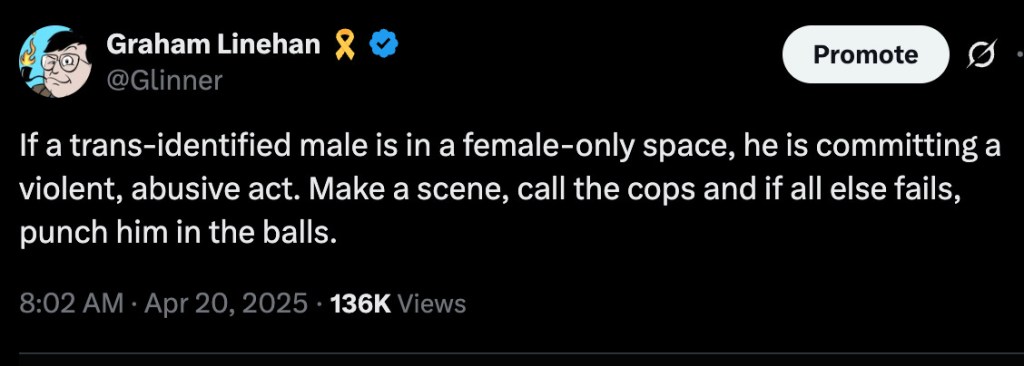
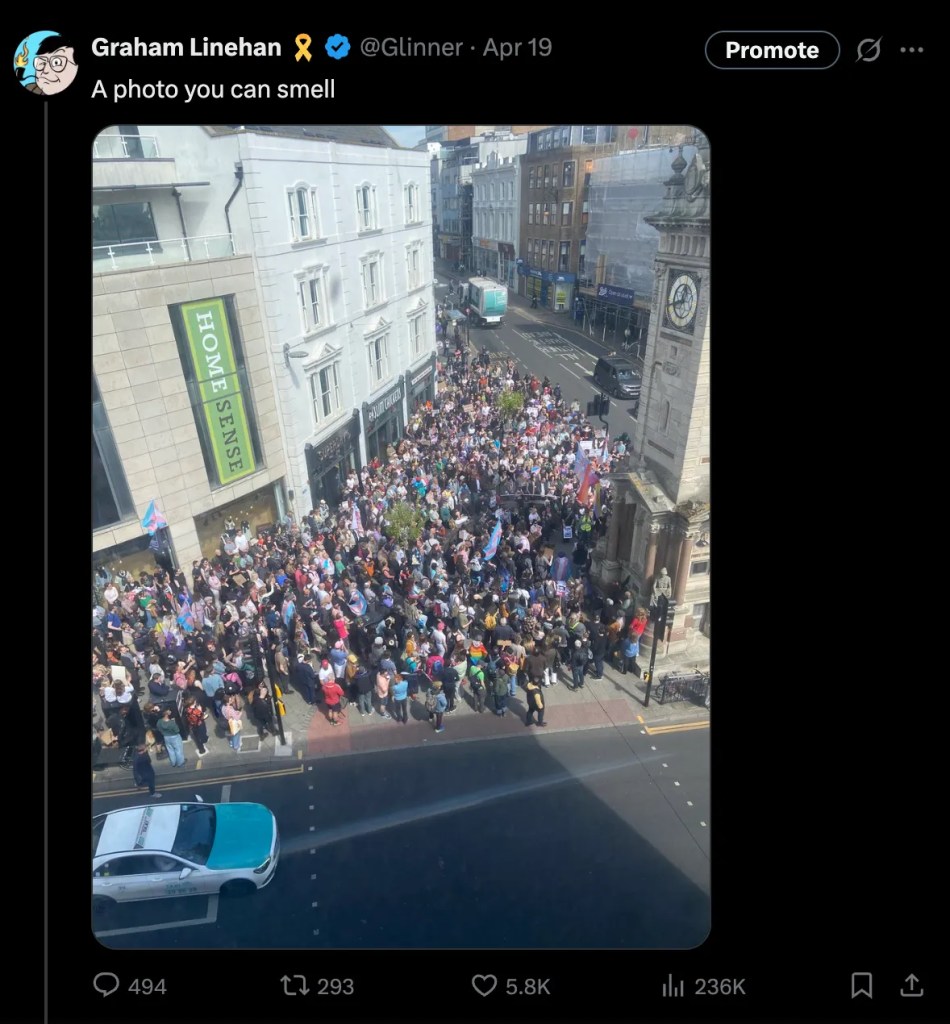
    Linehan’s tweets are nothing like Lucy Connolly’s. They are merely expressions of his view of trans ideology, albeit strongly worded, in his (entirely legitimate) style. In one, he posted a picture of what seems be a trans rights demonstration, with his caption: “A photo you can smell.” Another reads: “I hate them. Misogynists and homophobes. F— em.” And the third says: “If a trans-identified male is in a female-only space, he is committing a violent, abusive act. Make a scene, call the cops and if all else fails, punch him in the balls.”

    You might not like his tone. You might find his attitude confrontational. Trans people will doubtless find the posts offensive. So what? There is no law against giving offense.

    Except that appears no longer to be true. The Metropolitan Police has confirmed that Linehan was held “in relation to posts on X.” “The man in his 50s was arrested on suspicion of inciting violence,” a spokesman said.

    Criminality is evolving every day in this sphere. Increasingly, giving offense is being taken by the police and the Crown Prosecution Service as prima facie evidence of criminality. The other side of this coin is that taking offense is seen as legitimate grounds for a complaint. Presumably someone made a complaint to the police over these tweets – unless, and this is not beyond the realms of possibility, the police have officers who spend their days trawling the internet looking for posts that offend what they consider to be good taste. Is that really a good use of police time?

    Trust in the police is at an all-time low. In October 2024, 52 percent of adults told YouGov that they had no confidence in the police to tackle crime, compared to 39 percent in October 2019. What the police don’t now do – tackle crime – is just one aspect of the collapse in trust. Allied to that is what the police do now do – such as arresting people over social media posts which merely give offense to someone. It’s of a piece with what is seen on the regular hate marches, where they stand and watch when there are calls for the murder of Jews (such as the widespread “globalize the intifada”), but only spring into action when a counter-demonstrator turns up, saying that they are likely to provoke a breach of the peace.

    What we are seeing is the congruence of two dangerous developments. First, is the idea that giving offense is something which should be banned. The government’s current move towards adopting a definition of Islamophobia is part of this, and has rightly been labelled by Fiyaz Mughal, the founder of Muslim anti-prejudice group TellMAMA, as introducing a blasphemy law by the back door. Similarly, the onward march of the trans ideologues may have been stopped in its tracks by the Supreme Court’s ruling on the definition of “woman,” but the ideology has already taken hold of many institutions and spaces.

    Which leads to the second development – the police’s capture by this and other “woke” ideologies. Linehan describes how in his police interview a police officer mentioned trans people: “I asked him what he meant by the phrase. ‘People who feel their gender is different than what was assigned at birth.’ I said: ‘Assigned at birth? Our sex isn’t assigned.’ He called it semantics, I told him he was using activist language.”

    This is the nub of it. The police, supposed guardians of the law, have become players in the activists’ capture of the institutions. It is not that they are no longer concerned with crime, but that they are redefining what crime is. It is terrible that Linehan should have had to go through this. But if it wakes more of us up to what is happening in Britain, his arrest will have served our country well.

  • Can Bruno Retailleau defeat France’s Islamists?

    Can Bruno Retailleau defeat France’s Islamists?

    When France played Algeria at soccer in their national stadium, the Stade de France, in 2001, the French player Thierry Henry said afterwards he felt – disturbingly – as if he were playing away. The game had to be abandoned after dozens of Algerian fans, furious at being 4-1 down, invaded the pitch. 

    Bruno Retailleau, the interior minister of France since September last year and a key figure in the small boats crisis, has been known to cite Henry’s comment. Retailleau is carving out a distinct role for himself in government as the tribune of the growing number of his compatriots who share the same sense that they, too, are “playing away.” In other words, the millions who believe that they have become strangers in their own country.

    There is a trinity of issues at the heart of his agenda – porous borders, rampant crime and an increasingly self-confident Islamist movement that is on a long march through the institutions of the Fifth Republic.

    Jean-Luc Mélenchon, leader of La France Insoumise, the populist party which is currently the most powerful force on the left, thinks Retailleau is the man to watch. “For many right-wing people, Bruno Retailleau is more reassuring than [Le Pen],” he wrote in La Tribune. “Retailleau is the reactionary movement’s best chance at this time.” Retailleau’s prominence is all the more remarkable considering he leads Les Républicains, the once dominant force on the right, which long ago lost its position to Rassemblement National and has been written off by many as a dead party. Yet there’s an outside chance now that he can make it all the way to the Élysée when President Macron’s second term ends in 2027.

    So who is he? Retailleau was born in 1960 in the Vendée – a department best known in history for an unsuccessful royalist revolt against the revolutionary authorities in the 1790s. This revolt elicited Jacobin repression from Paris which was brutal enough to inspire Lenin. Retailleau’s great-great-great grandfather was part of the cross-class alliance that turned to the local aristocracy for military leadership; in his mother’s house there is a certificate of appreciation from Louis XVIII for their loyalty in an era of unprecedented upheaval.

    What happens when the rule of law starts to facilitate crime – and people can see that it’s doing so?

    But Retailleau is a conservative, not a reactionary, despite what Mélenchon may claim. His view of the French Revolution was influenced more by Edmund Burke than by 19th-century French royalists such as Joseph de Maistre. “I owe much of my understanding to Edmund Burke. There was the constitutional change of 1789, which Burke sympathized with, and the Terror of 1793, which he of course rejected. But the Terror of 1793 was not inevitable,” he says, when we meet in London during the recent state visit. “The Revolution could have been more liberal and respectful. But it gave a blueprint for totalitarianism – later communist and in our times Islamist absolutism, the ends justifying the means. And the total vision of society encompassing and politicizing every aspect of life. Meaning the attempt to perfect man from a tabula rasa.”

    The invocation of Burke is typical of the man who is one of the few top-level politicians who manages to keep up his reading while in office. Among writers directly addressing more contemporary issues, his choices are not always easy to predict: many on the French right would cite Jean Raspail’s anti-immigration novel The Camp of the Saints or Michel Houellebecq’s Soumission, an imaginary account about an Islamist takeover of France. 

    Retailleau, however, admires the French-Algerian writer Boualem Sansal, who is currently in prison in Algeria and is a staunch critic of the nationalist regime there and of the Islamists: Retailleau is now the most vocal member of the government calling for Sansal’s release. He is also keen on the writings on art and philosophy of Régis Debray, the tiers monde-iste friend of Che Guevara and Mitterrand adviser. Retailleau enjoys the company of Parisian intellectuals such as the cultural critic Alain Finkielkraut and the political philosopher Pierre Manent – who form a contrast with his circle of intimates from the Vendée, a difference of cultures which he relishes.  

    Retailleau’s career choices have also been unconventional. Most graduates of one of the grandes écoles would go on to become a mandarin serving an apprenticeship in the Cabinet of a minister. Retailleau, by contrast, after Sciences Po, returned to the Vendée – where his grandfather and father, a grain merchant, had both been mayor of Saint-Malo-du-Bois. His grandfather was severely wounded at the first Battle of the Marne in September 1914. His father served in the Algerian War and later ran the family farm.

    Retailleau himself has served as a reservist in the Régiment de Saumur, one of the best-known of the French cavalry regiments; and dressage is his competitive sport of choice. Today, his favorite pastime is riding alone in the Vendée (sometimes to the alarm of his security detail) and he has retained the figure of a jockey until well into his sixties. “I’ve had a few falls,” he notes, but his enthusiasm for the saddle remains undiminished. 

    His children presented him with a she-donkey for his 60th birthday. “When I have the time, I will take her on a journey to the Cévennes – in tribute to Robert Louis Stevenson, another of my favorite authors.” But for now, the crisis at the French borders makes this a luxury he cannot afford: he is a workaholic, often waking at 3:30 a.m. to read his official papers.  

    Retailleau started his career at Puy du Fou – the nearby theme park on French history that was founded by the local aristocrat Philippe de Villiers, a key figure in French Euroskepticism.

    He was a keen participant in Puy du Fou’s pageants and re-enactments. Under de Villiers’s guidance, he rapidly rose to become a member of the National Assembly, president of the Vendée departmental council, president of the Pays de la Loire regional council and finally leader of Les Républicains in the Senate. But the apprentice outstripped the master and there was a parting of the ways.

    ‘Islamophobia is a bogus concept. It conflates all Muslims with Islamism, which is not true’

    The difference in approach between the two men is meaningful. There is a certain non-sectarianism in Retailleau’s approach: behind his desk in the Interior Ministry at Hôtel de Beauvau hang portraits of the two greatest Vendéens – Jean de Lattre de Tassigny, a French marshal of World War Two, and Georges Clemenceau, the victor of the first world war. It’s hard to imagine a purist Catholic of de Villiers’s vintage revering an atheistic anti-clerical like Clemenceau. 

    And when it comes to Russia, Retailleau is firmly in the Giorgia Meloni camp: he parts company with those on the French right who see Vladimir Putin as a defender of family values and Christian civilization. Retailleau sees Putin not as the inheritor of Czarist tradition, but rather as a product of the KGB. 

    Retailleau believes in defending moral as well as physical borders – hence his opposition to euthanasia and his concern about the consequences of gender transitions in children. But restoring the status quo ante on capital punishment, abortion and gay marriage is hardly the mainstay of his policy vision. And he tells me that the restoration of Notre-Dame-de-Paris after the fire of 2019 will rank as one of Emmanuel Macron’s greatest achievements – less for religious reasons than as evidence of what the state can still accomplish in terms of grand projets that really matter, when it can summon the will to sweep aside bureaucratic obstacles. 

    Although the attention is now on what the French call les aspects régaliens of Retailleau’s current role – matters relating to the direct authority of the state – it was his economic agenda that mattered most to him in the Vendée. Retailleau is the antithesis of corporate man (he is proud of banning the word “management” from all departmental discourse), but he was nonetheless a big booster for business in the region. 

    Since the Revolution, the Vendée has got relatively little from the state, making it highly self-reliant. It therefore has some of the lowest claims for unemployment benefit of any department, at 6 percent compared to a 7.4 percent national average. The bulk of businesses comprise what Germans would call the Mittelstand – family-owned enterprises chafing under Parisian and Bruxellois regulations. 

    Intriguingly, Retailleau cites no one economic mentor like Milton Friedman or Friedrich Hayek – nor even that staunchest of French critics of Keynes, Jacques Rueff, who was also an adviser to Charles de Gaulle. Rather, he tells me, his economic inspirations are the Vendéen entrepreneurs who create real prosperity and jobs.

    His answer is shrewd, because it’s hard to be accused of being a “globalist” for extolling the virtues of local enterprises; but it says something about the French right that economic issues are now more internally divisive than cultural matters.

    If the state has interfered too much in the economy, Retailleau also believes it has been too laissez-faire in the realm of security. He poses to me a key theme of his: “What happens when the rule of law starts to facilitate crime – and people can see that it’s doing so? When the endless invocation of the rule of law becomes the enemy of honest people?”   

    Retailleau is referring to what he sees as the excessive solicitude of wide swaths of the French legal profession and judiciary for the rights of individuals accused of crimes at the expense of the collective rights of the law-abiding majority. A mere 7 percent of deportation orders for illegal migrants are implemented, and too often, in his view, that is because French judges rule that a procedural technicality has been breached.   

    This failure of the state on immigration and crime has a particular piquancy for Retailleau: his close friend, Fr Olivier Maire, was murdered in 2021, allegedly by a Rwandan asylum seeker with mental health issues. The suspect had been released on bail after being accused of setting fire to Nantes Cathedral and was being sheltered by Maire at the time. 

    Retailleau has therefore long wanted to re-empower the people by reforming article 11 of the Constitution on procedures allowing for a popular referendum on immigration – something which is not possible today. He also advocates cutting full medical aid for illegal immigrants, preferring to allow them just emergency care.

    ‘Islamists have a smooth narrative: to employ our freedoms to destroy our freedoms. It’s an all-of-society project’

    How did this shift in the ethos of the French judiciary and legal profession come about? Retailleau points the finger at the spirit of ’68 – and, in particular, the long-term effects of the Harangue de Baudot, the 1974 address delivered by the liberal Marseille magistrate Oswald Baudot urging new judges to side with “the weak against the strong,” which is now the sacred text for the left-wing Syndicat de la Magistrature, effectively the trade union for the Bench. 

    In Retailleau’s view, the price of this broad approach is also being paid by the 15,000 security personnel who were injured in France in 2023. Significantly, his first visit as interior minister was to the préfecture at La Courneuve in the Parisian banlieue of Seine-Saint-Denis, where he met three hurt gendarmes: one of the perpetrators of these assaults, a juvenile, already had 33 convictions to his name. 

    Success or failure in crime or immigration policy can at least be measured in numbers. It’s much harder to mark progress in the struggle against political Islam – which Retailleau believes constitutes the greatest subversive threat to the Fifth Republic. “They are a formidable enemy, despite the relatively small numbers of their core cadres,” he says. “They have a smooth narrative: to employ our freedoms to destroy our freedoms. It’s an all-of-society project. For example, they aim to ‘Islamize’ knowledge. And their message is as follows: ‘We will colonize you and we will dominate you.’”

    One of the first steps he took on Islamism after assuming office was to declassify the Interior Ministry’s 74-page report on the Muslim Brotherhood in Europe: his purpose was to alert the public via an approach of “name and shame.” It’s little secret now that Retailleau struggled with the Elysee to maximise its revelations about individual Islamist institutions; partly because the President’s office was initially reluctant to be seen to be dancing to Retailleau’s tune. 

    Retailleau is thus the one making the political weather on this issue: the Defense Council met again recently under the chairmanship of Macron to discuss, in the light of this most comprehensive official analysis of frère-isme to date,  just how to enforce the landmark 2021 French separatism law. The old pre-war French right saw laïcité as the enemy of Catholic France; now, it sees it as a bulwark to protect the country. As ever, practical implementation is the key to Retailleau’s way of doing things.

    This included new ways of disbanding the Brotherhood’s endowments in France which promote hatred – by exposing and then freezing its assets. Also high on the priority list are the law’s demands for neutrality in the public space (no display of symbols of religion by officials at any level) and support for public servants, notably teachers, who face threats because of discharging their public duties – a particular concern after false allegations of “Islamophobia” from a pupil were weaponized against the schoolmaster Samuel Paty in 2020, leading to his decapitation by a Chechen refugee.

    Mélenchon has, unsurprisingly, accused him of cultivating an “Islamophobic climate,” but Retailleau retorts: “The concept of Islamophobia is one of the defining messages of the Muslim Brotherhood and its allies, but it’s a bogus concept to tie our hands intellectually and to prevent us from criticizing Islamism. And it suits the Islamo-Gauchiste project of Mélenchon to build up a communalist bloc based upon a sectarian appeal to anti-state grievances. It conflates all Muslims with Islamism, which is not true.”

    Retailleau is gratified by the favorable official responses which the Brotherhood report has enjoyed in Europe – such as in Sweden and Belgium. Over 20 years ago, French intelligence bestowed the soubriquet “Londonistan” upon the British capital – because it was seen as a “safehouse” for Islamists. Are we still Londonistan, I ask? Retailleau diplomatically sidesteps my question, but his omission of the UK as an enthusiast for this report speaks volumes. 

    Controversial as these issues are, they may (counterintuitively) form the basis of a potential future national consensus. Retailleau respects republicans from the right and the left who want to maintain traditional French laïcité against the New Left’s identity politics: reaching out across party divides, he particularly notes the rigor of the former Socialist prime minister and interior minister Manuel Valls.

    What, then, are his chances in the 2027 presidential election? The conventional wisdom of the Parisian media holds that Retailleau is too old-fashioned to win. How, when he is hovering at around 10 percent in the polls, can he hope to make it through to the second round?

    But the issues of the era – “order, order, order” is how he characterized his priorities when he took office – are cutting in his favor. He remains the most popular minister in a very unpopular government. More-over, despite its poll lead, the Rassemblement National is struggling to find a fully credible candidate, with Le Pen’s legal difficulties potentially preventing her standing and Jordan Bardella, her 29-year-old deputy, lacking frontline experience. 

    Retailleau quotes to me the well-known French political maxim of the author Maurice Druon, who served as Georges Pompidou’s culture minister: “There are two parties of the left in France, one of which is called the right!” There is an opening for a force that is genuinely right-wing, and which stays right-wing in government.

    The question now is how long Retailleau, who is very much his own strategist, remains in government. On the one hand, the Interior Ministry has been a perfect platform for his policy agenda – and the police and fire brigades, with whom he has developed a genuine rapport, would miss him. But if he stays too long, his unique brand risks cross-contamination with that of Emmanuel Macron. That is why, as leader of Les Républicains, Retailleau is increasingly distancing himself from the President on several issues (notably public subsidy for wind farms, which he wants to end). Such open free-thinking does not always endear him to the Élysée. 

    Sir Roger Scruton – one of Retailleau’s heroes – would certainly have appreciated the apparent paradox of his public life to date: the story of a ruggedly individualistic son of La France profonde vindicating the long-neglected rights of the national and cultural collective, at the heart of power.

  • Two looming crises for France

    Two looming crises for France

    Financial crises are often linked to a political crisis. On September 8, the French government will submit itself to a vote of confidence – which, by all accounts, it will lose. At issue is France’s parlous financial state, which a minority French government seeks to address. This week, French 30-year bond yields reached levels unseen since the Greek debt crisis in 2011, while the 10-year yield has surpassed present-day Greece’s. 

    France’s economy minister was quick to warn that France’s lamentable financial position could leave it facing an IMF bailout. This was intended to frighten MPs ahead of the vote rather than reflect reality. Greece was borrowing at near 30 percent prior to its debt crisis and had a budget deficit of 15 percent GDP, while France’s is 6 percent. Parallels with Greece in 2011 are exaggerated. Yet debt markets can turn at the blink of a logarithm.

    If François Bayrou’s government falls, an optimistic outcome is unlikely

    Were that to happen, the European Commission would never allow an outside body alone to take control of a Eurozone member. As with the Eurozone crisis a decade and a half ago, a new “Troika” would be appointed: IMF, European Central Bank and European Commission. Thirteen years ago I happened to be a member of that Troika called in to propose wholesale reform of the Greek public sector as the corollary for massive loans. Witnessing firsthand France’s leading role and unforgiving manner in “Task force for Greece,” it was clear how France’s attitude did not endear it to the Greeks. Like the French, they express their anger openly and carry historical grudges.

    Demonstrations and riots were not the only signs of Greek frustration and humiliation. “Task force for Greece” was nominally led by France and Germany. But the Greeks ran a very effective press campaign showing how German reparations owed to Athens from World War Two equated to Greek debt. Germany’s delegate to the task force had his German home firebombed (whenever I caught sight of him, he was always flanked by armed detectives). Germany discreetly left the “dirty work” to France.

    The French team was run by senior members of the French Finance Ministry. They set about the task with technocratic zeal. My brief was to lead on reforming the Greek university sector (having served a few years previously on a French prime ministerial commission for French university reform). The Troika austerity reforms were truly harsh. Fierce cuts to public sector wages and pensions, tax increases, privatization of state-owned enterprises and labor market deregulation resulted. My bit part was cut short by Greece’s refusal to implement any reforms not proposed and directed by itself. That became the norm. Greek passive (and not so passive) resistance to the Troika austerity reforms and the consequent political turmoil led to Greece directing the reforms itself.

    France’s prominent role in the Troika austerity measures should be a salutary lesson given its own financial predicament. With a 6 percent budget deficit and national debt to GDP ratio at 113 percent (predicted to rise to over 120 percent), France is already operating at twice the EU’s Stability and Growth Pact requirements. In November last year, the country was placed in excessive deficit procedure (EDP). As a result, under Article 126 of the Treaty on the Functioning of the European Union, France is required to provide six-monthly plans to the EU Commission on the corrective action, policies and deadlines it will apply to return to a 3 percent deficit by 2029, failing which astronomical fines could be imposed.

    There is little chance France can comply with the plan. A political crisis is likely on September 8. If François Bayrou’s government falls, an optimistic outcome is unlikely. Three fateful scenarios present themselves. President Macron could appoint France’s fifth prime minister in two years. But who would want the poisoned chalice of applying austerity measures with no possible majority in the present National Assembly? The President could call new elections as he did in 2024. But opinion polls suggest another minority government, albeit clearly dominated by the Rassemblement National. A third scenario would be for President Macron to resign. That would lead to a new RN French president, by no means committed to austerity measures.

    Each of these options will seriously frighten financial markets, not to mention the European Union. Given the way President Macron has antagonized so many European leaders over the last ten years, not to mention its role in the Greek debt crisis, France should be fearful she is not forced into the indelicate hands of the Commission. Which country’s officials would march into Paris? Heaven forfend that I be invited to take part in a Greek-led “Task force for France.”