Category: International

  • Putin’s economic alchemy begins to tarnish

    Putin’s economic alchemy begins to tarnish

    The Kremlin’s accountants are having a problem: Russia’s state budget, once the engine of spectacular growth, is now flashing red. The mathematics are brutal. Russia’s fiscal deficit has ballooned to 3.7 trillion rubles in June – roughly $46 billion – skating perilously close to this year’s legal limit. As a share of GDP, the deficit threatens to breach the 1.7 percent ceiling, a prospect that has Valentina Matviyenko, speaker of the Federation Council, preaching the gospel of “strict savings” with all the enthusiasm of a Victorian governess.

    The root of Moscow’s monetary malaise lies in spectacular overoptimism. Last September, officials confidently predicted a 2025 deficit of just 0.5 percent of GDP, banking on Brent crude at $66 per barrel, robust 2.6 percent growth, and a conveniently weak ruble at 100 to the dollar. Instead, they’ve watched their projections crumble fast.

    The transformation of a petro-state into a war economy was supposed to demonstrate Russian resilience

    In the first half of the year, oil and gas revenues, which fund more than a quarter of the Russian state, have collapsed by 17 percent compared to last year and 25 percent below projections. The market consensus for next year’s Brent prices hovers between $55 and $65 per barrel, below the government’s projections. Meanwhile, an unexpectedly strong ruble means fewer rubles per exported barrel, creating the peculiar problem of being too successful at currency strength.

    The broader economy tells an equally grim tale. Growth has plummeted from a respectable 4.3 percent in 2024 to 1.4 percent in the first quarter of this year, with the Central Bank now forecasting sub-1.5 percent growth for 2025. Lower growth translates to reduced VAT and income tax receipts, creating a vicious cycle that would make even Gordon Brown wince. Lower growth also means lower GDP, and with nominal fiscal deficit rising monthly, the 1.7 percent legal threshold for this year’s deficit to GDP ratio has all the chances to be blown.

    Putin’s bookkeepers face a difficult problem. The president promised not to raise taxes, ruled out meaningful currency devaluation (which would stoke inflation and increase government costs), and ringfenced defense, security and social spending. What remains is a game of fiscal Jenga where removing the wrong piece brings down the entire structure.

    Defense spending alone accounts for roughly $172 billion – 7.7 percent of GDP – with little prospect of meaningful reduction. The stockpiles of Soviet weaponry that initially sustained the Ukraine campaign are running dangerously low, forcing expensive rearmament. The Kremlin has convinced itself that military production must remain the economy’s primary driver, a strategy worthy of Stalin planners’ applause, but expensive for the state finances.

    With limited options, the government would be passing the fiscal burden to business and citizens with the subtlety of a Moscow traffic policeman. Companies face the prospect of losing subsidies while shouldering additional costs for security and social programs: hardly conducive to investment or innovation. Citizens, meanwhile, can expect higher duties on vehicle registration, steeper excise taxes on life’s small pleasures, and increased fines. It’s austerity with Russian characteristics: brutal but presented as a patriotic duty.

    The regime’s fiscal contortions reveal a deeper vulnerability.

    In 2022, when sanctions first bit, Russian businesses and citizens queued cap-in-hand for state assistance, receiving generous help in exchange for war enthusiasm. Now the state coffers are running dry, but the enthusiasm must remain undimmed – dissent being rather more dangerous than bankruptcy in Putin’s Russia.

    Two external threats loom large over this precarious balancing act. Should President Donald Trump make good on threats to throttle Russian oil trade, or should Brussels tighten technological sanctions, Moscow’s fiscal gymnastics could collapse entirely. The Kremlin has thus far managed to fund its war without triggering mass protests, but the margin for error is shrinking.

    Putin’s great gamble – that Russia could outlast Western resolve while maintaining domestic stability – increasingly depends on economic alchemy. The transformation of a petro-state into a war economy was supposed to demonstrate Russian resilience. Instead, it may prove that even autocrats cannot indefinitely defy the laws of arithmetic.
  • How did the men who bombed Hiroshima live with themselves?

    Eighty years on, the atomic bombing of Hiroshima continues to provoke fierce debate, reflection, and deep moral inquiry. How did the thirteen men aboard the Enola Gay – the US aircraft that delivered the bomb that killed at least 150,000 people – live with the knowledge of what they had done?

    The morning of August 6, 1945 began like any other on the Pacific island of Tinian. That was, until the Boeing B-29 Superfortress lifted into the sky. Its destination: Japan. Its payload: “Little Boy,” the first atomic bomb ever used in warfare. Piloted by Colonel Paul W. Tibbets Jnr. and manned by a crew of twelve, the mission forever altered the course of history. The explosion over Hiroshima ushered in the atomic age, marked the beginning of the end of the Second World War, and created a moral legacy that haunted and defined the lives of those aboard.

    Some defended their actions unapologetically; others expressed private doubts or lingering sorrow

    The men of the Enola Gay were highly trained and mission-focused, yet none could fully comprehend the historic and human weight of the operation they had executed. After the war, these men returned to civilian life or continued military careers, each navigating the public scrutiny and personal reckoning that came with their roles in the atomic bombing. Some defended their actions unapologetically; others expressed private doubts or lingering sorrow. But all of them lived in the long shadow of that moment.

    Colonel Tibbets Jnr., the aircraft’s commander and pilot, remained the most visible and vocal member of the crew throughout his life. As the man who had selected the Enola Gay, named it after his mother, and led the 509th Composite Group, Tibbets carried the weight of command. Unapologetic to the end, you can only admire his message discipline, consistently defending the mission as necessary. In a 2002 interview, he reflected:

    “I viewed my mission as one to save lives. I didn’t bomb Pearl Harbor. I didn’t start the war. But I was going to finish it.”

    Tibbets served in the US Air Force until his retirement as a brigadier general in 1966. He never expressed remorse and, anticipating potential protests, requested no headstone after his death in 2007. His ashes were scattered over the English Channel by his French-born widow, Andrea.

    Major Thomas Ferebee, the bombardier who released the bomb, shared Tibbets’ view. A seasoned airman who had seen combat in Europe, Ferebee also showed little inclination toward public reflection or regret. He returned to service after the war and retired as a colonel, keeping a low profile for much of his life. Like Tibbets, he believed the bombing had ultimately saved more lives than it had taken.

    Navigator Captain Theodore “Dutch” Van Kirk was responsible for guiding the aircraft to its target. His recollections offered a blend of historical realism and quiet resignation. In a 2005 interview, Van Kirk said:

    “War is war. And in war, you do what you have to do to win. It was a different time and a different place.”

    After leaving the military, Van Kirk worked in private industry, remaining relatively quiet until his later years, when he began to speak more openly about the mission. He maintained that the bombing, tragic though it was, had likely prevented an even greater catastrophe. He passed away in 2014, the last surviving member of the Enola Gay crew.

    Co-pilot Captain Robert Lewis, in contrast, expressed deep emotional conflict shortly after the mission. In his logbook, written during the return flight, he famously recorded:

    “My God, what have we done?”

    This single line became one of the most quoted responses from the mission, often contrasted with the stoic tone of Tibbets and others. But his crew members have called into question the veracity of that account. According to Van Kirk, who was sitting behind the co-pilot, as they gazed at the giant mushroom cloud enveloping the heart of Hiroshima, Lewis exclaimed: “Look at that son of a bitch go!”

    Lewis, a civilian airline pilot before and after the war, wrestled with the event privately. Though he never publicly condemned the mission, his writings and interviews reflected a more complicated emotional legacy. He died in 1983.

    Sergeant George “Bob” Caron, the tail gunner, was the only crew member to witness the blast directly through a rear-facing window. He captured the famous photographs of the mushroom cloud that have since become emblematic of the bombing. In his 1995 memoir Fire of a Thousand Suns, Caron defended the mission as a necessary military action and expressed pride in his crew’s professionalism. After the war, he lived a relatively quiet life and worked in sales.

    Lieutenant Jacob Beser, the radar specialist, played a role not only in Hiroshima but also in the second bombing mission over Nagasaki. A physicist by training, Beser was deeply involved in the technical side of the weapon’s delivery. In later interviews, he was frank about his participation, stating that he had no regrets, though he did express concern over the uncontrolled spread of nuclear weapons in the postwar world. Beser passed away in 1992.

    Several crew members chose to step away from public life entirely. Staff Sergeant Wyatt Duzenbury, Sergeant Robert Shumard, and Technical Sergeant Joseph Stiborik all returned to civilian life without engaging in public commentary. These men had played crucial roles in maintaining the aircraft and monitoring its systems, yet their postwar narratives were largely defined by silence. Their private reflections, if any, were not widely recorded.

    Captain William “Deak” Parsons, the mission’s weaponeer, had the grave responsibility of arming the bomb during flight. A naval officer and ordnance expert, Parsons ensured that the weapon was live before it reached the drop zone. He continued to work in nuclear weapons development and held high-level roles in the Navy and at Los Alamos. Parsons died in 1953, before the larger public reckoning with the bomb’s legacy fully unfolded.

    Ensign Morris Jeppson, Parsons’ assistant, was the man who removed the bomb’s safety plugs mid-flight, allowing it to arm. After the war, Jeppson became an electrical engineer and worked in private industry. In later life, he occasionally gave interviews in which he offered a calm, pragmatic defence of the mission. He expressed neither regret nor triumph, focusing instead on the technical precision and professionalism required for such a complex operation.

    Their reflections were often grounded in the logic of the time: a brutal war, a feared invasion

    As the Cold War intensified and nuclear weapons proliferated, public sentiment around Hiroshima became increasingly divided. The 50th anniversary of the bombing in 1995 brought renewed scrutiny to the crew of the Enola Gay, particularly when the Smithsonian Institution’s planned exhibit on the aircraft was met with controversy. Veterans’ groups clashed with peace activists and historians over how the bombing should be remembered. Tibbets and other surviving crew members criticised what they saw as a politically skewed narrative that cast them as villains rather than soldiers following orders during wartime. The exhibit was eventually revised, displaying the aircraft without a strong interpretive stance.

    While many of the men maintained personal pride in their military professionalism, few glorified the destruction itself. Their reflections were often grounded in the logic of the time: a brutal war, a feared invasion, and the perceived necessity of demonstrating overwhelming force to end the conflict swiftly. These were not bloodthirsty men; they were professionals who had been tasked with delivering an incomprehensibly powerful weapon, under orders and in service to a broader strategic objective.

    As the years passed, the crew of the Enola Gay aged into a world that changed dramatically from the one in which they had taken flight. They watched as the power they had unleashed became the centrepiece of global geopolitics. Some lived long enough to see the fall of the Soviet Union, the debates over arms control, and the shifting global consensus about the use of nuclear weapons.

    Yet through it all, the men remained tethered to that day in 1945. Whether in silence or speech, pride or doubt, they carried the memory of Hiroshima with them. Their mission was history’s turning point, but also their personal burden. They did not ask to become symbols of victory, destruction, or moral ambiguity, but that is what history made them.

    Their story is not one of monsters or saints, but of men caught in the furnace of global conflict, making choices within the brutal logic of war. They dropped the bomb. And then, for the rest of their lives, they lived with it.

    ‘The Hiroshima Men: The Quest to Build the Atomic Bomb, and the Fateful Decision to Use It’ by Iain MacGregor is out now.

  • Mark Carney was asking for Trump’s tariffs

    Mark Carney was asking for Trump’s tariffs

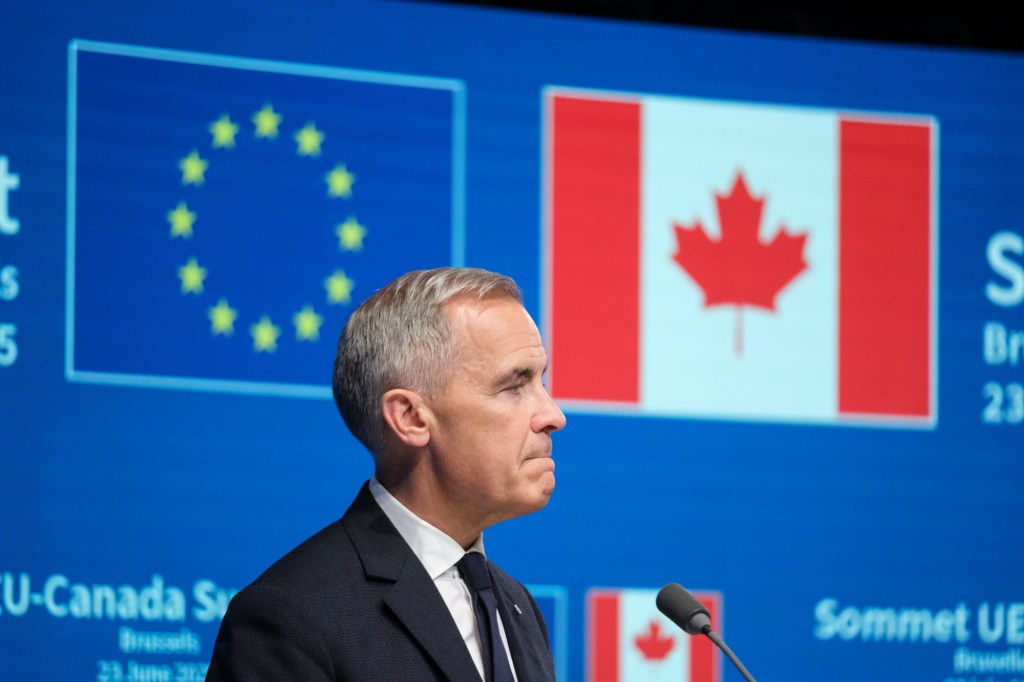
    Canadian Prime Minister Mark Carney announced on Wednesday that his Liberal government will recognize the state of Palestine at the United Nations in September, following the recent trend set by France and the UK.

    The decision to recognize Palestine at a time when the bloodthirsty terrorist organization Hamas is firmly in control is abhorrent, especially when the Hamas-led October 7 attack on Israel is still so fresh in many people’s minds. Democratic countries like Canada shouldn’t be enhancing the status of a murderous outfit that’s the equivalent of pure evil in our world.

    The Canadian government argues that they have put restrictions in place that must occur before recognition is approved. Carney said the Palestinian Authority must hold an election in 2026 and Hamas cannot be involved. He also insisted that Hamas releases the remaining Israeli hostages, and there must be a demilitarized Palestine. “Preserving a two-state solution means standing with all people who choose peace over violence or terrorism,” the PM said at Wednesday’s press conference, “and honoring their innate desire for the peaceful co-existence of Israeli and Palestinian states as the only roadmap for a secure and prosperous future.”

    Let’s put aside the obvious fact that terrorist groups like Hamas can’t be trusted when it comes to negotiating terms and conditions for just about anything. Does anyone truly believe Hamas’s leadership gives a tinker’s dam about Carney’s demands? Canada is a middle power with virtually no influence or cachet on the international stage since the path of destruction that former Prime Minister Justin Trudeau left in his wake. If Hamas barely pays attention to larger, more influential countries who have come around to their way of thinking, their perception of Canada won’t change. 

    There isn’t a chance in hell that Hamas will drop its political and military influence in Palestine. They’ll be pleased with the UN’s recognition of Palestinian statehood, but their end game hasn’t changed. That is: to destroy democracy, liberty and freedom in the West and beyond. Their enemies, including Israel, the US, France, the UK and yes, Canada, won’t suddenly become bosom buddies and lifelong chums.

    In fairness, Carney’s announcement could be for purely selfish reasons. He may believe it will solidify his political support among Canadian progressives. There’s some validity to this argument. Since he has a minority government, much like Trudeau did on two previous occasions, it could be the best solution to achieving long-term Liberal electoral support. While Carney’s decision will frustrate Canadian Jews, he knows there are many more voters in Canada’s Arab and Muslim community – including young ones.   

    Yet Canada’s relations with the US is another piece of this puzzle. Carney’s timing with this announcement couldn’t have been much worse, unless it was planned in advance to infuriate US President Donald Trump. 

    Canada and the US have been in the midst of a tariff battle. It started during the latter stages of Trudeau’s leadership last year, complete with Trump’s comments about Canada becoming the “51st US state.” A sizeble number of left-leaning Canadians foolishly believed Carney was the best leadership choice to take on Trump. That’s why his Liberals won the April 28 federal election. The working relationship between these two leaders seemed more positive at first blush, which wasn’t difficult to achieve with the bumbling Trudeau out of the picture. Some believed there was faint hope for a resolution before the August 1 deadline. 

    Alas, Carney’s con job with the Canadian electorate has been fully exposed. Early this morning, Trump announced that he was increasing the tariff rate on Canadian products from 25 to 35 percent.

    Even before Canada’s Palestinian recognition statement, it was clear the tariff negotiations weren’t going particularly well. Canada had briefly threatened to double its counter-tariffs on US metals from 25 to 50 percent and Carney’s own tone changed dramatically this month. He went from telling the press that Canada was in “intensive negotiations with the Americans” to resolve the tariff battle to making this eye-raising statement: “we’re working hard to get a deal, but we’ll only accept the right deal with the United States. The right deal is possible, but nothing’s assured.” It also didn’t help matters that Carney began to focus more heavily on a trade and security partnership with the European Union at the same time, even suggesting Canada was the “most European of non-European countries.”

    Carney’s announcement about Palestine was a slap in the face to Trump, who strongly supports Israel and regards Prime Minister Benjamin Netanyahu as a political ally. “Wow! Canada has just announced that it is backing statehood for Palestine,” Trump wrote on his Truth Social account. “That will make it very hard for us to make a Trade Deal with them. Oh Canada!!!”

    A trade deal between the two countries to reduce the 35 percent tariffs now seems highly unlikely. Carney has suggested that the talks may not end today, but he appears to be focusing on “broader discussions” like defense spending and investments. In other words, the tariffs will remain in place and the faith placed in him by far too many Canadian voters will be for naught.

    Is Carney bothered by the mess he’s caused? It sure doesn’t seem like it.    

  • The trade war isn’t over yet

    Maybe Trump doesn’t always chicken out after all. Rapid trade deals with the UK, Japan, the EU and others in recent weeks may have given the impression that the trade war was essentially over. Today, though, comes Trump’s Ardennes offensive, with immediate tariffs of 35 per cent announced for Canada. Other countries have been given a week to prepare for steep increases: India will be subject to 25 per cent tariffs, Taiwan 20 per cent and Switzerland – far from neutral in this particular conflict – 39 per cent.

    Those who insist Trump has a very clever strategy and is winning tend also to be people who, in any other context, are in favor of low taxes

    According to Trump, Canada has been singled out for harsh treatment because it has failed to cooperate on the flow of fentanyl across the border. Trump also hinted that he was punishing Canada for recognizing Palestine, but then he has just done a trade deal with the EU in spite of France taking the same action, and didn’t make any trade threats to Britain in spite of Keir Starmer saying this week that the UK will recognize Palestine in September if Israel does not meet certain conditions.

    It seems rather more likely that Trump is saying: look, other countries have yielded and agreed to one-sided trade deals with the US – I’m going to carry on beating you about the head until you agree to do the same. But will they? So far, the countries which have agreed to Trump’s rather rough and ready trade deals have acted as if the benefits of a trading relationship with the US are one-way – they have more to lose than the US if a deal cannot be struck. But of course that is not always true. Taiwan, for example, produces over 90 per cent of the world’s high-end microchips, which are implanted in just about every device manufactured in the US. What benefit does it bring America if those chips are in future taxed at 20 per cent?

    There is a strange dislocation in attitudes towards Trump’s tariffs. Those who insist he has a very clever strategy and is winning tend also to be people who, in any other context, are in favour of low taxes. But a tariff is just a tax like any other – it adds costs to business and so suppresses economic activity. If tariffs are set at modest levels, it may be worth putting up with tariffs’ depressing effect in return for the revenue they raise. Raise them above a certain level, however, and revenue will start to decline as business activity is discouraged – the classic Laffer effect. US growth may have proved more resilient than many feared it would be after Liberation Day, but it is certain that tariffs on raw materials and components are a negative influence on US manufacturing industry.

    A country does not “win” by taxing its imports more than other countries tax its exports – if it did, the US would be one of the poorest countries in the world while many African countries would be startlingly rich. The US has done brilliantly well out of a regime of low import tariffs – as has Singapore, one of the few countries which, prior to Liberation Day, imposed even lower tariffs than did the US.

    But even if you do think that imposing higher tariffs than your trading partners amounts to “victory,” it is far from clear that Trump will emerge the eventual winner. Some countries may have yielded to him, but others are clearly holding out, and may well make the calculation that the US has more to lose from a trade war than they do. This war has a long way to run yet.

  • The Art of the Dealmaker-in-Chief

    Who really thought Donald Trump’s America was about to join the stampede of first-world powers promising to recognize Palestine at the United Nations? 

    “Wow!” He exclaimed this morning on Truth Social. “Canada has just announced that it is backing statehood for Palestine. That will make it very hard for us to make a Trade Deal with them.” 

    All over the world, commentators convinced themselves that Trump’s expression of concern on Monday about “real starvation” in Gaza meant he was pivoting with global opinion and against Israel. 

    It turns out, however, that Team Trump is not for turning when it comes to the Middle East. Marco Rubio, the US Secretary of State, has accused the countries now embracing Palestinian statehood of falling for “Hamas propaganda”.

    Trump himself would rather focus all his diplomatic energy on trade, a subject about which he has been positively monomaniacal in recent days. He seems very taken with the new title he has given himself – the Dealmaker-In-Chief. 

    “We are very busy in the White House today working on trade deals,” said the President on Truth Social last night. Three hours later, he announced another “full and complete” agreement with South Korea, involving a 15 per cent tariff on them and $350 billion for the US. That’s on the heels of a deal between America and Japan, South Korea’s big rival in manufacturing terms. 

    The real coup for Trump’s trade strategy this week, however, has been the new framework arrangement with the European Union, which he announced on Sunday from his golf course in Turnberry, Scotland. 

    The EU deal is not simply a major breakthrough in and of itself. It’s also, as the US Treasury Secretary Scott Bessent suggested to my colleague Michael Simmons in Stockholm this week, a useful piece of leverage in the even bigger tariff struggle with China. Bessent was in Sweden for another round of negotiations with his Chinese compatriots and, for US officials, pulling Europe more towards a western trading orbit and less towards the east is an essential thing for the future of capitalism and the free world. China and the US appear to have agreed to take another pause from tariff hostilities – the two sides differ over fentanyl chemicals and Beijing’s role in supporting Iran and Russia. 

    It seems that now Russia is playing on Trump’s mind. On Monday, he suggested he would impose tariffs of up to 100 per cent on Russia if the war in Ukraine didn’t end within two weeks. Then yesterday, as he slapped further tariffs on India, he criticized New Delhi for buying up Russian oil and gas. “I don’t care what India does with Russia,” he said. “They can take their dead economies down together, for all I care.”

    Then, in perhaps the most intriguing trade development of the week, Trump declared a brand-spanking-new deal with Pakistan, including an arrangement to invest in Pakistani oil. “Who knows, maybe they’ll be selling Oil to India some day!” he “truthed”. 

    All jokes aside, Trump’s sudden enthusiasm for Pakistan at India’s expense marks a major shift in US policy in the last few years. Under Obama and Biden and Trump, the US state department has tended to prefer Modi’s India.  

    As ever with Trump, his apparent tantrum with India might conceal a subtler move. That’s the art of the Dealmaker-in-Chief. 

    In the last two decades, Beijing has made enormous investments in Pakistan, particularly in infrastructure through its Belt and Road Initiative. In some ways Pakistan has become an extension of China’s empire. 

    But not all Pakistanis relish the idea of being a Chinese satellite-state. And now the thought of Donald Trump suddenly wooing Pakistan’s government – which recently nominated him for the Nobel Peace Prize, funnily enough – will ring loud alarm bells among the highest ranks of the Chinese Communist party. With Trump’s international agenda, scratch beneath the hilariously crazy surface and you find a more serious campaign to isolate China, China, China. 

    This is taken from the latest Americano newsletter. To subscribe click here

  • The UK censorship files: Jim Jordan’s crusade against Britain

    The British Empire may be gone, but there is one area where the UK has not lost its global ambitions: online censorship. The latest vehicle is the Online Safety Act (OSA), a behemoth internet regulation law whose vast provisions are steadily coming into force – and increasingly drawing the ire of the Trump administration as it starts to impact US tech firms. 

    Under the OSA, “Britain has the power to shut down any platform” that breaks its content regulation rules, boasts secretary of state for technology Peter Kyle. The latest stage of its implementation began last week with new mandatory age-verification measures for social media platforms. 

    The Act is already curtailing what can be read online in the UK. Though the OSA was passed back in 2023 by the Conservatives, the Labour government has taken it up the internet “regulation” crusade with gusto. The rhetorical strategy is to claim that the law is unobjectionable since it is merely about restricting minors’ access to pornography and other “harmful” content – “think of the children”. But it all comes across as rather hysterical. In an extraordinary intervention this week, when the populist Reform Party’s Nigel Farage pledged to repeal the law, Kyle labelled him – and anyone else that’s opposed to it – as being on the side of child predators like Jimmy Savile.

    In reality, there are many valid criticisms to be made of this wildly overbearing law. Small online forums dedicated niche interests, for instance, including fixed-gear cycling and hamsters, have been forced to close due to heavy compliance costs. Many tech companies likewise view it as suffocating. Another major sticking pointis its stringent regulations on AI – a vital emerging field in which the UK risks being left in the dust.

    Most egregious, though, is the OSA’s impact on free speech. Since the new rules came into force, platforms have been forced to censor political speech that paints the British government in a bad light. This includes footage of recent anti-asylum protests, and even speeches in Parliament and court transcripts about the rape gangs scandal. This latter is particularly galling: this was horrific abuse that the British state abjectly failed to protect these children from – and now speech about it is being censored in the name of child safeguarding.

    The bigger problem, for Kyle and the British government, is how the OSA and their censorship cheerleading will play out in the eyes of America. The Trump administration is already unhappy with the state of free expression in Britain.

    A good example of the culture clash came this week, with Jim Jordan, a Trump ally, free-speech advocate and chair of the House of Representatives Judiciary Committee. Jordan will meet Peter Kyle himself, where he is expected raise concerns about free speech. As part of his UK visit, Jordan has viewed documents produced by the Committee that seem to show that the UK government attempted to censor online content during the riots that swept the country last summer. Posting them on X as ‘THE UK CENSORSHIP FILES’, he has accused the British government, including Kyle and Keir Starmer, of “trying to censor criticism of itself,” and clamping down on “narratives” wounding to the British state – like claims of “two-tier justice”. Here’s hoping that Peter Kyle will refrain from alleging that Jordan is “on the side of predators” for his free-speech advocacy.

    While freedom-loving Brits are grateful that their American cousins are helping to safeguard free speech, there is also the question of how the OSA will impact Americans’ own jealously-guarded First Amendment rights. If Washington, DC, looks askance at censorship laws the UK, it’s even less pleased about the British state’s attempts to expand the scope of that regulation across the Atlantic to US websites and tech firms. Back in May, the State Department fired a warning shot, mooting visa bans for foreign officials found to have censored “protected expression in the United States”. US free-speech concerns are also expected to feature in any forthcoming trade deal. Both Trump, in his recent visit, and JD Vance, in the Oval Office back in February, have publicly needled Keir Starmer over the issue.

    The key question is whether America is happy to allow a few hundred Whitehall bureaucrats to bring its tech titans to heel. With the US celebrating 250 years of independence next year, there are many free-speech warriors stateside who would sooner tell Ofcom, Britain’s broadcast regulator, where to get off.

    Prominent among the minutemen is Preston Byrne, an Anglo-American lawyer and free speech activist who also works with the Adam Smith Institute, a British free-market think tank. Byrne has already tangled with Ofcom over the OSA, following enforcement letters it sent to US websites including Gab and Kiwi Farms earlier this year. These sites, however, were comparatively small fry. Ofcom has now sent similar letters to Reddit and Rumble, and in response, Byrne is set to bring a case against Ofcom in the US federal courts.

    For a notice to be served by a foreign power against a US company, typically it would have to go through the Mutual Legal Assistance Treaty (MLAT) to be valid. But that doesn’t seem to be the case for these notices: indeed, if Ofcom had gone through the MLAT, Byrne believes that the State Department and the Department of Justice would not be minded to abide by them. So the letters, for all they threaten these companies with fines or worse, are in fact legally dubious. “Ofcom,” Byrne tells me, “is the international equivalent of a stalker-y ex – they’ve been told to stop, it’s unlawful for them to continue, and now we need the courts to intervene.”

    Just how much more will this battle heat up? What’s clear is that British officialdom’s zeal for online regulation is setting it on a collision course with a resurgent and energetic US free-speech lobby. Yet with trade talks looming, such escalation would surely be a grave mistake. Britain does not rule the world anymore. If London wakes up the “screaming Eagle”, Byrne says, “they’re not gonna like the results”.