Two terror attacks which hit Colombia on Thursday revealed a scary new level of sophistication among the country’s ever present narco-terrorists – and threatened to return the country to the violence and chaos that many had hoped it had finally escaped.
The double terror strikes killed 18 people and involved a car bomb in Colombia’s third most populous city of Cali in which at least six people died, and an earlier drone downing of a police helicopter near the city of Medlllin – long notorious as Colombia’s drugs capital – in which 12 people died.
The use of a drone is thought to be the first time that the 21st century weapon has been used by terrorists in Colombia, and indicates that a worrying new level of sophistication has been reached by the ruthless so called narco-terrorists.
Colombia has been plagued for decades by violence perpetrated by drugs gangs controlled by millionaire barons who have made their fortunes producing and selling cocaine. At the same time until 2016 the country’s democratically elected governments were fighting a jungle war against the left-wing guerilla army the FARC and far right paramilitary groups.
Like many Latin American states Colombia has a long history of alternating between dictatorship and democracy, but the explosion in its production of illicit narcotics since the 1970s to feed the ballooning markets in the US and Europe has fuelled and fed these political conflicts.
Colombia was prostrated for ten years of civil conflict between 1948 and 1958 between the traditional ruling Liberal and Conservative parties. The fighting, known simply as “ La Violencia” killed an estimated 200, 000 people – or 1 in 50 Colombians.
Hardly had ‘La Violencia’ ended with the rival parties forming a pact of national unity when the influence of Fidel Castro’s socialist revolution in Cuba spawned guerilla rebellions launched by groups like FARC. At the same time the worldwide escalation in the demand for drugs saw the rise of drugs barons like Pablo Escobar, who accumulated so much wealth and bribed officials with their ill gotten gains that their criminal power came close to ousting elected governments. The Medillin Drugs cartel run by Escobar practically formed a criminal parallel regime to the legal government in the capital Bogota.
Escobar and his bodyguards died in a gun battle with police in 1993, but other drugs lords picked up his torch and it became increasingly hard to differentiate between purely criminal violence and the political terror caused by groups like FARC. In 2016, after years of tortuous negotiations, the government reached a truce with FARC and the following year the guerillas laid down their arms and announced that they were transforming themselves into a legitimate political party.
In 2022, the current President Gustavo Petro was elected as the first left-wing President in Colombia’s recent history and he has continued to pursue a peaceful path both with the far leftist groups who still use violence and the narco-terror criminal cartels.
The latest two acts of terror are a hammer blow to the ever fragile peace process, and many fear that so long as the rest of the western world does drugs in industrial quantities the violence will continue.
Category: International
-

Is Colombia reverting to chaos?
-
Putin’s trap: how Russia plans to split the western alliance
Though you wouldn’t know from the smiles around the table at the White House this week, a trap has been set by Vladimir Putin designed to split the United States from its European allies. In Washington on Monday, Europe’s leaders, plus Sir Keir Starmer and Volodymyr Zelensky, agreed with Donald Trump that the killing in Ukraine should and can be ended as soon as possible. They lavished praise on Trump for reaching out to the Kremlin, despite having themselves treated Putin as a pariah for the past three years. And they even enthusiastically applauded the notion of security guarantees similar to NATO’s Article 5 “all-for-one and one-for-all” mutual defense clause as a way to safeguard Ukraine’s borders in the future.
But behind every one of these apparently promising areas of agreement lurks a fatal misunderstanding of the intentions of the one man in the world who has the power to make the war stop – Putin.
Let us not forget that the Washington talks were based on Trump and his team’s highly optimistic interpretation of what Putin had agreed to in Anchorage, Alaska. That team included precisely zero Russia experts capable of reading the hidden meaning behind Putin’s weasel words. Steve Witkoff, Trump’s leading point man on Kremlin affairs, is a real estate lawyer with no experience of diplomacy. And the last time that Trump himself spoke in person to Putin, in Helsinki in 2018, he was quickly persuaded by his Russian counterpart that Kremlin election interference was all just a big hoax.
One of Putin’s great skills is appearing to be measured and constructive when in fact he’s being insincere, intransigent or plain threatening. Take his innocuous-sounding remarks at the post-summit Anchorage press conference. In order to achieve a long-term settlement in Ukraine, Putin said: “We need to eliminate all the primary root causes of the conflict.” Decoded, that is a clear reference to Putin’s historical thesis that Ukraine is an invented country that has been used for centuries by Russia’s enemies as a base from which to attack Moscow – and in his view remains so today. He called, apparently reasonably, for Trump to “consider all the legitimate concerns of Russia and reinstate a just balance of security in Europe and in the world on the whole.” But to Putin that “just balance” means a withdrawal of most Nato forces from countries along Russia’s borders.
The remark that has caused most excitement among European leaders was Putin’s assurance that “naturally we are prepared to work on” Trump’s suggestion that “the security of Ukraine should be secured.” Trump and his team came away from Anchorage in the belief that Putin had acquiesced to western security guarantees – and Secretary of State Marco Rubio and Witkoff himself have been touting that as a major breakthrough.
In truth it’s no such thing. Security guarantees were discussed at length during the abortive peace talks between Russia and Ukraine in Istanbul in April 2022, and detailed plans of what those guarantees might look like were included in three drafts of a peace deal that was never signed. Back then Russia, absurdly, tried to insist on itself being a guarantor of Ukraine’s security as in the Budapest Memorandum of 1994, and on having a veto over any intervention. But that point was never resolved after Europe promised Ukraine it could win the war in the field rather than compromise at the negotiating table.
Trump was caught on a hot mic in the White House telling his European guests: “I think Putin wants to make a deal. You understand that? As crazy as it sounds!” In fact, it doesn’t sound crazy at all – Putin undoubtedly does want to make a deal. But what Trump has not yet grasped is that Putin wants to make it on his own terms.
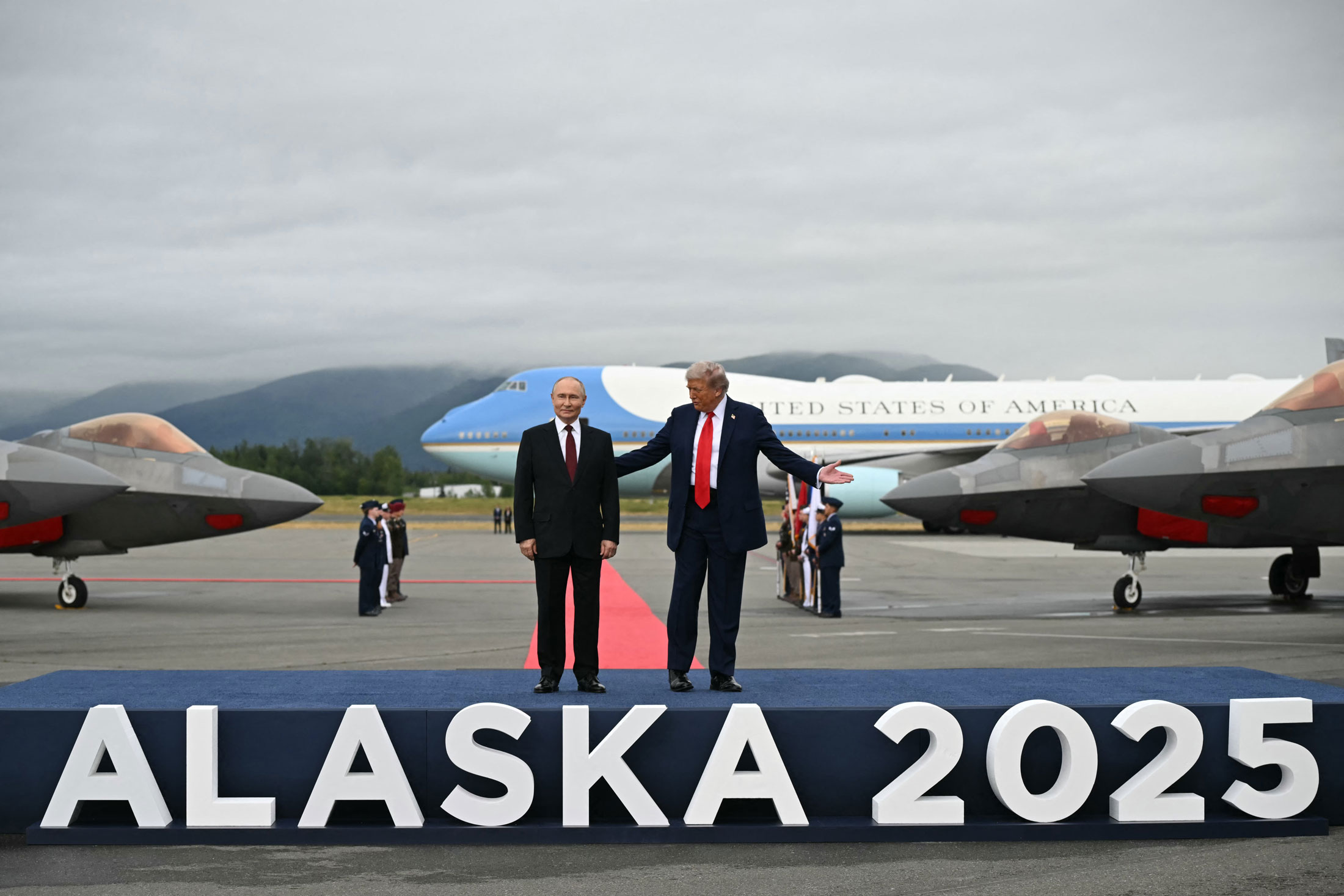
Putin and Trump in Anchorage, Alaska, August 15 2025 (Getty) And therein lies Putin’s trap. His plan for the endgame in the war is to do everything in his power to convince Trump – his new best buddy and business partner – that he is behaving reasonably, making concessions, bending over backwards to keep dialogue open. At the same time, he will lay down a series of conditions that Zelensky will refuse to accept.
At which point Europe will be forced to choose between heroic and principled words about refusing to compromise Ukraine’s sovereignty – which would mean supporting Ukraine’s war effort without US assistance – and an ignoble compromise with the Kremlin.
Take the “land swaps” which Trump has mentioned so many times. In reality, that’s a reference to Putin’s demand that Kyiv surrender control of the third of Donetsk and a small sliver of Luhansk provinces that he has so far failed to take. In exchange, Putin proposes to withdraw from small chunks of Sumy and Kharkiv provinces that he occupies, and also drop his claim on the remainder of Kherson and Zaporizhia. Effectively he’s demanding some very valuable and heavily defended real estate – including the fortress cities of Kramatorsk, Sloviansk and Konstantinovka – in exchange for land that he has not yet been able to conquer.
Amazingly, Trump has reportedly agreed that this is a reasonable price for Kyiv to pay for peace. Yet Zelensky cannot surrender this territory either politically or practically. Tens of thousands of Ukrainians have died defending those positions, and it’s possible that his troops would refuse orders to withdraw even if he tried to make them. And Ukraine’s ultranationalists would be literally up in arms over such a betrayal, making Ukraine instantly ungovernable.
The brutal truth is that for the past three years the Europeans have been lying to Ukraine and themselves
Putin has laid a similar political minefield for Zelensky and his European allies over legal recognition of the territories he has occupied. Again, Trump is reportedly in favor of forcing Kyiv to de jure recognize Crimea as Russian, while leaving the rest of occupied Ukraine in a legal limbo. Again, such a humiliation would be political death for any Ukrainian leader who made it and incur the armed wrath of legions of angry, heavily armed, well-organized and politically vocal veterans groups such as Azov.
Putin has dozens more such humiliations in store for Kyiv and its backers before he is ready to end his assault on Ukraine. On the economic front, his wish list includes the lifting of sanctions, a resumption of flights and the unfreezing of billions of Central Bank assets. On the geopolitical front, he wants a constitutional guarantee that Ukraine will never join Nato and restrictions on weapons and troops NATO can deploy to border countries such as the Baltic states, Romania and Poland, as well as an assurance of no more Nato eastward expansion to Moldova and Georgia.
In Ukraine, he would demand the enshrinement of Russian as an official language, granting Russian-speaking regions the right to their own education and examinations, and the restoration of the properties of the wing of the Ukrainian Orthodox Church which remains loyal to the Moscow Patriarchate. He would also insist on scrapping Ukrainian laws banning Soviet symbols and suppressing the memory of Soviet-era war heroes and cultural figures, in addition to allowing towns to restore demolished monuments to Russian czars and writers. Putin would have Kyiv un-ban Russian-language radio and TV stations and newspapers, as well as political parties sympathetic to Moscow, and unfreeze the assets of the 5,000 people sanctioned for being pro-Russian by Ukrainian presidential decree.
That’s to mention just the top dozen of Putin’s demands. Some he will get, some he won’t. But we can be sure that he will push for all of them, and more.
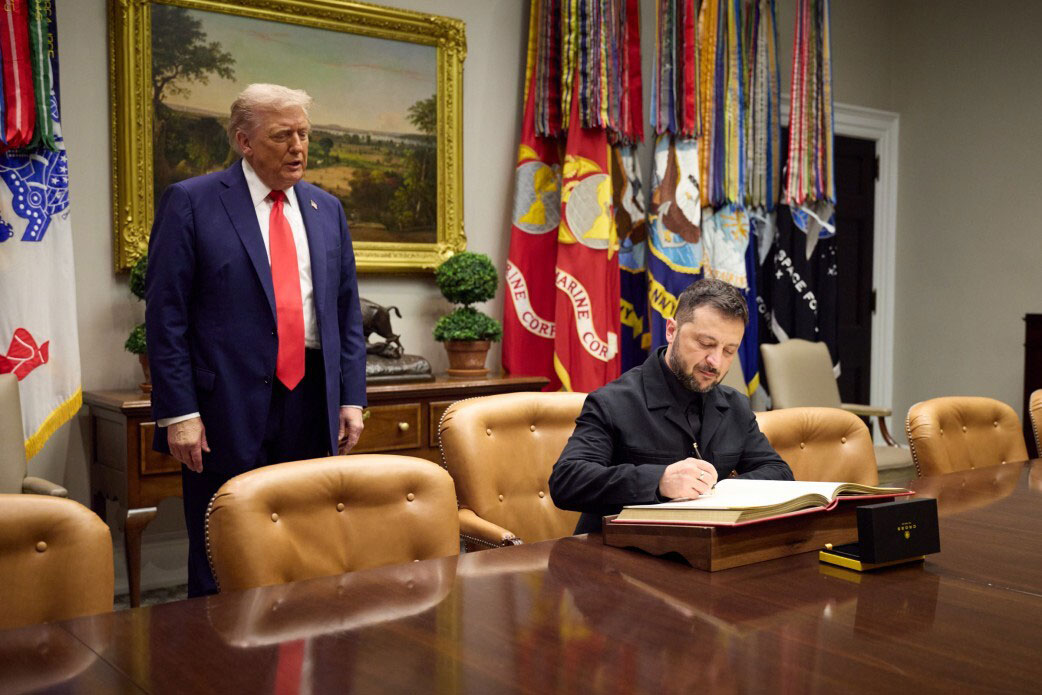
Zelensky signs the guest book following his meeting with Trump in Washington, August 19, 2025 (Getty) The question for Europe is stark: what will they do if and when Ukraine refuses to submit? If Trump is fine about surrendering the remainder of Donbas, we can be sure that he’s not likely to take a stand against Putin over such details as statues of Pushkin or the rights of the suppressed Russian Church (a major grievance for religious-minded MAGA supporters).
J.D. Vance has made his position on Europe clear. “This is your neck of the woods… you guys have got to step up and take a bigger role in this thing,” the Vice President said earlier this month. “If you care so much about this conflict you should be willing to [fund] this war yourself.” The US, for its part, “wants to bring about a peaceful settlement to this thing, we want to stop the killing,” he added. Trump has repeatedly promised to do his best to play the peacemaker. But if the Ukrainians and their allies don’t wish to agree, Washington will walk away. “Keep fighting,” wrote Trump last week. “Good luck.”
The brutal truth is that for the past three years the Europeans have been lying to Ukraine and themselves. In the spring of 2022, Europe, led by Boris Johnson, encouraged Zelensky to fight on and promised Ukraine “as much support as they need for as long as they need it.” Ukraine kept its part of the bargain, and with the help of hundreds of billions in military and financial aid pushed Putin’s far larger army back from over half of the territory it once occupied.
That’s an extraordinary achievement. But it hasn’t been enough to win. And by this point many of Kyiv’s most passionate defenders in Europe are starting to acknowledge that there is little military or political point in fighting on. Others, like the Baltic nations, disagree.
For those allies who believe that it’s time to call it a day, the main point that remains to be decided is how Ukraine’s reduced new borders can be protected in a way that Putin will not dare to challenge. Starmer and Emmanuel Macron’s idea of putting NATO boots on the ground is foolish and misunderstands that the basis of Putin’s paranoid logic in starting the war was to avoid precisely that outcome.
The “NATO Article 5-like” security guarantees of which Italy’s Giorgia Meloni spoke in Washington this week (albeit accompanied by extravagant air quotes) sound formidable. The problem is that security guarantees have to be credible to work. And will Putin believe that Starmer or Macron will send their voters’ sons to fight over Donbas, when they have already said that their proposed minuscule peacekeeping force will be “backstopped” by US air power?
Of more practical use is a proposal to create a network of air defences made of Patriot batteries and drones along the length of Ukraine’s border, funded by Europe. That’s what Ukraine’s reported offer to buy $100 billion in US weaponry is about, and includes a staggering $50 billion to develop new-generation drones in partnership with the world’s biggest experts in Ukraine itself.
Ben Wallace, the former UK defense secretary, has called Trump the “appeaser-in-chief” and warned that the peace process could be “another Munich 1938,” when independent Czechoslovakia was sacrificed to Hitlerite aggression. But that is a bad analogy. At Munich, Sir Neville Chamberlain failed to avert war. Today’s Ukraine, with western help, has failed to win a war. But neither have they lost. Instead, like Finland in 1941, they have heroically fought a much stronger adversary to a halt and saved 80 percent of their country and now face a bloody, attritional stalemate.
Putin would like nothing more than for Europe to encourage Ukraine to fight on, and to lose even more of their land and independence. The question Ukraine’s friends must ask themselves today is whether it’s time to choose an unjust peace over a righteous but never-ending war.
-
Trump must not make concessions to North Korea
When dealing with rogue states, being pessimistic often means being realistic. The much-anticipated summit between Donald Trump and Vladimir Putin last week allowed the Russian leader to relish the bright Alaskan lights of summitry with Trump, buy the precious commodity of time, all while maintaining his ambition to defeat Ukraine. Amidst this week’s numerous meetings between Trump and Volodymyr Zelenskyy, a resolution to the Ukraine war remains elusive. But we must not forget that hours before Trump and Putin met in Alaska, another high-level meeting took place in Pyongyang between Kim Jong Un and the Chairman of Russia’s state Duma. It was a stark reminder that ending the Ukraine war on the battlefield is not going to end the ties between Pyongyang and Moscow.
The date of August 15 2025 now holds significance for the trajectory of the Ukraine war, but whether it marks the start of a drawn-out process of negotiations between Moscow, Washington, and Kyiv or continued lip service from Putin remains to be seen. Yet for different reasons, August 15 is also a day of commemoration on the Korean Peninsula, signifying the liberation of Korea from Japanese colonial rule as the second world war neared its conclusion. Unusually, it is one of the only public holidays celebrated across both sides of the Demilitarised Zone.
For North Korea, the occasion is a moment to chastise the once-imperial power of Japan, and – on some but not all years – host military parades in Pyongyang’s Kim Il Sung Square. After all, according to North Korea’s false narrative, Kim Il Sung led an anti-Japanese guerrilla movement all by himself in the 1930s. In South Korea, August 15 marks the day the country became a separate state to the communist North in 1948 and often witnesses the South Korean president outlining their vision for inter-Korean relations and, of course, their relations with Japan.
Hours before Trump and Putin were to meet, the visit by yet another confidante of Putin to Pyongyang only stressed how the Ukraine war is not over and any deal acceptable to all sides is a long way off. It was not just Trump who would roll out the red carpet for Putin. Kim Jong Un would do the same to Vyacheslav Volodin, who would later deliver a letter to the North Korean leader from Putin himself, thanking him for North Korea’s military support in his fight against Ukraine.
This week’s meetings between Trump, Zelenskyy, and European Union leaders make clear that whilst the interests most directly at stake in the war remain those of Kyiv, Moscow, and Washington, there are other parties. The escalating North Korea-Russia relationship – which Kim Jong Un once again described as “invincible” – has meant that South Korea is no longer a peripheral observer to the war. With military and missile technology likely heading from Moscow to Pyongyang – which will be relished by North Korea in helping to develop its nuclear and missile capabilities – a swift conclusion to the war is firmly in Seoul’s interests. Yet, although South Korea has supplied tanks, howitzers, and FA-50 fighter jets to Poland, which subsequently transfers the arms to Ukraine, Seoul remains reluctant to supply lethal assistance directly.
Giving Pyongyang benefits will only lead to further abuse, a logic which can also apply to Russia
Just over a week after having met Putin, Zelenskyy, and Western leaders, Trump will host South Korea’s leftist President Lee Jae-myung in Washington on August 25 for the first summit between the two leaders. Whilst the infamous tariffs – which negotiations between Seoul and Washington have reduced to 15 percent – will dominate talks, another topic of discussion will be the US-South Korean alliance amidst Trump’s calls for South Korea to pay more for the US’s extended deterrence and security guarantee.
How to deal with the intractable issue of North Korea will also likely feature at a time when left-wing Lee has proclaimed that South Korea does not seek to “absorb” the North and wishes to “usher in a new era of peace on the Korean Peninsula.” Speaking of peace on the Korean Peninsula is all well and good, but akin to the case of Russia, Seoul must not underestimate Pyongyang’s penchant and strategy for continued delinquency.
For all Trump’s intentions to meet Kim Jong Un and Lee’s calls for reconciliation and dialogue with Seoul’s northern neighbor, Seoul and Washington must make clear how the world cannot give Kim Jong Un what he wants, namely international recognition of North Korea as a nuclear-armed state. The easy way to convince North Korea to improve its behavior may be to ease sanctions, but Seoul and Washington must resist this time-old urge. Giving Pyongyang benefits will only lead to further abuse, a logic which can also apply to Russia. There is no such thing as a free lunch.
As global eyes were fixed on Alaska, Kim Jong Un lauded the “friendship and unity” between North Korean and Russian soldiers in the ongoing fight against “a mutual enemy.” Identifying this undefined mutual enemy, however, was no Sisyphean task: it was not just Ukraine or the United States but also the broader West. For as long as we must wait for the next Trump-Putin or Trump-Kim meeting – in Moscow or elsewhere – Russia and its allies will not relent in forging a “coalition of the willing,” united in their opposition of the United States, its allies, and its leadership of international order. For this reason, the West cannot capitulate.
-
The Alaska summit went much as expected
The summit between Presidents Donald Trump and Vladimir Putin ended predictably, without a ceasefire deal or, it seems, assent on much else. Trump said “Many points were agreed to, and there are just a very few that are left,” but failed to offer any details. Even if true, the leftovers are critical, and the gulf between the two governments on the war remains huge. Critically, Putin cares more about security than image or economics, and understandably believes that he would lose leverage by agreeing to halt military operations before winning the concessions he demands from Ukraine.
Nevertheless, the summit improved, however slightly, the prospects for negotiating an end to the war. With Moscow on the offensive, a peace that preserves Ukrainian sovereignty and independence requires that Kyiv talk with the Putin government. Diplomacy has stirred, however ineptly. Necessary now is getting Ukraine and Russia to negotiate, while encouraging both to be realistic. To end a conflict that is costing both sides dearly, Kyiv will have to lose territory and endure neutrality, while Moscow should accept a Ukraine that leans West politically and economically, though not militarily. Since battlefield success may have emboldened Putin, Trump should use the prospect of improving political relations and economic dealings with the West in an attempt to pull Moscow toward a compromise capable of delivering a stable peace.
-
Trump, Putin, and the hidden power of the Bering Strait
Ahead of the Trump-Putin summit in Alaska to discuss Ukraine, President Trump said there would be “some land swapping.” He waxed lyrical about “prime real estate.” The summit’s location is a good example of land swaps and prime real estate and is in a region of growing geopolitical importance.
In 1867 Russia “swapped” Alaska for $7.2 million in a deal mocked as Seward’s Folly after Secretary of State William H. Seward who negotiated the exchange. It turned out to be a snip. Commercially viable oil was discovered three decades later and has brought in more than $180 billion in revenue since Alaska became a state in 1959.
However, it’s not just the 49th state’s oil (and gas) which makes it so important, it’s the maxim which is so close to prime real estate agent’s hearts – “location, location, location.” Alaska sits on one side of the Bering Strait which separates the US from Russia. The Strait connects regions each country considers vital for trade and security – the North Pacific, and the Arctic.
Strategic thinking in Moscow increasingly views the entire Arctic coastline as a continuous domain stretching from Norway, across the top of Russia, and then down through the Bering Strait. The route links Russia’s Northern Fleet, based in Murmansk on the Arctic, to one of the main bases of its Pacific Fleet in Kamchatka. This is the Northern Sea Route, or NSR.
The Arctic Ocean has begun to thaw seasonally, a trend expected to continue. This means the NSR is already navigable for cargo ships for at least three months a year without needing icebreakers. Ships taking this route from Asia to Europe can sail 5,000 fewer miles than via the Strait of Malacca and Suez Canal. Journey times are cut by at least ten days with concurrent savings in costs. The savings (including insurance) are even bigger if compared with the path around Cape Horn in Africa which some vessels now take due to the Houthis firing at ships in the Red Sea en route to Suez.
Russia charges vessels a tariff in parts of the NSR’s waters, all of which are within its Exclusive Economic Zone. Over the next few decades this source of revenue will increase concomitant with more frequent use, while Egypt will see a decline in fees for the Canal. The melting ice caps, and new shipping route, also make the Arctic’s untapped deposits of rare earth minerals, oil, and gas more accessible. The eight Arctic countries all hope to benefit from this but others, notably China, are also involved.
These are the reasons why more than a decade ago Russia began re-establishing its military power in the Arctic. It has reopened bases mothballed at the end of the Cold War and invested in new airfields, radar stations, and infantry equipped with “Arctic-proof” drones built to withstand the climate.
The Strait connects regions each country considers vital for trade and security – the North Pacific, and the Arctic
This has drawn attention back to what was thought of as a conceptual relic of the Cold War – the Greenland-Iceland-UK (GIUK) Gap. This gateway to the Atlantic consists of the sea lanes the Russian Navy would need to pass through to strike targets in Europe or the Northeast American seaboard – hence President Trump’s interest in Greenland. The world’s largest island is the shortest route to the eastern parts of the US for Russian submarines and missiles. Controlling Greenland would allow the building of more radar stations and missile defense systems in addition to the Pituffik base which is home to part of US Space Force. It would also allow access to Greenland’s huge supplies of cobalt, uranium and lithium – metals upon which the Americans are overreliant on China.
It is to be hoped that President Trump knows some of this history and geography because the fate of Ukraine is connected to what happens in regions listed above. A victorious Russia would embolden Putin to continue pushing out in all directions – towards Moldova, the Baltics, Kazakhstan, and possibly even the Bering Strait.
The “Baker-Shevardnadze Line” across the Strait was agreed between the USSR and US in 1990. However, although Russia and the US later agreed that it marks their maritime border Russia never ratified the deal and said it would only observe it on a temporary basis. Moscow is no position to seriously contest the line, or passage through the Strait, but may do in the future especially if it wins in Ukraine. There are even nationalist voices in Russia claiming Alaska is Russian and that the country was cheated out of its ownership.
However, Seward’s Folly is now a fully integrated part of the US, its economy, and its defense strategy, as reflected in the air bases and ballistic missile defense systems located in a state which is closer to Moscow than Washington, DC. As well as being keenly aware of the above, the US looks southward. So does Russia.
The Aleutian Islands, for example, are part of Alaska and host some of America’s missile defense system. The chain stretches 1,000 miles across the southern part of the Bering Strait towards Russia’s Kamchatka Peninsula – home to Russia’s Pacific Fleet submarines and long-range fighter jets. Further south is the Fleet’s main base in Vladivostok. Everything is connected, and the gateway to the Arctic is the Strait.
It’s importance waxes and wanes, 56 million years ago the region was tropical. It’s heating up again, in many ways.
-

What will happen in Alaska?
“Alaska,” said the mountaineer Jon Krakauer, “is a place that constantly reminds you of just how small you are in the grand scheme of things.” I doubt somehow that Vladimir Putin and Donald Trump will echo that sentiment when they meet tomorrow in the Last Frontier to carve up the future between themselves – Plumb-Pudding-in-Danger-style. The two leaders will have each traveled some eight hours over their own mighty lands to see each other. It will be a case of today, Ukraine; tomorrow, ze world.
Yesterday, the Trump administration went to great lengths to assure nervous European leaders and Ukrainian President Volodymyr Zelensky that Trump would not, in their absence, simply roll over for Putin. There would be “severe consequences” for Russia, said America’s Commander-in-Chief at the Kennedy Center Wednesday morning, if Moscow did not agree to a ceasefire in Ukraine. Trump wants his meeting with Putin to “lay the table” for a trilateral with Zelensky.
Zelensky had said that “substantive and productive talks about us, without us, will not work.” So Trump struck an unusually humble note. He said that if tomorrow’s summit “goes OK, we’ll have a quick second one… between President Putin and President Zelensky and myself, if they’d like to have me there.”
But in European capitals, and among the Atlanticist foreign-policy blob, the anxiety about the Trump-Putin summit goes beyond the possibility of disadvantageous land swaps in the Donbas. The fear is that Putin will cannily offer Trump some groundbreaking energy-and-investment deal, some ice-breaking Arctic Accord that resets US-Russia relations on a better footing. It’s worth noting that Putin will be accompanied by his special envoy Kirill Dmitriev, the head of Russia’s sovereign wealth fund, so we can perhaps expect talk of trillion-dollar schemes to bring the two great nations together.
Aleksandr Dugin, Putin’s right-wing philosopher, who lost his daughter to a car bomb in 2022, said yesterday on X: “The real success of Alaska will be if Trump and Putin don’t mention Ukraine at all. There are so many other important issues.”
Dugin, who sees Russia’s role in the world as being the defender of Christian values against Satanic forces, added that the “Deep State” – by which he means the forces of western liberal internationalism – “now controls Trump too openly and too brutally. But Trump doesn’t like to be controlled. So Alaska is the opportunity to restore the balance.”
This is almost certainly how Putin will approach tomorrow’s negotiations. He will praise Trump for being strong enough to resist the NATO warmongers in his midst and bold enough to begin a new divinely ordained alliance between “Daddy Trump” and Mother Russia.
It is, of course, wildly unrealistic to expect Trump and Putin to not mention Ukraine. Trump wants the three-way meeting in order to make good on his campaign promise to achieve peace. How on Earth that might work is another matter. The Times of London yesterday reported that the compromise on offer was for a Russian-style occupation of Ukrainian land modeled on Israel’s occupation of the West Bank (because, er, look at how happily that region is getting along). The White House said the Times’s scoop was “total fake news and sloppy reporting… Nothing of the sort was discussed with anyone at any point.” Clearly, however, Trump’s special envoy Steve Witkoff, who visited Moscow last week, agreed something with Russian officials before the Alaska summit was announced. The question for tomorrow is: will we find out what?
-
Zelensky must give way
Is Volodymyr Zelensky becoming a liability for the West and for his own country? We are entitled at least to pose this question as we (I mean America and Europe) are funding this war.
I ask because it is clear, and for years has been clear, that the conflict with Russia must end in a compromise, and the shape of that compromise should not be in doubt. Russia must be given a ladder to climb down and this must involve land. Ukraine must gain what from the start has been the great prize that Moscow has tried to deny it: an unshakeable place in the community of European democracies, with the military and economic guarantees from the West that make that place secure.
It was the then-British Prime Minister Boris Johnson who first framed the idiotic boast that now threatens to block progress towards such a settlement. “Not an inch!” he cried, to Ukrainian cheers, when he was prime minister. Perhaps he thought this was just the kind of thing you say for an easy headline and the whoops of the groundlings; but even he must have doubted that Russia could realistically be driven from everything it had gained, and Vladimir Putin be forced to grovel. Too many Western minds, I think, have been prey to the illusion that the second world war was a template for future conflict, and Hitler a template for Putin. Most wars, however, end in messy compromises, and that is how this one must end too.
Let me start with the issue of land. It would be stupid for a generalist columnist like me to feign the knowledge that will be needed once negotiations over new borders begin, but I will volunteer this: Crimea (it can at least be argued) is not historically part of Ukraine and only got tacked onto Ukraine when the Soviet Union had both of them among its many countries and regions. I spent time in Ukraine last year, choosing to talk not to soldiers, generals or politicians, but to the under-25s. If you seek the point on the dial when many younger Ukrainians’ refusal to contemplate ceding territory begins to waver, that place is Crimea.
The fact is that neither side seems capable of winning, so let’s park the sermonizing and look for the compromise in which so many wars – just wars as well as unjust ones – have always ended
Despite official assurances from Ukraine that most citizens are against a land-for-peace deal, other polls (and my own conversations) suggest that people don’t have principled objections to any ceding of land so much as serious doubts about whether Putin could ever be trusted to keep his word once a land-for-peace deal had been signed.
That then – the security side of the agreement which I suggested at the beginning of this column – is absolutely the nub of the entire settlement. I’m in no doubt that if the Ukrainian people could be convinced the settlement would be permanent, and backed to the hilt by the West, they would vote tomorrow for a treaty that gave Russia permanent possession of some of what it has already taken.
Let me anticipate at this point some readers’ objections. Firstly this: “Nothing agreed with Putin can he be relied upon to honor.” The trouble with this objection is that it is too strong. It means that even if he could be driven back to the old frontiers, and surrendered, he would try again later. I reply that he well might: that is why the security guarantees for Ukraine remain key.
Secondly this: “We must never reward Putin’s aggression.” I’m afraid that, ever since wars began, aggression has often been rewarded. This one, in which incalculable numbers of lives on both sides have already been lost, and if it continues many more will be, must not be accorded the status of a moral lesson for the ages. The fact is that neither side seems capable of winning, so let’s park the sermonizing and look for the compromise in which so many wars – just wars as well as unjust ones – have always ended.
And finally this: “We owe it to the Ukrainian military dead, brave men and women whose lives were sacrificed for their country, not to settle for less than victory.” Well, if so, does Russia not owe it to the greater numbers of Russian military dead whose lives were sacrificed for their country too? What do we owe the American or British dead whose sacrifice in Afghanistan was also for a noble cause? This logic, applying as it must to both sides of any conflict, leads only to madness.
None of us should be at all confident that Putin is ready to deal. I suspect otherwise. The greater likelihood is that in any negotiations he will fall back on Moscow’s insistence that “the root causes” of this conflict must be tackled. By this he means Ukraine’s departure from the orbit of the Russian Federation. That is why security, not land, is what may prove the sticking point this time, because Ukraine’s departure from Moscow’s orbit must indeed be made secure.
But if not this summer or this year, then next summer and next year, when the West’s military support for Ukraine does not waver, and Moscow grows weary, this – security – must be at the heart of any negotiations. And those guarantees are up to us.
Which brings me back to Zelensky. Who can blame him? Perhaps years of war, years of acute personal tension, years of sticking doggedly to your guns, years in the eye of the storm when your whole country’s future rests on your shoulders, jam the flexibility of mind needed, not to fight but to deal. But there’s a real danger now that Zelensky’s apparent stubbornness over this “not an inch” business may so infuriate a temperamental US President that American (and with it European) resolve begins to fray.
Zelensky should not be digging in his heels on the question of land, and European nations should not be encouraging him to. Europe probably can’t save Ukraine without the Americans, and the Americans won’t save Ukraine unless there’s movement on conceding land.
The Ukrainian President must get off his high horse, and Europe should stop indulging his intransigence. It’s as simple as that.
-

What Alaska means to Putin
From the Kremlin’s point of view, holding a US-Russia summit in Anchorage, Alaska is an idea of fiendish brilliance. The venue itself determines the agenda. Literally half a world away from the petty concerns of the European continent, Donald Trump and Vladimir Putin can flex the vastness of their respective countries. Anchorage is an eight-hour flight from Washington D.C. and roughly the same distance from Moscow, flying over no other country but Russia for most of the way. By traveling to the point where their countries almost touch in the North Pacific, both leaders can feel justified in prioritizing issues that concern just the two of them, from arms control treaties to space cooperation to Arctic mineral rights. Seen from Anchorage, Ukraine seems a very distant and very local problem.
The summit is the brainchild of Yuri Ushakov, a veteran diplomat who joined the USSR’s foreign ministry in 1970. Ushakov is a wily old attack dog who learned the ways of Washington during a decade-long stint as Russian ambassador from 1998 to 2008. And in suggesting Alaska as a meeting point, Ushakov clearly knows how to flatter not only Trump’s ego but also his own President’s obsession with history.
For Putin, Russia’s conquest of northeast Asia and much of the coast of America’s Pacific Northwest is the founding myth of his country’s modern greatness. In the 16th century Muscovy and Spain had both defeated Muslim occupiers and began expanding into rich new worlds east and west – in Spain’s case, gold-rich America; in Muscovy’s, fur-rich Siberia. Spanish conquistadors and Russian Cossacks reached the Pacific from different sides and started settling colonies along the coasts. In 1776, the Spanish Crown ordered the foundation of San Francisco – in the form of a Franciscan Mission and garrisoned Presidio – in direct response to news that Catherine the Great had started assembling a major Russian fleet to grab the unclaimed territory of northern California. In the event, Catherine’s fleet was redeployed to fight a war with the Swedes, leaving most of California to the Spanish. Who was to say who was the more logical ruler of America’s north-west coast, distant Madrid or distant St Petersburg?
For Putin, Russia’s conquest of northeast Asia and much of the coast of America’s Pacific Northwest is the founding myth of his country’s modern greatness
From 1816 until 1842 the southernmost frontier of the Russian empire was 70 miles north of San Francisco at Fort Ross on the Russian River (hence the name). For a brief period in the early 19th century Russia had a colony on Kaua’i island in Hawaii. And until 1867 the modern state of Alaska with its 6,500-mile coastline was known as Russian America and was a possession of the czar’s.
In the wake of the Crimean War, during which a Royal Navy force bombarded and briefly occupied the port of Petropavlovsk on Kamchatka, Czar Alexander II realized he lacked the naval power to maintain control of his American colonies. He first offered Russian America to the British prime minister Lord Palmerston for the eminently logical reason that the territory was contiguous with British Columbia. Palmerston, however, was uninterested in acquiring half a million square miles of mostly unexplored North American wilderness. The only other plausible buyer was the US. But it took two years, and the distribution of tens of thousands of dollars in bribes to congressmen, for the Russians to persuade a reluctant secretary of state, William Seward, to write a cheque for $7.2 million for the Alaska Purchase – mocked at the time as “Seward’s Folly.”
Even today, Alaska still bears the stamp of its century and a half as part of the Russian empire. A third of Alaska’s population is Native American (by far the largest proportion of any US state) and most of the Aleut and Tlingit peoples still adhere to the Russian Orthodox faith. The major feature of every coastal town from Sitka to Kodiak is a distinctively Russian church, and there are communities of black-robed monks on out-lying islands – though most are Americans and their services are in English. Colonial echoes of Britain, France and Spain are commonplace in other countries, whether Anglican worshippers in Simla, French baguettes in Saigon or Spanish missions in California. Living echoes of a vanished Russian empire are much rarer and exist mostly in Alaska.
It is clearly flattering and heartwarming for Putin to meet his American counterpart on what was once Russian territory. Some more excitable western commentators have claimed that hosting a summit in Anchorage encourages Putin’s neo-imperial ambitions – including, supposedly, reclaiming the American lands sold by Alexander II. But the idea that “Alaska Nash” (Alaska is Ours) is anything other than a Russian pub joke is absurd. A roadside billboard bearing that slogan and featuring a map of Russia including all of Alaska has been doing the rounds of Twitter as supposed evidence of Putin’s revanchism. In fact it’s just a jokey advertisement for a real estate company called Alaska.
Rather than dog-whistling Russian imperialism, the location allows Putin to appeal to a bygone age of Russian-American cooperation where the two nations divided up large swaths of the world. The most recent example is, to Putin’s mind, the Yalta conference of February 1945 where Stalin, Roosevelt and Churchill pored over maps and divided spheres of influence in the crumbling Nazi empire. A similar carve-up of Ukrainian territory is exactly what Volodymyr Zelensky fears and he has spent the week since the summit was announced gathering European support to insist that no deal can be done over the heads of the Ukrainians.
Unfortunately for Kyiv, and for the Europeans, they’re not invited. It’s also highly likely that even if Putin and Trump reach some kind of a deal on a ceasefire, it will be largely on Russia’s terms. But it’s also possible that Moscow and Washington could agree on other, non-Ukraine related issues, such as getting Putin back on board with the New START treaty limiting the number of deployed nuclear weapons – the kind of deal that nuclear superpowers make between each other. And there is nothing that both Putin and Trump enjoy more than playing the role of imperial presidents.
-

Trump’s plan to smash the BRICS
Donald Trump has never lacked confidence. “I’m here to get the thing over with,” he said last week when announcing the meeting with Vladimir Putin. “President Putin, I believe, wants to see peace. And Zelensky wants to see peace. Now, President Zelensky has to get… everything he needs, because he’s going to have to get ready to sign something.”
To many, that sounded like a variation on Trump’s much repeated election claim that he would end the Ukraine war in 24 hours: a grandiose statement that will probably bear little if any fruit this week. Indeed, the smart money is on the Alaska summit resulting in claims of a “historic breakthrough,” which will change little on the front lines.
One of the challenges when assessing Trump’s administration has been how to separate the signal from the noise. The President’s personality and his stream of consciousness comments often give the impression of a man operating on instincts. Trump’s transactional instincts, though, made him think Putin would behave in a logical way – that the Russian leader would welcome the chance of a reset to calm an overheating economy, move Moscow away from the horrors of an estimated million men killed or wounded, and bring Russia back into the family of nations.
The fact that, until now, Putin has rejected Trump’s overtures is revealing about the former’s view of the strength of his hand – as well as a misreading of his opposite number, something that is regularly reinforced in the Russian media’s lampooning of Trump.
The President may have taken his time to play his cards, but he’s chosen a good time to play them – and not only in the case of Russia. The Alaska summit isn’t just about Ukraine: it’s a key point in an elaborate, even existential game of geopolitical chess that will define the coming decade, if not longer. It’s about Trump vs BRICS (Brazil, Russia, India, China and South Africa).
Few paid much attention when the foreign ministers of Brazil, Russia, India and China first met on the sidelines of the UN General Assembly in New York in 2006, at the first summit in Yekaterinburg in Russia three years later, or when South Africa joined in 2010 to form the BRICS grouping. This has subsequently expanded to ten full members, with Egypt, Ethiopia, Iran and the United Arab Emirates joining as full members last year and Indonesia joining in January.
BRICS represent half the world’s population and 40 percent of its GDP in terms of purchasing power
Taken as a group, BRICS represent around half the world’s population and some 40 percent of its GDP in terms of purchasing power parity. Although the aims and ambitions of its members diverge on many topics – including on what BRICS can and should do – the underlying theme is that global economic power needs to be passed from the West to the developing world, and that, as a result, a more balanced global order will emerge.
Trump has had the BRICS group in his sights for a while – especially the possibility that they might act to create an alternative to the US dollar. Soon after last year’s election, he declared: “We require a commitment from these countries that they will neither create a new BRICS currency nor back any other currency to replace the mighty US dollar, or they will face 100 percent tariffs and should expect to say goodbye to selling into the wonderful US economy.” For BRICS to succeed, he said, they would need to “go find another sucker.”
Trump has repeatedly returned to the BRICS problem. “BRICS was put there for a bad purpose,” he said earlier this year, shortly before meeting Indian Prime Minister Narendra Modi. Indeed, the BRICS bloc provides, if not all, then at least a major part of the framework through which Trump’s economic policy has been constructed. Just last month, he said that tariffs would apply not only to the BRICS countries, but to any that align with what he called their “anti-American policies.” He spoke about BRICS again soon after, saying that if the original members “ever really form in a meaningful way, it will end very quickly.” He added that the US “can never let anyone play games with us.”
It’s no coincidence, then, that the efforts to push Russia into a settlement in Ukraine are taking place now. Trump announced 50 percent tariffs against Brazil – something that led to President Lula da Silva, tellingly, to say he would confer with fellow BRICS members. Likewise, the President has said he will probably “send someone else” to the G20 meeting being held (for the first time) in South Africa because of that country’s “bad policies.”
The President ’s main concern is the group might act to create an alternative to the US dollar
Trump also knows that Russia’s economy is in a bad way. The US having used tariffs to squeeze Putin’s allies in BRICS, Moscow looks increasingly vulnerable. Indeed, recent economic news coming out of Russia is bad. Elvira Nabiullina, the governor of the central bank, warned in June: “We have adapted to some external challenges [but] now we are facing very turbulent times ahead.” Putin himself expressed that Russian officials not only had to be vigilant “not to allow stagnation or recession,” but also that it was crucial for Russia to “change the structure of our economy.”
Although interest rates have been trimmed back to 18 per cent, things continue to look bleak. More than 50 coal producers have either closed or are closing. Steel production among the largest producers is down by a fifth, year on year. The chief executive of Domodedovo airport, one of the busiest in Russia – and, before the war, in Europe – is close to bankruptcy.
Unseasonable frosts followed by extreme drought have had a dramatic impact on grain and food production, which have seen prices spike. The shortfalls compared with previous years are impacting Russia’s export economy and its foreign currency earnings.
This comes on top of concerted action by the European Union to move away from Russian natural resources. A decade ago, Russia’s trade with the EU totaled around $420 billion a year. With sanctions, that had plummeted to roughly $60 billion last year; it’s projected to shrink further to only $40 billion this year. Alexander Grushko, the deputy foreign minister, warned last month that trade with the EU – once a linchpin of Russia’s economy – could “fall to zero” if current trends continue.
Perhaps the best example to show the strain that Russia is under comes from seeing who sits behind its war economy. An estimated 40 percent of ammunition used on the front lines is supplied by North Korea – and significantly more in some places. Zvezda TV, a state-owned network run by the Russian defense ministry, has shown films of teenagers working in drone factories in Tatarstan, a region which has just seen the influx of a small army of industrial workers from North Korea – estimated to be 25,000-strong – to work as technicians, machinists and electronics assemblers.
For all of Moscow’s tough talk, the reality is that minds are more focused than they have been since the start of the invasion. That’s why substantial groundwork has been done over the past few weeks – and why there’s more to the Alaska meeting than a photo opportunity.
Trump’s push to get Russia to agree to a settlement – and the US’s efforts to encourage Kyiv to accept it – are part of a wider attempt to reshape the emerging multipolar new world order. Trump is not just gunning for Russia; he is trying to use US firepower against BRICS at the same time.
Of the BRICS grouping, India is one country that Trump has had in his sights for a while. In 2020, relations between Trump and Modi were unusually warm. India was “one of the most amazing nations,” Trump declared. Things were similarly sweet when Modi visited the White House in February. Just as Trump sought to Make America Great Again, Modi was seeking to Make India Great Again. “When America and India work together, this MAGA plus MIGA becomes a mega partnership for prosperity,” Modi said.
Trump has decided, however, to show that American power can focus minds. As India’s veteran external affairs minister S. Jaishankar put it, India sees its role as being to “engage America, manage China, cultivate Europe, reassure Russia, bring Japan into play, draw neighbors in, extend the neighborhood, and expand traditional constituencies of support.”
That sounds sensible; but balancing acts are tricky to pull off. Deep ties between Moscow and Delhi, which go back to before Indian independence and which remained strong during the Cold War, have been maintained since the fall of the Berlin Wall. India pointedly abstained from a vote at the UN to condemn Russia’s invasion of Ukraine in February 2022 and has abstained on subsequent occasions, too.
Apart from membership of BRICS, the heavy dependence on Russian military hardware – including the delivery of two warships built in Russian shipyards in recent months – and a formal agreement reached between the two countries at the end of 2023 to deepen collaboration, India has seen its trade with Russia boom in recent years.
Before the 2022 invasion of Ukraine, trade between the two countries stood at around $12 billion a year; by the end of 2023, it had quintupled to $65 billion. Much of that was through the purchase of discounted oil – a great deal of which has in turn been sold on to markets elsewhere. So great have volumes been that India has overtaken Saudi Arabia as the biggest supplier of oil to Europe – impressive given that India is only a modest producer in its own right.
That realisation is why Trump turned on Delhi last week, announcing a 50 percent tariff on Indian goods. India operates “strenuous and obnoxious trade barriers,” he said.
But it was the fact that Delhi is siding with Moscow that underpinned his change of pace. The Indian government doesn’t “care how many people in Ukraine are being killed by the Russian war machine,” Trump said. Russia and India “can take their dead economies down together, for all I care”. While officials in India said the US charges were “unfair, unjustified and unreasonable,” Trump used the opportunity to announce a new trade deal with Pakistan, adding that the US would help develop the latter’s “massive oil reserves,” and that perhaps one day Pakistan will be “selling oil to India”.
This is part of a coherent effort to use US economic and political power to frame the world of today and tomorrow. There is intention, in other words, behind the lining up of different pieces of the geopolitical jigsaw at a time when, as Xi Jinping told Putin: “There are changes, the likes of which we have not seen for 100 years.”
Trump is not just gunning for Russia; he is trying to use US firepower against BRICS at the same time
Together with China and their fellow BRICS members, Putin believes that Moscow is driving these changes. Trump feels that the US needs to stand in the way.
At a Senate hearing shortly before Trump’s inauguration, the Secretary of State-designate Marco Rubio made the telling claim that “the post-war global order is not just obsolete, it is now a weapon being used against us”. He reiterated this at Nato headquarters in Brussels a few weeks later. This is why it is so essential to “reset the global order of trade,” he said.
The view that we are in an age of existential competition is shared elsewhere. The influential Chinese scholar Liu Jianfei argues that not only is there a “great game” under way between rival superpowers, but this represents “a contest between national governance systems and the direction of global governance and international order.”
The Alaska summit is a key moment in that contest – perhaps even a turning point.
Of course, there’s a giant piece of the jigsaw missing here – and with good reason: China. The shadow-boxing between Trump and Xi is more nuanced, more intense and more evenly matched. That is where the battle over the global order goes next.
For now, the question will be whether Trump’s grand strategy to break up the emerging multipolar order has enough force behind it to deliver the results he is hoping for. Or whether it might in fact strengthen, rather than weaken, those countries who feel their time has come.
-

Beware the Nagasaki and Hiroshima revisionism
2025 is the 80th anniversary of the end of World War II, the most calamitous conflict in history. The victory over Nazism in Europe is universally fêted, but the triumph over Japanese militarism receives far less celebration. The atomic bombing of Japan, which forced unconditional surrender, has long been criticized by revisionist historians as unjust, unnecessary and morally depraved; that narrative has been absorbed as the truth of the matter.
Decades of liberal education have shifted opinions massively, with only 35 percent of Americans believing the bombings were justified as compared to 85 percent in 1945. Those younger than 50 oppose the bombings by significant margins. The revisionist case is promoted on every anniversary, but this year has seen even more, mostly from left-wing politicians and outlets.
Three of their oft-repeated claims deserve debunking. Contra the revisionists, Japan was nowhere near surrender, the plausible alternatives would have killed far more than the 200,000 who died in the atomic bombings and Hiroshima and Nagasaki were military targets.
In August 1945, the Japanese Empire had lost much of the territory it had conquered and faced direct assault on the homeland. Its commerce was devastated, its navy defeated and its cities under constant air raid. Enormous swathes of territory had been obliterated from the air, including more than half of Tokyo, which saw 100,000 civilians killed in a single night. America was closing the noose and would only be able to bring more firepower to bear. But Japan was not cowed; indeed, it repeatedly repudiated Allied proposals for capitulation on better terms than Germany received. Even after the atomic bombings, on August 6 in Hiroshima and August 9 in Nagasaki, the War Cabinet refused to accept unconditional surrender, with military leaders seeking control of war crimes trials, self-disarmament and no Allied occupation. When the Emperor reluctantly accepted surrender – something he was against until Hiroshima – thousands of soldiers attempted a coup d’état. Surrender was by no means guaranteed before the atomic bombings, and it was barely executed afterwards.
What of the other options? Could we merely demonstrate the bomb? Given that the Japanese refused to surrender after Hiroshima was actually destroyed, this is a farcical hypothetical.
The two serious alternative options – blockade/bombardment and invasion – would have killed far more civilians. Japan was on the verge of mass famine when the war ended; a tightened blockade combined with strategic bombing would have led to millions of starvation deaths, on top of those killed by bombing.
Invasion was just as bad. Japanese troops routinely fought to the death, with most battles leading to fatality rates of 95 percent or higher and immense civilian death. Taking Okinawa alone accounted for 17 percent of the total casualties the US Navy and Marines took over the entire war. The Home Islands would have been worse. American casualty estimates easily reached the hundreds of thousands and could have eclipsed one million. The Japanese toll would have been an order of magnitude higher. Japan’s war machine was killing 250,000 civilians a month; shortening the war saved far more lives than it took.
Revisionists falsely claim that the cities destroyed were purely civilian targets with minimal military value. Hiroshima was the most important military city left standing, hosting Army headquarters, materiel depots, war manufacturing and was a primary embarkation point for the invasion defense. It also had the highest proportion of combatants (43,000) to noncombatants (280,000) of any major Japanese city. Nagasaki contained the largest naval shipyard in Japan, hosted military barracks and would have been a defensive redoubt from which to defend against invasion.
Civilian deaths are obviously awful, but the reality of modern warfare is entirely different than that of World War II. There was no precision bombing. Total war made all military production – often co-located with Japanese civilians – a target. And given Japan’s suicidal defense strategy, there was little distinction between civilian and combatant. Japan started a total war. America finished it.
This particular revisionist narrative, like that of the 1619 Project, is ahistorical, shorn of critical context, and blatantly partisan. Worst of all, the revisionists commit the cardinal sin of history: presentism. Good history involves taking the past on its own terms, not applying current rubrics to historical events. The revisionists do this in spades, and all in service of a political project – in this case, undermining the moral claims of the West against our enemies. History definitively shows that this narrative is based on a foundation of falsehood. The decision to drop the atomic bombs was the correct one. It saved far more lives than it took. America was the moral actor then and it remains so now, revisionists be damned.