Category: International

  • Britain’s foreign secretary faces fine for fishing without a license

    What people on the other side of the pond call “Brand Britain” has taken something of a knock in recent years – especially in the United States, which the British often still view as an errant son. With unnerving speed Britain’s reputation has collapsed stateside, especially among the political right, from the country of Brideshead Revisited to a grotty Airstrip One. The symbol of the new Britain in the eyes of many Americans are the ubiquitous licenses (or, in the argot of a London copper, “loicenses”) that citizens seem to need for everything – including, most notoriously, owning a TV.

    Now even the Foreign Secretary has been caught without a loicense. On Friday David Lammy went fishing with the now-Vice President J.D. Vance, who is here for an extended visit, on the grounds of Chevening – the grace-and-favor country house granted to the incumbent Foreign Secretary. But there was a snag. It turns out that Mr. Lammy did not have a rod license – and fishing without one can incur a fine of up to £2,500 ($3,400). Not ideal for a country that’s looking to burnish its libertarian bona fides.

    Earlier this week, the State Department warned that the human rights situation in the UK had “worsened” amid some heavy-handed enforcement of the country’s laws on so-called hate speech. And last year the then-Senator J.D. Vance joked that the UK was the “first Islamist country with nuclear weapons.”

    British Prime Minister Keir Starmer has been keen to curry favor with the 47th President and so is determined to shake off the litigious image. He’s been saying all sorts of Whig, Macaulay-ite things about our national story that went out of style in the UK long ago. Magna Carta, the “Mother of Parliaments,” all the rest of it. All calculated to soothe the feelings of a stately fellow of the Heritage Foundation, for whom England is still the birthplace of constitutional government. “We have had free speech for a long time so, er, we’re very proud of that,” Starmer told reporters during Trump’s visit to Scotland last month.

    But this stratagem may have just hit a bump. Lammy has now referred himself to the Environment Agency, an independent watchdog that handles such matters. An act of nobility on a level with the heroes of the English Civil War, to be sure.

  • Essex-boy Elegy: J.D. Vance meets the Bosh man

    Vice President Vance is currently receiving visitors at an 18th-century Georgian manor in the Cotswolds, an implausibly quaint patch of the English countryside. Petitioners so far have included James Orr, the Cambridge academic and right-wing activist, Robert Jenrick, likely the next leader of Britain’s Tories, and Nigel Farage, likely the next UK Prime Minister.

    Also on the list was one Thomas Skinner, a gregarious wide boy from East London turned e-celebrity turned patriotic influencer. After a stint as a pillow and mattress merchant Skinner, 34, found fame as a contestant on the 15th series of the British version of The Apprentice. In 2022 he began posting videos on social media of himself gobbling down steaming platters of traditional English fare – pie, mash, bacon, beans, sausage, chips (fries), fried eggs, fried bread, black pudding – while extolling the virtues of family and hard work. Each homily would end with Skinner’s trademark catchphrase: “BOSH.”

    Skinner’s politics began to emerge. “I love Trump, I think he is brilliant, that’s my opinion. I think it’s good he is back in charge, it will be good for the UK economy,” he said in late 2024. Mayor Sadiq Khan had “ruined” London and militant eco-protesters were “ruining people’s lives.” Orr, who has emerged as a leading theorist of a newly-galvanized British right, took notice. Had they finally found their own Trump – or at the very least their own Archie Bunker? In June Skinner delivered a speech at Now and England, a conference organized by Orr, where he spoke of “kids being taught to be ashamed of their own flag.” The Vice President watched.

    Now the two netizens meet at last. Vance, a longtime online admirer, invited Skinner over for beers and a barbecue. Skinner relayed his experience with his usual brio:

    When the Vice President of the USA invites ya for a BBQ a beers, you say yes. Unreal night with JD and his friends n family. He was a proper gent. Lots of laughs and some fantastic food. A brilliant night, one to tell the grand kids about mate. Bosh❤️

    Here is a pic of Me and Vice President @JDVance towards the end of the night after a few beers 🍻 I’m overdressed in my suit, but when the VP invites you to a BBQ, you don’t risk turning up in shorts an flip-flops 😂 Cracking night in the beautiful English countryside with JD, his friends and family. Once in a lifetime. Bosh ❤️🇬🇧🇺🇸

    The encounter is another sign of the chaotic merger that’s being carried out between politics and the online world. Is Skinner a meme, or a politician? It’s increasingly difficult to disentangle the two.

  • How the Arctic could thaw US-Russia relations

    “It is in Alaska and in the Arctic that the economic interests of our countries converge and prospects for implementing large-scale mutually beneficial projects arise,” said Yuri Ushakov, Vladimir Putin’s long-time foreign policy adviser and former Russian ambassador to the United States, at a Friday press conference in Moscow. His words pointed to Arctic economic cooperation being firmly on the agenda when Donald Trump meets Vladimir Putin in Alaska on Friday. For Trump, a massively important commercial deal of this kind is his typical negotiating strategy. It’s the “Art of the Deal” – offer something big, lucrative and tangible, then leverage it to unlock political concessions. It’s the template Trump just used to broker a peace agreement between Rwanda and the Democratic Republic of Congo, where economic incentives were bound up with resolving a long-running security dispute.

    An Arctic agreement between the US and Russia could revive energy collaboration between the two countries on a breathtaking scale. A deal would be massively lucrative for both sides. The Arctic contains an estimated 13 per cent of the world’s undiscovered oil, roughly 90 billion barrels, and 30 per cent of its undiscovered natural gas. Russia controls around half of that, with explorers pointing to 2,300 million metric tons of oil and condensate, and 35,700 billion cubic meters of gas. It’s a bonanza tailor-made for Trump’s America First. Parlay US expertise and capital into these frozen assets and the pay-off would be staggering. The shipping upside is no less compelling. The Northern Sea Route offers the promise of slashing shipping times between Asia and Europe by up to 50 per cent. As melting ice slowly opens the Arctic lanes, that cut becomes ever more real: less fuel burned, no queueing at chokepoints, and avoidance of piracy hotspots. Pair that with a fleet of US oil champions and Arctic logistics savvy, and Trump suddenly holds a commercial deal that has the feel of an irresistible boardroom trophy.

    The US and Russia have been here before. In 2011 ExxonMobil struck a landmark deal with Russia’s Rosneft to explore and drill in the Russian Arctic, including the Kara Sea. It was a project worth tens of billions, giving Exxon access to vast untapped reserves and giving the Russians US technology and expertise. Drilling began, but the partnership was suspended in 2014 when western sanctions were imposed after Russia’s annexation of Crimea. Bringing it back to life, or using it as the template for new ventures, would be straightforward in commercial terms. The infrastructure, geological data and corporate relationships already exist. A revived Arctic partnership could go beyond oil and gas to include liquefied natural gas terminals, port upgrades, and joint development of the Northern Sea Route, binding the two economies together in one of the last great frontiers for energy extraction.

    There is no confirmation that the Arctic and Ukraine will be explicitly linked. Yet the logic is obvious enough and the hints coming from Moscow cannot be ignored. For Putin, the Arctic could be the sweetener that secures US agreement to a settlement on his terms in Ukraine. Moscow is unlikely to shift on the fundamentals: Crimea and the Donbas are written into Russia’s constitution as part of its territory. Any deal would lock in those gains, demand Ukraine’s demilitarisation and secure a buffer against Nato. Trump could claim an Arctic deal as a massive commercial win for the US and the end of a war which he insists was caused by Biden. Putin could gain Washington’s help in pushing Kyiv to accept the deal.

    Trump’s leverage is blunt. Kyiv’s very survival depends on American weapons and cash. By threatening to cut them off, Trump can force Zelensky to the table on terms Kyiv has long rejected. For Trump, this is straight from his negotiating playbook: create a crisis point, hold the most valuable card, and make sure everyone knows you are prepared to walk away. For Zelensky, the choice would be between accepting a peace agreement that leaves Ukraine truncated, or facing a war without US backing.

    Ukraine’s position is fragile. Its army is drained, its economy battered, and its war effort hinges on western aid. European and UK promises mean little without US firepower and financing. If Trump decides to pivot towards an Arctic bargain with Putin, Kyiv may need to fall in line or face the battlefield more or less alone. Zelensky can draw red lines, but without American support they’ll count for little.

    The EU and Britain would protest loudly, but they lack the leverage to block an American/Russian deal. Brussels, London, Paris and Berlin have all made clear that no settlement should be struck over Ukraine’s head, yet moral objections are no substitute for raw power. British, French and German support for Ukraine may not make much of a difference to the Russian advance if the war were to drag on without full US support.

    Kyiv would be furious about a deal on the Arctic linked to Ukraine. Zelensky has built his presidency on reclaiming occupied land and has vowed never to cede Crimea or the Donbas. A deal that locks in those losses would be denounced as a betrayal. London would echo the outrage, while Brussels would convene summits and issue condemnations. Yet despite the rhetoric, the Europeans would be powerless to change the outcome. The settlement would already be signed and control of US financing of the war firmly in Trump’s hands.

    Beyond the western alliance, the reaction would be far warmer. Much of the global south sees the war in Ukraine less as a clash over borders, and more as a drag on global trade and growth. For China, India and Brazil, an end to the war, even entirely on Russia’s terms, would be hailed as pragmatic diplomacy. Trump could present the Arctic bargain as proof that US-Russia cooperation can solve global problems, and this would help blunt criticism from Europe and the UK.

    The incentives for both Trump and Putin line up neatly. For Trump, it would be another Trump ‘deal’ in which commercial muscle underwrites a political settlement. Putin would keep his territorial gains and reopen the Arctic to US investment, and Ukraine would be left to make the best of a settlement it didn’t shape. Britain and the EU would be reduced to a role of bystanders.

  • How much of a say does Zelensky still have?

    Over 1,265 days of full-scale war, Volodymyr Zelensky has delivered almost as many nightly addresses to the nation. Only a handful have been truly decisive. There was one just hours before the invasion when he asked, “Do the Russians want war?” and vowed that Ukraine would defend itself. The next day, standing outside his office in Kyiv with his top officials, he told the world: “I’m here. We’re all here.” And last weekend, when he declared that Ukraine would not surrender its land to the occupier – and that the war must end with a just peace:

    “[Putin’s] only card is the ability to kill, and he is trying to sell the cessation of killings at the highest possible price. It is important that this does not mislead anyone. What is needed is not a pause in the killings, but a real, lasting peace. Not a ceasefire sometime in the future – months from now – but immediately. President Trump told me so, and I fully support it.”

    Zelensky has felt blindsided by Donald Trump’s decision to meet Vladimir Putin in Alaska this Friday to discuss Ukraine’s fate without Ukraine present. Putin has reportedly proposed a ceasefire – not an end to the war, but a temporary halt ahead of the next stage of talks – in exchange for Ukrainian territory. Ukrainian forces would have to withdraw from the entirety of the Donetsk region, leaving the 2,500 square miles – about a quarter of the region – that they still hold. 

    This includes fortress cities such as Pokrovsk, Kramatorsk and Sloviansk, the strongholds Russia can’t seize quickly. The Institute for the Study of War notes that while the Russian push towards Pokrovsk has picked up speed in recent weeks, Moscow has spent the last 18 months fighting for an area of just ten square miles. It took 26 months for Russian forces to advance seven miles from western Bakhmut to western Chasiv Yar. This battle began in April last year and ended only last week, with Russia bearing immense losses. Since January only, Putin has lost 100,000 troops, according to Nato chief Mark Rutte. 

    Accepting Putin’s offer would strip Ukraine of its main defensive line at the western edge of the Donetsk region, which it has fortified since 2014, leaving only open fields all the way to the Dnipro river. That is why Zelensky insists that any discussion of territory can only happen after the guns fall silent. The idea of Russia pulling back from parts of the Kherson and Zaporizhzhia regions in exchange for Donbas has been floated before, and this land swap could be agreed de facto but not de jure. But even that seems to be a fantasy at the moment, given that Putin will not give up his land corridor to Crimea, and Zelensky will not hand over hundreds of thousands of Ukrainians still living in the part of the Donetsk region under Kyiv’s control – people who oppose their homes being ceded to Russia.

    Zelensky insists that any discussion of territory can only happen after the guns fall silent

    Kyiv’s stance was backed this week in a joint statement by European leaders, whom Zelensky has been calling to forge a united negotiating position to present to Trump before Alaska. “Meaningful negotiations can only take place in the context of a ceasefire or reduction of hostilities,” it read. “We remain committed to the principle that international borders must not be changed by force. The current line of contact should be the starting point of negotiations.”

    With Europe behind him, Zelensky tried to appeal to Trump on Saturday. In his speech, Zelensky reminded the American president that Ukraine had backed all of Trump’s earlier proposals, including an unconditional ceasefire and talks with the Russians in Istanbul, even while Moscow stalled and bombed Ukrainian cities. No one, Zelensky said, doubts America’s power to end the war. The mere threat of secondary sanctions on Russia and its allies had been enough to drag Putin out of his bunker and into negotiations. “The President of the United States has the leverage and the determination,” Zelensky said, leaving hanging the question of why Trump is not using them.

    Ukrainians have seen where appeasing an aggressor leads. Putin was allowed to take Crimea, and that led to the occupation of parts of the Donetsk and Luhansk regions. No punishment followed when he massed over 100,000 troops on Ukraine’s borders – and that led to the full-scale war, further occupation and hundreds of thousands of deaths. 

    “Putin wants to exchange a pause in the war, in the killings, for the legalization of the occupation of our land,” Zelensky warned. “We will not allow this second attempt to partition Ukraine. Knowing Russia, where there is a second, there will be a third. That is why we stand firm on clear Ukrainian positions.”

    Finally, Zelensky turned to the Ukrainian people, many of whom were protesting outside his office just two weeks ago after the government attacked anti-corruption agencies, to thank them for standing with him. A new poll from the Kyiv International Institute of Sociology shows 76 per cent strongly oppose Russia’s proposed peace deal. If even half were in favour of peace at any price, Zelensky might have been tempted to respond differently to Putin’s offer. But as Ukrainians are afraid that without cast-iron security guarantees, Russia will start the war again, they expect their president to fight for a lasting peace. 

    “Independence is built on dignity,” Zelensky said. “Fear and concessions do not make nations safe. Russia’s desire to rule over Ukrainian territory will remain just that – a desire – for as long as Ukrainians stand shoulder to shoulder, helping the army and the state.”

  • A Trump-branded peace deal

    A Trump-branded peace deal

    Mount Ararat rises over Armenia’s capital, Yerevan, its peak often lost in clouds. It is the country’s national symbol, yet it stands across the border in Turkey. That border has been closed since the early 1990s, when Turkey sided with Azerbaijan against Armenia – cutting Armenia off from its largest western neighbor and leaving it dependent on narrow trade corridors through Georgia and Iran.

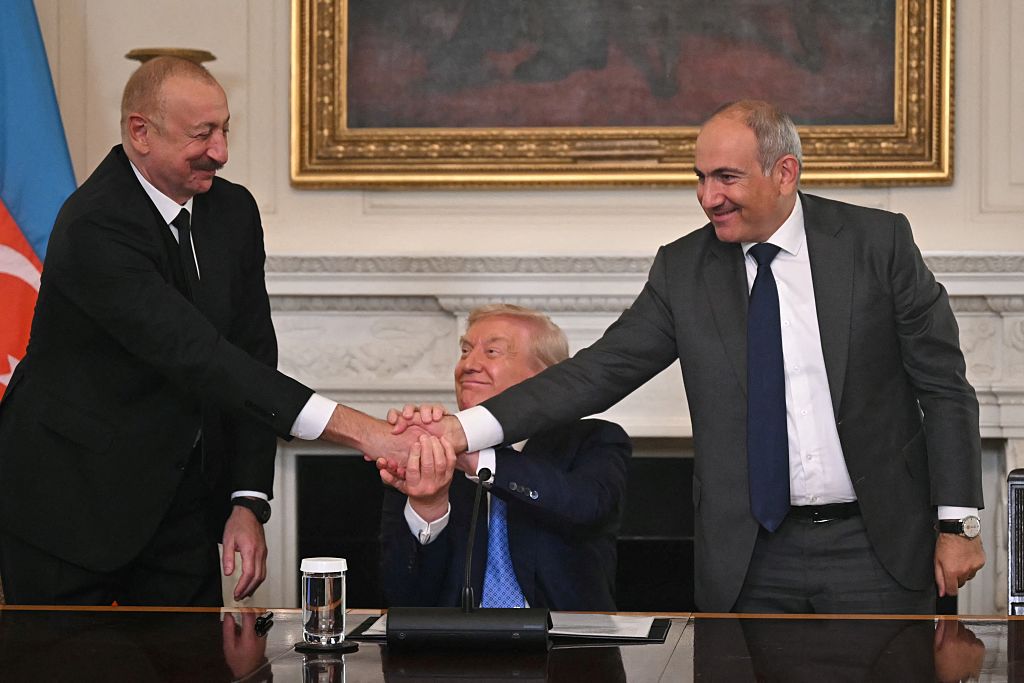
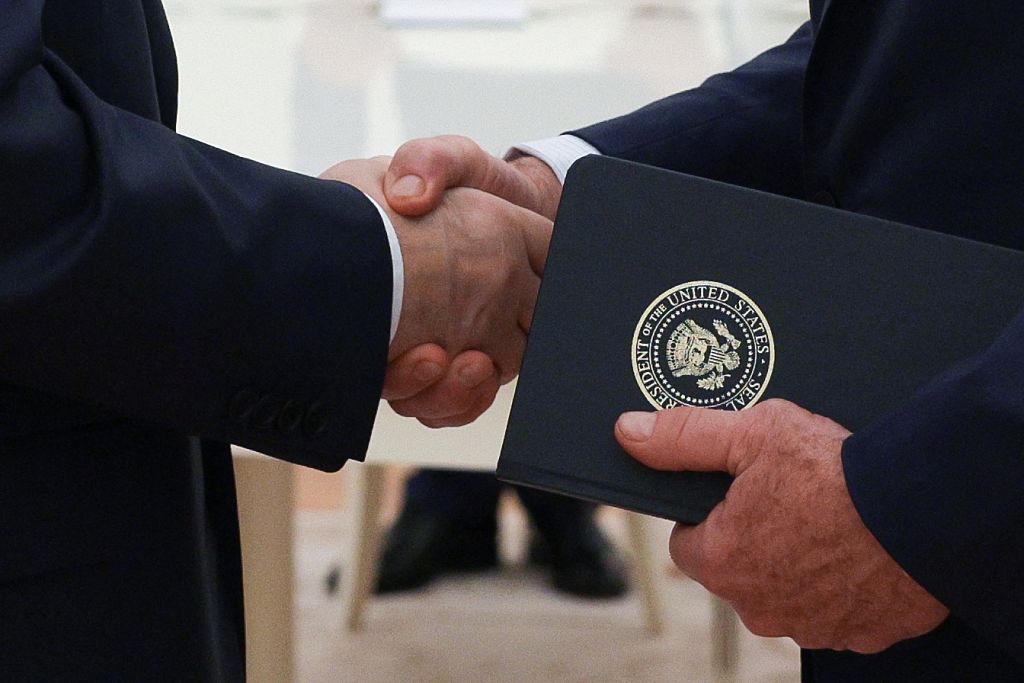
    For three decades, the conflict shaped the politics of the South Caucasus, drawing in Russia, Turkey and Iran. The peace agreement between Armenia and Azerbaijan, signed today in Washington, represents more than the end of a long-standing territorial dispute. It marks the return of American power in the region and one of the most significant strategic interventions since the Soviet collapse.

    The agreement negotiated by the Donald Trump administration establishes a transit corridor, to be known as the Trump Route for International Peace and Prosperity, or TRIPP, and links Azerbaijan, through Armenia, to Turkey. The United States will hold exclusive rights to operate the roughly 20-mile route under Armenian law, leasing it to a Western consortium for rail, pipeline and fiber-optic projects over a multi-decade term.

    It’s the first frozen conflict to be solved in the former Soviet Union in the last three decades. The historic agreement restores diplomatic, political and economic ties between the two countries. Trump announced that the United States had signed separate agreements with each country to expand cooperation in energy, trade and technology and the US is to deepen defense cooperation with Azerbaijan.

    The press conference that followed the signing on Friday was heavy on flattery for President Trump, of the sort Washington audiences have grown accustomed to, but with an extra layer of Caucasian courtliness. Both leaders on stage, veterans of a region where public praise is both an art form and a form of political currency, laid it on thick, saying they plan to send the Nobel committee a letter to award the president the peace prize. 

    The Trump administration has pushed through an agreement that will carry the President’s name, one he is certain to frame as a personal victory. It joins the Abraham Accords, which successfully normalized relations between Israel and several Arab states in 2020, among Trump’s most significant diplomatic achievements during the first term.

    While other initiatives, such as his bid to end the war in Ukraine or proposals to offer economic incentives to Palestinians in exchange for political concessions, have yet to bear fruit, the Armenia-Azerbaijan agreement delivers tangible benefits for both countries and advances US strategic interests in a region bordering Russia and Iran.

    The corridor gives the US a non-military but a strategic foothold in a transit hub linking Europe and Asia. It diversifies energy routes away from Moscow and China, offers US companies opportunities in infrastructure, and strengthens NATO’s southeastern flank.

    Yet it also carries risks. US interests are now tied to the stability of Armenia-Azerbaijan relationship, opening another theater for Moscow or Tehran to manipulate US engagement and test Washington’s resolve. A century ago, the British moved into Baku – the capital of Azerbaijan – for its oil, only to abandon it when the Bolsheviks arrived, handing the region to Moscow for the next hundred years. The danger is Washington letting it slip away just as quickly or risking greater involvement.

    The Zangezur corridor – or now Trump corridor – is a short strip of road that has long been a point of contention between Armenia and Azerbaijan. The signing caps months of talks in which US officials replaced Russia as the main mediator. This reversal of roles was shaped by Russia’s preoccupation in the war in Ukraine, Moscow refusal to side with its long-time ally Armenia and follows a US strike on Iranian nuclear facilities that demonstrated American power to the regional players.

    The Nagorno-Karabakh war began in the late Soviet period, when Armenian forces, took the Armenian majority enclave and surrounding Azerbaijani districts. By 1994, more than 600,000 Azerbaijanis had fled, and a Russia-brokered cease-fire froze the lines. For a generation, Moscow dominated the process. The Minsk Group, co-chaired by Russia, the US and France, produced proposals but no settlement. Armenia held the territory, with Russia its strategic partners, while Azerbaijan rebuilt its military with oil and gas revenue, soon swapping diplomacy for drones.

    In 2020, Azerbaijan recaptured much of the land in a six-week war, using Turkish-supplied drones and Israeli technology. In September 2023, Azerbaijani forces took the rest in a one-day operation, prompting a full exodus of over 100,000 Armenian population. Russian troops did not intervene and started to withdraw from the territory over a year ago. Moscow was already consumed by its full-scale invasion of Ukraine.

    Armenia has now distanced itself from Moscow, quitting active participation in the Russia dominated organizations, conducting small military exercises with the United States and calling the alliance with Russia a “strategic mistake”.

    The American-controlled route carries strategic value that extends beyond the immediate participants. It adds a new link to the modern Silk Road, complementing the existing route that carries Caspian oil to the Mediterranean. The latter has been the region’s primary east-west artery for two decades, the new link offers an additional transit option for critical goods, energy and infrastructure from Central Asia to the West, and curtails Beijing’s ambition to draw Central Asian countries closer.

    For Washington, the agreement marks more than a diplomatic win. It places US infrastructure on Iran’s northern border. This when Tehran is grappling with the aftermath of attacks against its nuclear facilities and when its proxies, including Hamas and Hezbollah are weakened by Israeli campaign. Israel, too, stands to benefit from the project, given its close defense ties with Azerbaijan and its push to have Washington invest more in countering Iranian efforts in the region.

    The deal also narrows Russia’s room for maneuver in a region it has sought to dominate for two centuries.

    More importantly, it’s a signal to the regional actors that American power is now a factor, altering calculations for governments that have sought alternative alignments in Washington’s absence. Among them is Georgia, which for decades was a close US ally until recent years, when its leadership, with a pro-Russian billionaire at the helm, turned the country away from the West going against the will of its overwhelmingly pro-American, pro-Western population. The tilt toward Moscow and growing authoritarianism may become harder to sustain if American engagement deepens.

    However, caution remains warranted. The Caucasus has a record of peace agreements collapsing within months, and trust between Armenia and Azerbaijan is minimal. Whether the United States can turn this foothold into a durable constraint on Russian and Iranian influence while advancing regional stability will depend on the seriousness of the engagement as well as on the management of long-standing rivalries.
  • My battle to buy pierogi might end up in court

    I have been going to the farmers market in Martha’s Vineyard for nearly half a century. I buy corn, tomatoes and homemade products. Until last week every vendor at the market treated me with respect and loved to have my business. I spent about $100,000 on farm and home products over the years, so I was shocked when one vendor refused to sell me their pierogi.

    It turns out that this particular vendor, Krem Miskevich, doesn’t approve of Zionism – that is support for Israel’s right to exist as the nation-state of the Jewish people. To be a Zionist does not require agreement with Israel’s policies or actions – just its right to be. I strongly believe in Zionism. It is an essential aspect of my religion. Jewish prayer, going back thousands of years, asks God to help the Jewish people return to Zion, which is Israel. The Jewish bible and prayer book is filled with references to God’s decision to give the holy land to the Jewish people. Indeed, the bible warns that those who curse Israel shall be cursed. Israel is at least as central to Judaism as the Vatican is to Catholicism, as Mecca is to Islam and as Salt Lake City is to Mormonism.

    Jerusalem is mentioned in Jewish religious sources thousands of times. (Not in the Quran.) The very flag of Israel is based on the Jewish prayer shawl: The tallit. Its most basic symbols – the star of David and the menorah – are deeply religious in nature. To deny the religious connection between Zionism and Judaism is itself an act of anti-semitism, as well as ignorance. So it is difficult to separate the religious, nationalistic and political aspects of Zionism and Judaism. Not all Jews are Zionists, but not all Jews keep kosher or obey the Sabbath. That doesn’t mean that keeping kosher isn’t an important aspect of Judaism. So is Zionism. If a vendor refused to sell to all people who keep kosher, that would be unlawful, even though many Jews don’t.

    Accordingly, when Krem Miskevich refused to sell his pierogi to Zionists, they were engaged to a significant degree in religious discrimination, since most Jews are Zionists. To date I’m aware of no court that has ruled on whether Zionists who base their Zionism on the Jewish religion, are a protected class under the Constitution. That issue may be tested in court based on the vendor’s refusal to serve me. If they had refused to serve a customer because he was black or gay or Israeli or a Jew that would be expressly prohibited by Massachusetts law, as well as the law in many other states.

    This case is different from the supreme court case involving the baker who refused to design a cake for the marriage of a gay couple. Designing the cake involved artistic input and was therefore protected by the First Amendment. Selling already made pierogi, that was sitting on the counter, is not protected speech. It is like refusing to rent to somebody based on race, religion and other invidious factors. It is also wrong as a matter of morality: vendors who hold themselves out as selling to the public should not discriminate on the basis of political or religious views. If they were to, there would have to be two pierogi stands at the farmers market – one that sells to non-Zionists only; and one that sells to Zionists as well.

    After Miskevich’s refusal to sell me their pierogi was made public, a number of people called to advise me that Miskevich has engaged in antisemitic in addition to anti-Zionist protests. They are among the leaders of an organization on the vineyard that not only supports Hamas, but also protests Jewish cultural events that emphasize Jewish music, food, art and other aspects of Judaism that have nothing to do with Zionism. In other words, Krem Miskevich is strikingly similar to the infamous “Soup Nazi” on the Seinfeld show. “No pierogi for you” because you’re a Jew who supports Israel.

    They claim that their refusal to serve me is based on who I have represented as a lawyer. That, of course, is the essence of McCarthyism. In other words, their defense against accusations of anti Zionism is McCarthyism. I don’t know which is worse!

    Many residents of Martha’s Vineyard have shown their support for my fight against bigotry, but a considerable number support the bigot. Not surprisingly, his refusal to sell to me increased his pierogi sales at the farmers market. There is a very strong anti-Israel component on Martha’s Vineyard, as there is a strong element of hard-left radicalism. So I don’t know whether the farmers market will adopt the rule I’ve asked them to adopt: namely that in order to be a vendor at the farmers market one has to be willing to sell to everybody. I hope they will do that, but if not, this case may end up in the judicial system, which will have to decide whether Zionists are included in the class of people against whom discrimination is prohibited. Based on the close connection between Zionism and Judaism, they should be.

  • What would an Israeli occupation of Gaza look like?

    In a decision of historic weight, the Israeli government has formally approved a plan to expand its military operation and establish full control over the Gaza Strip. This has come despite the opposition of Chief of Staff Eyal Zamir, who raised pointed warnings during a meeting that began at 6:00 pm Israeli time last night and stretched late into the night. 

    Tensions between Zamir and Prime Minister Benjamin Netanyahu surfaced throughout the protracted session, with several ministers directly challenging the chief of staff over his stance. Eventually, the Political-Security Cabinet voted by an “overwhelming” majority to endorse Netanyahu’s proposal to defeat Hamas through a combination of military occupation, strategic disarmament, and post-conflict governance.

    The new plan confirms what had been building for weeks: Israel is preparing to enter Gaza City and take direct control over what remains of Hamas’s operational stronghold. It is the most decisive phase of the war yet, and it carries with it a magnitude of risk, cost, and complexity that has few historical parallels in modern Israeli warfare.

    According to the statement released by the Prime Minister’s Office, the cabinet adopted five foundational principles to conclude the war. Firstly, the disarmament of Hamas, followed by the return of all hostages, living and deceased. Thirdly, the full demilitarisation of the Gaza Strip and permanent Israeli security control over Gaza. And finally, the establishment of an alternative civilian government – one that is neither Hamas nor the Palestinian Authority.

    These are not abstract aims. They reflect the growing consensus in Jerusalem that the status quo is unsustainable, and that partial solutions – international pressure, containment, diplomacy – have all run their course.

    Israel already controls a large percentage of the Gaza Strip. Through successive operations, including the recent “Gideon’s Chariot” campaign, the IDF has cleared and now holds areas such as Rafah, Beit Hanoun, Beit Lahia, and large sections of Khan Yunis and Jabalia. But the northern corridor, including Gaza City, remains contested, and that is where the war will now focus.

    Who will take responsibility for civil life in Gaza once the guns fall silent?

    The cabinet’s decision follows months of strategic stalemate. Despite substantial battlefield success, Hamas remains operational. Crucially, the hostages taken during the 7 October 2023 attacks, while mostly returned (some alive and many not), have become pawns in a gruesome psychological campaign. Palestinian terrorist groups have refused further negotiations, releasing sickening propaganda videos of emaciated captives, including footage of one digging what he was forced to declare was his own grave. The videos are not just acts of cruelty but calculated provocations aimed at breaking Israeli will.

    That effort has failed. The government has now resolved to act, believing that the only way to secure Israel’s future and to rescue the remaining hostages is to dismantle Hamas physically, structurally, and politically.

    As part of this next phase, the IDF will initiate what is expected to be the largest civilian evacuation of the war, directing nearly one million Gazans from the north into central zones. There, humanitarian corridors and aid operations are being scaled up to accommodate a population already displaced multiple times. Israel insists that civilians will be kept outside combat zones, and aid will be delivered systematically under military supervision.

    Yet the challenges remain immense. Militarily, the IDF will be entering terrain that Hamas knows intimately, where tunnels, traps, and guerrilla tactics are expected. Politically, the idea of long-term Israeli ‘security control’ over Gaza without actual annexation or direct governance presents an unsolved riddle: who will take responsibility for civil life once the guns fall silent?

    Netanyahu has said Israel does not seek to govern Gaza. But the cabinet also rejected the Palestinian Authority as a viable alternative, owing to its corruption and unwillingness to properly abandon support for terrorism. The prospect of bringing in external Arab forces remains vague and possibly unworkable without significant international coordination and legitimacy.

    Still, for Israel, the calculus has shifted. The events of 7 October were not simply an outrage, they were a turning point. The goal now is not merely deterrence, but dismantlement. Not another ceasefire, but an end-state.

    Twenty years ago, Israel unilaterally withdrew from Gaza. Within a month, the rockets resumed. Within two years, Hamas ruled the enclave. The promise of that disengagement, peace through distance, collapsed under the weight of ideology and violence. What is being attempted now is, in essence, a reversal of that failure. To re-enter Gaza not to reoccupy it in perpetuity, but to crush the architecture of terror and replace it with something not yet defined but necessarily different.

    This may not be clean. It may not be swift. It may not even succeed. But for a government that sees no other viable path, and a public that, though divided, largely refuses to live under the threat of another 7 October, Netanyahu and his cabinet see it as the only course left to pursue.

  • Tariffs and the psychodrama of Trump diplomacy

    Tariffs and the psychodrama of Trump diplomacy

    A bleached white conference room, somewhere near Jeddah in Saudi Arabia. On one side sits Volodymyr Zelensky, the Ukrainian leader, in his soldier-boy outfit. On the other, Russian President Vladimir Putin in dark suit and tie. And in the middle, a beaming President Donald J. Trump. “People said this could never happen,” he says, as Zelensky and Putin stare awkwardly at the floor. “But it’s a beautiful thing.” A White House memo lands in inboxes across the world: “THE PEACEMAKER-IN-CHIEF…”

    Pure fantasy, perhaps, but Trump does have an almost cosmic ability to get what he wants – and he really wants to end the war in Ukraine.

    Last night, having spent weeks telling the world how “disappointed” he was with Putin, Trump abruptly announced “great progress” in US-Russia dialogue. His special envoy, Steve Witkoff, had just spent several hours talking to Putin in Moscow, and it promptly emerged that Trump and Putin could meet as early as next week for a preliminary sit-down ahead of a possible three-way session between Trump, Putin and Zelensky. Putin and Trump have not met since their infamous encounter in Helsinki in 2018 and, then as now, European leaders will be very nervous about the two men getting on. On the other hand, as Trump has always said, he just wants “people to stop dying.” And if he can achieve a meaningful peace deal in Ukraine, he should perhaps be rewarded with the Nobel Peace Prize that everyone says he craves.

    Call it the psychodrama – not madman – theory of international relations. The personal is political and, as we’ve seen with Kim Jong-un, Emmanuel Macron, Zelensky and now Putin, Trump likes falling out and making up with world leaders. It makes for great headlines, plus the emotional rollercoaster helps advance his agenda because statesmen have to worry about what’s in the news.

    The difficulty is that Putin is an exceptionally cold fish who doesn’t care about being hated outside of Mother Russia. The reason earlier peace initiatives failed is that Putin is not losing the war. Putin could “tap,” as Trump put it, America along because, having largely frozen Russia out of the international community, the West doesn’t have much clout over him.

    Trump understands the concept of leverage, which is why last month he agreed to provide new arms to Ukraine. That didn’t seem to intimidate Russia, so Trump also targeted India, the leading buyer of Russian seaborne crude oil, with punishment tariffs. And he ostentatiously dispatched two nuclear submarines towards Russia at the weekend.

    The India tariffs, in particular, appear to have brought the Kremlin back towards the peace table. But who is playing whom? It’s possible that Putin believes Trump’s trade aggression is pushing America’s rivals closer together, which is very much in Russia’s interest. The Kremlin has long believed that America’s hegemony is waning and that, while Trump’s theatrics might dazzle the world, in the long run the BRICS (Brazil, Russia, India, China and South Africa) are in the ascendancy. India’s Prime Minister Narendra Modi, for instance, shows no sign of breaking off trade relations with Russia in the face of Trump’s threats.

    “IT’S MIDNIGHT!!!” Trump barked on Truth Social at 11:58 p.m. ET last night, as his latest tariff program kicked into effect. “BILLIONS OF DOLLARS IN TARIFFS ARE NOW FLOWING INTO THE UNITED STATES OF AMERICA!”

    If only things were that simple. It’s no coincidence that Trump’s most punitive duties are now being imposed on India, Brazil and South Africa (the China and Russia tariff deadlines are upcoming). The White House believes that America still has enough financial muscle to disrupt the BRICS and play them off against each other.

    But, similar to Canada and Europe, the BRICS countries regard America as an increasingly unreliable mercantile power. The biggest downside to Trump’s tariffs, then, may turn out to be geo-strategic rather than economic – as a brave, new multipolar world increasingly tries to get along without America. Politics is personal. And the psychodrama is exhausting, after all.

  • Trump has brought the Swiss to heel

    The Swiss president and economy minister are rushing to Washington in a last-ditch attempt to reverse Donald Trump’s decision to impose a devastating 39 per cent tariff on Swiss exports. That decision landed in Bern with the force of a punch to the stomach. Officials were blindsided and the stock market and Swiss franc slumped. The tariff, higher than what the EU or UK received, threatens the very foundations of Switzerland’s export-led economy. With just one days before the tariffs come into effect, the mood in Bern is one of quiet panic.

    Right up until the announcement Switzerland thought it had done everything right. It sent billions in investment to the US and removed nearly all industrial tariffs on American goods. It signed up early to US-led sanctions against Russia, and in recent years all but dismantled its once-sacrosanct banking secrecy regime at Washington’s request. Switzerland went from being a truly neutral country to towing the line on pretty much everything the US requested. And now none of this deference appears to have counted at all. The Swiss have been hit with one of the harshest tariffs imposed on any US trading partner. In truly humiliating fashion, the new tariffs were announced by Trump on Switzerland’s national day. Now, in a move that smacks of desperation, the Swiss president is making a last-minute, uninvited dash to Washington to plead for mercy. Her mission is so urgent it was launched without a formal White House invitation, in the hope perhaps of securing a face-to-face meeting.

    The blow could hardly have landed harder. The US is by far Switzerland’s largest export market. Pharmaceuticals, luxury watches and precision machinery are all heavily reliant on American buyers. Shares in flagship companies like UBS, Richemont and Roche tumbled after the announcement. Analysts immediately downgraded growth forecasts. The Swiss franc fell. What was once a model trade relationship now threatens to upend the country’s economy. Swiss officials had expected perhaps 10 or 15 per cent tariffs, but nothing on this scale.

    What makes the blow even harder to swallow is who got off lightly. The EU, of which Switzerland isn’t a member, secured a 15 per cent tariff in its deal with Washington. The UK got a 10 per cent rate. Swiss officials entirely expected to be treated on similar terms, if not better. Switzerland had gone further than most, scrapping all industrial tariffs on US imports and pledging nearly $150 billion in American-bound investment. Instead, it was hit with a 39 per cent levy, one of the highest Trump has imposed on any country. The sense of humiliation is acute. Switzerland believed it was a trusted ally. It’s now wondering if that trust was hopelessly naïve.

    The humiliation wasn’t just economic. It was personal. Last Thursday President Karin Keller-Sutter held what officials now describe as a “disastrous” phone call with Trump. For weeks, Swiss negotiators believed they were on track to secure a deal close to the UK’s 10 per cent at most. Instead, Trump made it clear that was off the table. “The woman was nice, but she didn’t want to listen,” he told reporters after the call. He raged about the trade deficit. Reports from Washington suggest that all Trump had focused on was that Switzerland’s deficit was “stealing money” from the US. The next day, when he imposed the 39 per cent tariff, the Swiss press called it Keller-Sutter’s “greatest fiasco”. Blick compared it to the country’s worst military defeat, at the Battle of Marignano in 1515, when Swiss forces were decisively defeated by the French.

    A country that once prided itself on independence is learning that deference earns no favors in the age of Trump

    At the centre of Trump’s wrath is Switzerland’s vast pharmaceutical sector. Companies like Novartis and Roche dominate Swiss exports to the US. Pharmaceuticals alone account for nearly 50 per cent of Swiss exports. Trump wants the Swiss to cut prices and shift production to America. But the real trigger for the tariffs was the trade imbalance: a $39 billion deficit. Much of that imbalance comes from gold bullion, which merely passes through Switzerland to be refined. More confusing still, both gold and pharmaceuticals are, at least for now, exempt from the new tariffs. Which leaves the Swiss scratching their heads – if the problem isn’t what’s being taxed, what’s Trump punishing them for?

    The answer may be that Switzerland was playing by the wrong rulebook. In Bern, officials approached the talks with the US as technocrats, expecting that transparency, fairness, and compliance would be rewarded. They believed in offers that made sense on paper, pledging investment, scrapping tariffs, and upholding the international order. But Trump didn’t focus on that. Perhaps he just wanted spectacle. Perhaps he just wanted to win. “The problem is the Swiss believe we have to make reasonable and honest offers,” one person close to the negotiations told the Financial Times. “We are not good at international power politics”. That misreading of the moment has left Switzerland exposed and scrambling. The goal now appears to be to offer Trump something, anything, that might convince him to reverse course.

    Behind closed doors, the Swiss government is hurriedly assembling a package of concessions. Agriculture is said to be on the table, despite fierce opposition from Swiss farmers who have already vowed vehemently to fight any changes. There’s also talk of revisiting the contentious deal for the F-35 fighter jets Switzerland ordered from Lockheed Martin, after Washington requested up to 1.3 billion Swiss francs more than the agreed price. Analysts say opening the contract to further concessions could become part of Bern’s pitch. Officials are also said to be pushing pharma giants to pledge fresh investment in the States, and to lower prices of pharmaceuticals sold there, though the Swiss government has no legal means to compel them. Energy purchases, particularly American LNG, may also be part of the mix. However, Switzerland is a landlocked and nuclear-powered country, and barely uses gas. In short, it seems the Swiss now are preparing to offer a little bit of everything. Whether that’s enough for Trump remains to be seen.

    The deeper reckoning is with Switzerland’s foreign policy. In recent years, Switzerland has gradually surrendered its cherished neutrality, not just in rhetoric but in action. It caved on bank secrecy when Washington demanded it. It signed up to US-led sanctions on Russia, aligning itself with Nato positions it once studiously avoided. The once proudly neutral country has become, in effect, a loyal US satellite state, but without the protection or reciprocity the Swiss government thought that status was supposed to guarantee. And now, the Swiss find themselves targeted with the harshest tariffs. It turns out that compliance may not afford privileges. A country that once prided itself on independence is learning that deference earns no favours in the age of Trump. Analysts speculate that Trump’s tariff is less about economics and more about projecting strength against an easy target.

    The spectacle of Switzerland grovelling for a better tariff rate, rushing to Washington with watches, LNG pledges and budget sweeteners, is more than a diplomatic embarrassment. It marks the end of an era.  A small, rule-abiding country can no longer rely on predictability in global affairs. Switzerland believed that concessions would shield it from geopolitical storms. But it now finds itself alone, humiliated, and economically exposed. Trump’s tariff is a brutal reminder that global trade isn’t governed by fairness, it’s governed by leverage. And in this game, the Swiss have discovered, deference counts for nothing.

  • Is Bukele a tyrant or a triumph?

    Is Bukele a tyrant or a triumph?

    El Salvador’s young and telegenic president, Nayib Bukele, has rewritten the rules. Term limits? Scrapped. Presidential terms? Extended. Runoff elections? Abolished. If all goes according to the script – penned and passed by his party in the legislature – Bukele will remain in power well into the 2030s, if not beyond.

    A decade ago, such a move might have sparked bipartisan alarm in Washington. Today, reactions are mixed – with many in the growing MAGA wing cheering El Salvador’s constitutional shake-up as a win of their own.

    This shift is a window into a deeper realignment in conservative foreign policy: one that moves closer to the unapologetic defense of national interest and drifts further from the spread-democracy-everywhere consensus.

    What makes this case especially eye-catching is that Bukele is, of course, no ordinary leader. He rose to power on a promise to end the gang violence that long made El Salvador one of the most dangerous countries on Earth. And by most measures, he’s delivered. Homicides have plummeted. Extortion rackets have collapsed. Salvadorans can now walk the streets at night and let their kids play outside. He may have packed the prisons – and skipped a few due-process steps along the way – but the impact is undeniable.

    With MAGA, impact sells. “The people of El Salvador have found a transformational leader,” declared former Congressman Matt Gaetz on X. “They deserve to keep President Bukele as long as they want him.”

    It’s not just lawmakers. Bukele has become a superstar among the American right’s activist and pundit class, with fans including Elon Musk. The leader is a symbol of tough-on-crime leadership with digital-age flair – governing like a startup CEO, tweeting like a memelord and dubbing himself a “philosopher king.”

    While his popularity may be understandable, that doesn’t settle whether his actions are justified – or in America’s long-term national interest. Beyond the spectacle of friend-versus-foe politics, there are harder policy questions worth confronting.

    Joshua Treviño, Senior Fellow at the America First Policy Institute’s Western Hemisphere Initiative, told me that “the whole reason term limits became a feature in El Salvador to begin with is the incredibly rich history of caudillismo in Latin America.” Caudillismo refers to a political system characterized by the dominance of a military-backed, charismatic strongman. Treviño cautions against viewing the situation through a simplistic lens: “We’ve seen caudillismo work around limits before,” he noted, pointing to both Mexican and Salvadoran history. “I’d encourage those fixating on El Salvador to think beyond the case study of Hugo Chávez.”

    Treviño adds that a hierarchy of needs must be considered. “America’s interest is to have [an El Salvador] that is safe, that cooperates on immigration, that provides for flourishing,” he said. “None of this means we abdicate our criticism, but this one thing doesn’t strike me as the straw that breaks the camel’s back.”

    He has a point. History may rhyme – but we shouldn’t mistake the verse. And Bukele has indeed gone further than any of his peers in cooperating with Trump’s deportation agenda. In today’s foreign-policy calculus, that counts for something.

    Daniel Di Martino, a fellow at the Manhattan Institute, emphasized caution in his remarks to The Spectator. “Bukele did make El Salvador a safer country,” he concedes. “But he hasn’t done anything meaningful to make it a richer country. Salvadorans still emigrate; they still depend on remittances.” His concern? That Bukele’s “lack of commitment to the rule of law will only deepen economic isolation and underdevelopment.”

    For Di Martino, the issue isn’t a dramatic collapse – but long-term stagnation, something like what’s occurred under Rwandan President Paul Kagame, a technocrat who won the war on violence but lost the prosperity in peacetime.

    This tension – between short-term success and long-term order – is causing friction among the American right. On one side, there’s the realpolitik crowd, eager to see results and happy to have a regional partner who plays ball. On the other, there’s the group flinching at the idea of celebrating power-consolidation, no matter how well-dressed.

    I’ve noticed something fascinating among the folks who focus on this region, some of whom are quoted above and some of whom fear to comment on such a beloved figure: they all agree on the immediate benefits of Bukele’s reign. But they don’t agree on the risks.

    Heberto Limas-Villers, a Latin America specialist, shared with me excitement for the short-term successes, but worried that “in the long term, such actions can be harmful to the country, especially as Bukele ages and needs to find a worthy successor.” Similarly, Joseph Addington, who writes a Latin America column for The American Conservative, cautioned me about two potential risks: Bukele could go the way of former Peruvian President Alberto Fujimori and “squander his law-and-order popularity on corruption and favoritism”; or he could remain effective but leave with a succession crisis.

    One thing is clear: Bukele is still riding high, both in El Salvador and in Washington. He’s turned a nation of fear into a showroom for tough-on-crime governance. When he tweets his defense – in English – accusing critics of attacking “a poor country [that] dares to act like a sovereign one,” it reaches an audience almost as big as the population of his entire country.