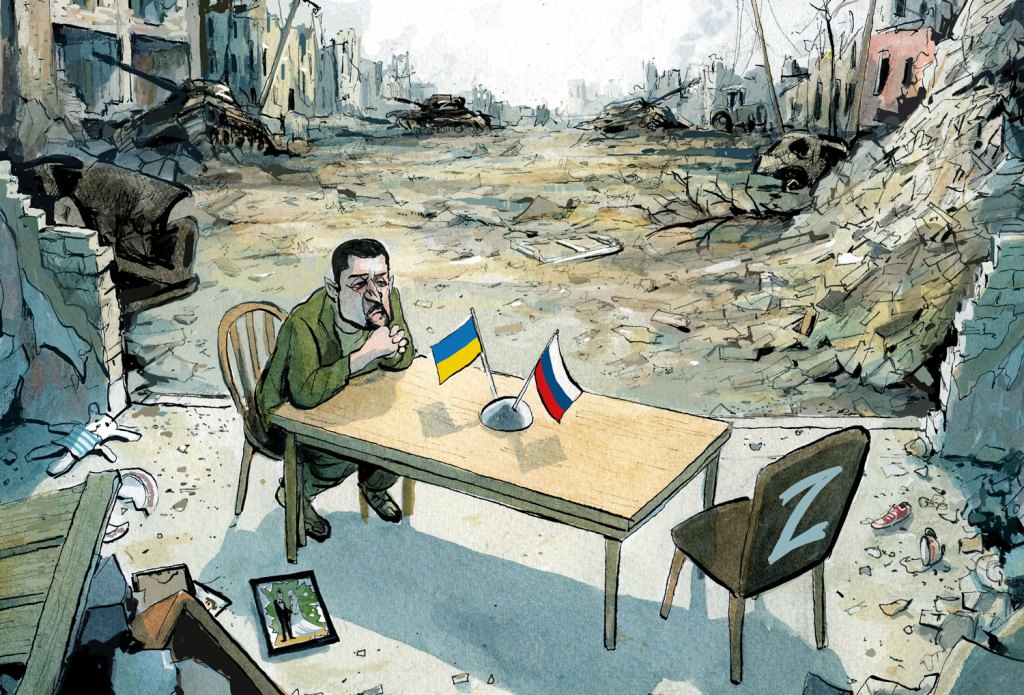
With Ukrainian president Volodymyr Zelensky’s political authority already under grave assault in the wake of a major corruption scandal, he now faces a new challenge – this time from his erstwhile ally, the United States. A high-level US delegation led by army secretary Daniel Driscoll is meeting Zelensky in Kyiv today to present the latest version of a peace plan aimed at ending the war.
The contents of the plan have not been officially revealed and so far it has not been publicly endorsed by Donald Trump. But two things are already clear. One is that there’s nothing new in it. And two, there’s nothing good in it for Zelensky.
The latest plan was thrashed out during a series of secret meetings between Kremlin envoy Kirill Dmitriev and his US counterpart Steve Witkoff in Florida earlier this month. The details of the 28-point proposal were leaked yesterday to Axios, apparently by the Russian side, and accidentally confirmed by Witkoff himself who tweeted that the reporter “must have got this from K.” Presumably, Kirill Dmitriev himself.
The plan differs little from previous proposals already rejected by the Ukrainians and is, in essence, a restatement of the maximalist demands with which Vladimir Putin began the war. One clause demands that Ukraine cede the remainder of the Donbas region that Russia has so far failed to occupy, another calls for Kyiv to cut its armed forces by half and reduce or altogether abandon certain types of weaponry, particularly long-range missiles that could hit targets in Russia. Kyiv would also have to agree to reduce or halt Nato military assistance and ban Nato boots on the ground in any form – thus scuppering any chance of a peacekeeping force envisioned by the Franco-British-led “coalition of the willing.” In terms of domestic policy Ukraine would be required to recognize Russian as an official state language – in fact something supported by Zelensky when he was first voted into power in 2019 as a candidate who could reach a compromise with Moscow. The deal also demands that Kyiv grants formal status to the Russian Orthodox church, which the Zelensky government had targeted as an agent of Kremlin influence.
The deal is “exactly what Putin has always demanded – de-Nazification, demilitarization and partition,” says a former senior member of the Zelensky administration who is currently in Kyiv. “What did we fight for, if only to arrive back where we were at the beginning… People will ask, who made us spill our blood?”
The proposals on the table today in Kyiv are, without a doubt, far worse for Ukraine than any of the Minsk accords signed in 2014-15 but rejected by many Ukrainian nationalists. Indeed, when Zelensky came close to doing a deal on the breakaway republics of Donbas in October 2019 and again in 2021-22, an active and aggressive “Resistance to Capitulation Movement” linked to the Security Service of Ukraine threatened Zelensky with a “veterans’ Maidan” if he “capitulated” to Russia.
The terms are also harsher than the draft peace deal discussed in Istanbul in March and April 2022 but abandoned by Ukraine as being too punitive.
Even in the extremely unlikely event that Zelensky were forced into signing away the Ukrainian-held part of the Donbas, the moment he did so Ukraine would become instantly ungovernable. Frontline Ukrainian units who have fought for years to hold the so-called “fortress belt” of cities from Sloviansk to Kramatorsk would likely refuse orders to withdraw. “This [deal] demands that hundreds of thousands of Ukrainians be forcibly evacuated from their homes or handed into Russian captivity,” says the Ukrainian official, who spent two years as a member of Zelensky’s cabinet. “There is no way our forces would abandon these people… and government that signed such a deal would be treated as traitors and overthrown.”
The demand for a pull-back in Donbas makes the Witkoff-Dmitriyev plan, as it stands, politically and militarily impossible to implement. Which raises crucial questions: is Putin deliberately insisting on an unworkable deal because he does not want peace? Or are some parts of his demands, for instance the remainder of Donbas, a negotiating position he is prepared to abandon?
Another question is why the US is pushing for this deal in the full knowledge that neither Zelensky nor any other Ukrainian president could ever agree to it. Acquiescing to the partition along the line of control is already politically painful and perilous enough – but demanding a voluntary withdrawal from lands successfully defended by the blood of thousands of young Ukrainians is a deal-breaker. It’s possible that Trump wants to wash his hands of the whole Ukrainian mess and walk away, blaming Zelensky’s supposed intransigence. It’s also possible this is just another zig-zag in Trump’s diplomatic slalom over Ukraine, sliding back and forth between threats to Zelensky and threats to Putin. It’s not even clear whether Trump or Secretary of State Marco Rubio even fully endorse the latest plan, with their respective spokesmen remaining resolutely tight lipped.
One thing is clear – this is not a proposal that Zelensky can sign. But with the front lines slowly advancing westward, his own political credibility crumbling under allegations of outrageous war profiteering against his closest allies, money running out, and Russian assaults on Ukraine’s energy infrastructure increasing in accuracy and impact, Zelensky is also running out of options.
Who will pay for Ukraine’s war effort now the Trump administration has turned off the financial taps? European leaders have expressed themselves ready and willing to take up the burden, with European Commission President Ursula von der Leyen affirming that “if we continue to believe that Ukraine is our first line of defense, we need to step up our assistance.”
Individual countries have come up with generous funding packages – most open-handed of all being Germany, which has recently pledged more than €3 billion in direct funding. But that’s just a drop in the ocean compared to what Ukraine says it needs. With more than 40 percent of GDP destroyed and the tax base completely wrecked by the war, it’s not just Ukraine’s military spending but also its public services which are dependent on international handouts. At present, Kyiv’s war effort is facing not just a crisis in manpower but also a serious funding crunch.
So far, the financial support of western allies has been Kyiv’s superpower and force multiplier. Without it, Ukraine’s economic collapse at the outset of the war would have quickly translated into military collapse, too. Ukraine also enjoys the goodwill of world financial institutions such as the International Monetary Fund, the World Bank and the European Bank of Reconstruction and Development – as well as of international lenders who have collectively agreed to overlook the fact that Ukraine is effectively in default on its own debt.
That’s an advantage that Russia, by contrast, absolutely lacks. Cut off from international money markets, Moscow is forced, more or less, to balance its own books, borrow from its own major companies and print more money to fund its war production. But Ukraine’s reliance on outside funding is also a strategic weakness, leaving Kyiv entirely dependent on the goodwill of outsiders to continue the fight. Kyrylo Shevchenko, the former head of Ukraine’s Central Bank, calls the system “donornomics” – defined as “the fragile system where Ukraine’s fiscal survival depends on how far its allies are willing to go.”
How much cash does Ukraine need to fight Russia and survive as a functioning state? The basic figure that the Verkhovna Rada, Ukraine’s parliament, approved for defense and security this year was 2.2 trillion hryvnias, or $54 billion – equivalent to approximately 26 percent of Ukraine’s GDP. But that sum eats up more than half of Ukraine’s depleted tax take, so Kyiv needs to find additional money to fund everything else from healthcare, pensions and education to government salaries.
‘Come on Donald, amuse me.’
Ukraine’s 40 percent budget deficit has to be covered in one of three ways – from direct donations from allied countries, from internationally backed debt and, potentially, from Russian state funds currently held in G7 countries. That’s not even counting military expenses directly shouldered by Ukraine’s backers – most expensively the vital air defenses such as Patriot batteries which cost $1 billion dollars each and fire missiles costing around $4 million a shot. With Russian missile and drone attacks now regularly topping 600 projectiles a night, it’s a small wonder that Reuters has estimated the real cost of the war to be up to $150 million a day. Ukrainian eyes are focused on getting hold of Russia’s sovereign wealth funds, which were frozen at the beginning of the war. Estimates vary, but at least $250 billion of the Kremlin’s money is held in various G7 countries. At least €150 billion of that sum is parked in Belgium’s Euroclear, a depository system used by governments and central banks around the world to hold their hard currency assets. There is, as yet, no legal way that Belgium, the European Union, the United Nations or any other national or international body can just confiscate that money.
Indeed, many European leaders including French President Emmanuel Macron have warned that doing so would seriously jeopardize Europe’s reputation of having respect for the rule of law in the eyes of other sovereign investors such as China, Saudi Arabia and Qatar – and trigger sovereign capital flight that could quickly bankrupt the continent.
Instead, western finance officials have been dreaming up various legal workarounds that would allow the funds to remain formally the property of the Russian government, while in practice making them available for Ukraine’s use. In October last year, the G7/EU came up with a scheme known as the Extraordinary Revenue Acceleration loans mechanism, which created a $50 billion loan backed by the interest payments from Russian capital without touching the capital itself. But with the war effort burning through that sum annually, this year European leaders have attempted to create a similar loan package involving the whole sum.
The idea of this Special Purpose Vehicle (SPV) – also known as the Reparations Loan – has been to create a €140 billion loan backed by Russia’s Euroclear capital that would be lent to Ukraine and, notionally, repaid by Ukraine once Ukraine is paid back by Russia for wartime damages. The trouble is, reparations are vanishingly unlikely and are not even a subject of discussion in any iteration of peace talks with the Russians. On the contrary, the Kremlin very much does want its cash back – and it is very likely to make that, along with the lifting of sanctions, a key demand once negotiations begin in earnest. In other words, handing over Russia’s money to Ukraine could become an obstacle to peace.
On a practical level, too, the small print of the SPV means that Belgium would be on the hook if and when Russia sues for its money back. Bart De Wever, the Belgian Prime Minister, has refused to sign off on the loan unless all European nations share the risk. So far, they have refused – not least because Europe’s national bankers are legally forbidden from issuing or backing loans that have next to no chance of ever being repaid. The practice is known as “bad-faith lending,” and has been much abused by China in recent years as a way to grab strategic real estate across Africa and Asia in lieu of loan repayments. And since seizing Ukrainian assets isn’t the EU’s style, European taxpayers will ultimately be liable for the entire sum of the loan when the Russians inevitably refuse to pay war damages to Ukraine, forcing Kyiv to default.
Despite the shaky legal and political foundations of the SPV, “Kyiv sees these assets as the main pillar of budget stability for 2026-2027,” says Shevchenko. Indeed, securing a reparations loan from the EU is key to Kyiv’s parallel negotiations with the International Monetary Fund, from which Ukraine is hoping to secure a four-year multibillion-dollar extension of its existing $11 billion credit facility. But Ukraine has no real plan to repay the IMF except out of the SPV – effectively, one loan paying for another. European states do this kind of thing all the time – but they, unlike Ukraine, have predictable revenues and single-figure deficits. “The plan is risky,” says Shevchenko. “Without a deal, Kyiv’s $60 billion [budget] gap could deepen fast.”
Though using Russian assets to help Ukraine sounds like a panacea, many in Kyiv are also crying foul over Brussels’ suggestion that €45 billion of the SPV money be used right away to repay last year’s G7/EU Extraordinary Revenue Acceleration loan. More egregious still to Ukrainians has been German Chancellor Friedrich Merz’s suggestion that much of the SPV money be spent on arms for Ukraine manufactured by expensive European suppliers such as Germany, cutting Kyiv out of the picture. That is, more or less, what happened to the lion’s share of US aid which was never paid out to Kyiv at all and was instead sent to US defense contractors to replace old military equipment dispatched to Ukraine. And as the SPV-Reparations loan will be disbursed by the European Union, the temptation to buckle to lobbyists and spend the money inside the EU, pork barrel-style, will be high.
In addition to massive physical destruction, Russia’s invasion has also disrupted two key structural elements of Ukraine’s economy – access to cheap Russian gas, which was the secret to the competitiveness of much of the country’s industry, and cash income from transit of Russian gas to Europe. Remarkably, for the first three years of the war Ukraine continued to quietly move Gazprom gas across its land and into the EU via a network of pipelines to Slovakia. As late as last year, Kyiv was using the $900 million annual transit fees paid by Moscow (via a Swiss subsidiary) to help fund its war effort. Those payments, bizarrely, made Gazprom one of Ukraine’s biggest wartime budget contributors.
Some of Gazprom’s gas was even re-imported into western Ukraine’s Lviv and Ivano-Frankivsk provinces having looped through Slovakia, creating the legal fiction that the gas was European. It’s the same story with Russian crude oil pumped to Slovakia, the Czech Republic and Hungary via the Druzhba pipeline – which in fact crosses Ukrainian territory and generated precious revenue for Kyiv.
Under pressure from Brussels, Ukraine shut down most Russian gas transit at the start of this year, and is now moving to close down the Druzhba oil pipeline too. But that leaves Ukraine dependent on liquefied natural gas (LNG) imported from halfway across the world – and which costs up to three times as much as piped Russian gas. Early this month, under the auspices of Europe’s Partnership for Transatlantic Energy Cooperation, Ukraine’s Naftogaz signed agreements on the supply of at least 300 million cubic meters of American LNG with the Polish company ORLEN. Such western-provided supplies will, Kyiv hopes, be enough to keep heating and electricity going over the coming winter. But there’s no way Ukraine’s heavy industries can return to their prewar competitiveness with energy costs tripled.
The long-term outlook for a postwar Ukraine is as bleak as its current cashflow. A rapid damage and needs assessment, prepared by the Ukrainian government with the World Bank, UN and European Commission, estimates immediate recovery and reconstruction needs to be approximately $524 billion over the next decade – roughly 2.8 times Ukraine’s 2024 GDP. The good news is that official creditors – including holders of Kyiv’s government debt – have agreed to pause Ukraine’s debt service until the end of March 2027 pending restructuring. But with Kyiv already struggling to make ends meet without repaying its debts, that’s as useful as a chocolate teapot.
Underlying Kyiv’s coming cash crunch is a fundamental disconnect between Europe’s undoubtedly sincere desire to support Ukraine and the reality that the UK, France and Germany are facing serious fiscal crises of their own. Promises to support Ukraine are of a piece with European NATO members’ pledges to commit 5 percent of their GDP to defense spending by the end of the decade – both declarations are, for the most part, unfunded. Yet senior Brussels bureaucrats such as António Costa, President of the European Council, continue to make sweeping pledges – including in person to Ukrainian President Volodymyr Zelensky. “Today we will make the political decision to ensure Ukraine’s financial needs until 2026 and into 2027,” Costa told Zelensky last month. “We are not tired and we are here to continue to support Ukraine diplomatically, politically, militarily and financially.”
Costa isn’t lying – Europe’s material and political support for Ukraine will undoubtedly continue. The question is at what level – and for how long. The story so far of Europe’s engagement with Ukraine has been one of big pledges followed by considerably smaller deeds – and that was before Trump took away Uncle Sam’s billions. Unfortunately for Kyiv, there’s little to suggest that Europe has the means or the will to actually provide Ukraine as much as it needs, for as long as it needs.
This article was originally published in The Spectator’s November 24, 2025 World edition.
Since the start of the Russian invasion of Ukraine in February 2022, discussion of the Ukrainian far right has been verboten in western media, largely because one of Vladimir Putin’s stated war aims is the “denazification” of Ukraine. Putin’s claim that Ukraine is a Nazi state has been recycled by Russian propagandists and the western party line has consistently been that while the Ukrainian military does have far-right strains, they are marginal and inconsequential. This may have been true in 2022, but things have changed significantly after almost four years of war. Today, far-right figures control some of Ukraine’s strongest military units, and neo-Nazi ideology is displayed openly in the Ukrainian ranks.
The latest evidence of this came on November 4, when Volodymyr Zelensky handed out military awards to soldiers fending off the Russian offensive in the Donetsk region. As shown in photos published on Zelensky’s official Telegram and X accounts, some of the soldiers receiving the awards had patches with symbols that looked suspiciously like the emblem of Hitler’s SS. The unit flags adorning the walls told a similar story: the Azov brigade’s insignia is a variation of the Nazi Wolfsangel, while the Chervona Kalyna brigade’s ensign emulates the red-and-black flag of the Ukrainian Insurgent Army, a far-right militia that played an instrumental role in the Holocaust in western Ukraine and massacred tens of thousands of Poles in the regions of Volhynia and Eastern Galicia between 1943 and 1945. Zelensky was photographed with these two flags in the background.
Both the Azov and the Chervona Kalyna brigades form part of Ukraine’s 1st Azov corps, a unit that comprises tens of thousands. The corps is led by Denys Prokopenko, the commander of the Azov regiment that defended Mariupol in 2022 before being captured by the Russians. He and his men were eventually freed from captivity in a prisoner exchange and their “heroic resistance” was praised by the western media. What was often left out of the gushing puff pieces was Prokopenko’s background. In the 2010s, Prokopenko was a member of a far-right Ukrainian soccer-hooligan association called the “White Boys Club.” A quick browse through its Facebook page shows frequent glorification of Nazi units such as the 14th Waffen Division of the SS (also known as the 1st Galician division). In 2014, Prokopenko joined the nascent Azov. His platoon was nicknamed “Borodash” (bearded man) for its insignia, which featured a bearded Nazi Totenkopf. In spite of appearing to like the aesthetics, Prokopenko has denied that he or the men serving under him have far-right sympathies.
But the 3rd Army Corps, comprising some 40,000 men and widely heralded as Ukraine’s strongest military formation, is commanded by an even more sinister figure, Brigadier General Andriy Biletsky. In 2010, Biletsky publicly stated that Ukraine must “lead the white nations of the world in a final crusade for their survival, a crusade against the Semite-led Untermenschen.” In 2014, after being held as a political prisoner, he founded the Azov volunteer battalion to fight the Russian-backed separatists in the Donbas. From 2014 to 2022, human-rights organizations described widespread use of torture by Azov fighters against civilians in the Donbas and western media routinely reported on how this white-supremacist, fascist and neo-Nazi paramilitary unit served as a model for violent far-right extremists all over the world. In 2016, Biletsky also established the far-right political party National Corps, which the US State Department called a “nationalist hate group” in 2018.
In those days, contrary to Russian propaganda, the Ukrainian people had little affinity for the extremist ideology of Biletsky and the Azov movement. Although Biletsky managed to get himself elected to the Ukrainian parliament, his party only received 2 percent of the vote in the 2019 elections. In other words, prior to the war, Azov was a fringe phenomenon.
That changed in 2022. After the Azov’s capture and release by the Russians, figures such as Prokopenko and Biletsky became national and international heroes overnight. From a regiment in 2022, Azov grew to a brigade in 2023 and a full corps this year. Today, its members are among the most admired men in the country.
There’s a reason Zelensky is so resistant to signing an armistice, especially one involving territorial losses. In promoting such men as Prokopenko and Biletsky, the President has potentially created a monster. If their ideologies are as suspected, Ukraine is now in the position of Germany in 1918. Fighting a war of attrition against an opponent with vastly more resources, manpower and firepower, Ukraine is bound to lose, or at the very least to suffer major losses. After World War One, the Dolchstoßlegende – the stab-in-the-back myth – spread around Germany. It convinced many Germans that the country hadn’t lost the war on the battlefield but had instead been betrayed by citizens on the home front – Jews, mainly. After years of Ukrainian and western media hyping up the Ukrainian army and predicting a Russian collapse, an unfavorable peace risks creating Ukraine’s own version of the Dolchstoßlegende, with Zelensky playing the role of the Jewish scapegoat.
If a ceasefire is signed, it is far from clear whether Prokopenko and Biletsky, who believe in victory at any cost, will lay down their arms. Between them, they command tens of thousands of Ukraine’s best troops. Well-equipped, well-trained and ideologically motivated, these units have the potential to be Ukraine’s very own Freikorps, and Prokopenko and Biletsky may well lead their own Kapp Putsch or march on Kyiv in the event of an American-mediated diktat.
While some armies have neo-Nazis, in Ukraine some neo-Nazis have armies. The threat they pose to a democratic and prosperous postwar Ukraine is obvious.
This article was originally published in The Spectator’s November 24, 2025 World edition.
Very well then – war. That is the bottom line of Vladimir Putin’s response to Donald Trump’s latest attempts at mediating an end to Russia’s invasion of Ukraine. In August, Putin rejected the peace deal that Trump lined up in Alaska. Now, the Kremlin has scuttled the White House’s plan for a summit in Budapest by insisting that Russia’s demands for Ukrainian demilitarization and “de-nazification” remain in force. Clearly, the Russian President still believes that he can win the war on the battlefield – and terrorize Ukraine’s civilians.
What is Putin’s plan? Why does he still believe that Russia can chart a path to victory even as Washington unveils painful new sanctions on the country’s two largest oil exporters, Ukrainian drones have begun smashing up oil refineries deep inside Russia and a summer of heavy fighting in the Donbas has moved the front line forward by a handful of miles at huge cost in blood?
First and foremost, Putin is gambling that time is on his side – backed by Russia’s cruel allies General Winter and General Frost. Massive missile and drone attacks on Ukraine’s energy and transport infrastructure are aimed at making as many cities as possible uninhabitable as temperatures drop. It’s not a new strategy. But the increased scale and accuracy of Russian strikes over recent months will make this winter the coldest that Ukraine has faced. According to one senior official source, Germany’s security services have already warned Berlin to brace for a fresh influx of Ukrainian refugees.
Like many elements in this apparently deadlocked conflict, the livability of a city can radically change in a tipping-point moment such as the destruction of an electricity substation or gas pipeline. Early last month, a series of catastrophic hits on Kyiv’s power grid left half the capital without power. Some areas waited a week for it to be restored. Smaller cities with fewer air defenses are suffering worse. “My hometown Kherson is turning into a ghost city,” reports Iuliia Mendel, former press secretary to Volodymyr Zelensky. “Relentless Russian shelling has driven out nearly four out of five residents – just 65,000 remain from the 300,000 who once called it home.”
Putin’s forces are targeting other humanitarian essentials, too. In late October, Russian missiles scored a series of direct hits on the Kyiv warehouse of Ukraine’s second-largest pharmaceutical distributor, Optima Pharm, destroying an estimated $100 million of medicines.
Whether a dark winter will precipitate a morale crisis in Ukraine – and a crisis in Zelensky’s legitimacy – remains to be seen. But a new wave of Ukrainian refugees would certainly stress European political resolve. Forcing a mass winter exodus of Ukrainian women and children (military-age men have been banned from leaving Ukraine since the start of the war) is the Kremlin’s ruthless way of weaponizing civilian suffering and testing the limits of Europe’s support.
Poland has recently suspended benefits to many Ukrainian refugees, and leaders in some countries – such as Lithuania and Germany – have begun arguing that Ukrainian men should be sent home to address the country’s recruitment needs.
On the front line in the Donbas and around the edges of the Kharkiv province, the apparent stalemate may not be as stable as it appears. Russian progress toward encircling the “fortress cities” of western Donbas has been painfully slow and increasingly bloody. Analysis by Britain’s Ministry of Defence suggests that this year has been Russia’s deadliest of the war: 100,000 Russian soldiers have been killed from a total of nearly 250,000 since 2022. But if Russia’s forces succeed in taking Pokrovsk in the north of Donetsk province, then the 50-kilometer fortress line of Slovyansk, Kramatorsk and Konstantinovka becomes vulnerable to outflanking from both north and south.
Ukrainian efforts to find manpower are becoming increasingly critical, even more so than weapons procurement or missile defense. Every month, Ukraine mobilizes 30,000 soldiers. Army press gangs often use brutal methods to snatch unwilling recruits off the streets and bundle them into buses. But, admits Ukrainian MP Fedir Venislavskyi – a member of Zelensky’s party and of the Committee on National Security, Defense and Intelligence – up to 20,000 soldiers will desert or go absent without leave over the same time period.
That leaves only 10,000 fresh recruits, most of them conscripts. Ukraine’s military blogging sites are full of officers complaining about manpower shortages. “Our frontline units operate at about 50 percent strength,” Ukrainian army Major Yegor Checherinda recently told the website Voennoe Delo. Bohdan Krotevych, a former Azov regiment officer, complains that “frontline units currently operate at only about a third of their required strength.”
But the most important arms race isn’t playing out in the trenches of the Donbas, but in the skies above the Russian and Ukrainian heartlands. Attacks by 800 Russian drones and missiles a night have become commonplace. Until recently, up to 80 percent of these weapons were typically downed by air defenses. But Russian glide bombs – created by attaching wings, rocket motors and guidance systems to 500-kilo conventional bombs – are much harder to hit and have a 200-kilometer range. Over recent weeks, Russia has significantly increased glide-bomb use, with devastating effect.
Ukraine has unveiled a homemade cruise missile called the Flamingo, with a warhead weighing more than a ton and a range of 1,500 kilometers. Since August, long-range Ukrainian drones have begun regularly striking Russian oil refineries and arms factories. Kyiv can use domestically built missiles to strike targets deep inside Russia without restrictions from western allies.
Russia’s economy – in particular its oil and gas production and export – has become Putin’s most dangerous vulnerability both militarily and diplomatically. Publicly available maps of Russia’s pipeline network clearly show that just two dozen key nodes and pumping stations are crucial to the whole system. Many of these – through quirks of geography and Soviet-era planning – lie within striking distance of Ukraine’s drones and missiles.
The Biden administration held Kyiv back from crippling Russia’s oil industry for fear of causing a spike in global prices – and, for the same reason, never directly banned or sanctioned Russian oil. Under Trump, that’s changed. Recently announced US sanctions on Lukoil and Rosneft, Russia’s two biggest oil companies, could squeeze 65 percent of Moscow’s exports. These announcements seem to have caught Putin off guard. Like a helicopter trying to dodge heat-seeking missiles, the Kremlin’s response has been to fire off hot propaganda chaff left and right.
For example, in response to Trump’s announcement, Putin hastily revealed a new super weapon: the Burevestnik, a cruise missile powered by an onboard nuclear reactor that can stay aloft for days and carry nuclear warheads. The unveiling looked a lot like Putin’s announcement last November of a new model of the Oreshnik hypersonic nuclear missile. The Kremlin believes both weapons showcase Russia’s military-industrial complex – but more importantly, their rollout serves as a not-so-subtle message to the world that Russia is a nuclear power and shouldn’t be messed with.
The Kremlin also immediately dispatched Kirill Dmitriev – the Harvard Business School-educated former Goldman Sachs banker who heads Russia’s sovereign wealth fund – to Washington. Putin believes that Dmitriev, with his excellent English and extensive US contacts, is an ideal Trump-whisperer. Dmitriev has been busy talking up the grand possibilities of US-Russian business cooperation on Arctic oil exploration and rare-earths mining during a series of meetings with Trump’s envoy Steve Witkoff. But Dmitriev’s welcome seems to be wearing thin. No top member of Trump’s team met with him publicly during this last visit, and Treasury Secretary Scott Bessent called him a “Russian propagandist.”
According to Sir William Browder, once the largest foreign portfolio investor in Russia, “the fact that Putin dispatched Dmitriev to Washington within minutes of the US sanctioning Lukoil and Rosneft shows just how rattled Putin is.” But Dmitriev’s message to Washington showed little sign of Russian willingness to compromise. He mostly hyped up the power of the Burevestnik. He told Fox News and CNN that Putin considers Ukraine an existential threat to Russia and that he won’t back down.
Ukraine and Russia are in a war of attrition – and that is a war Putin bets he can win. Even as commodities analysts report that many of Rosneft and Lukoil’s biggest customers in India and China are canceling orders and seeking oil from non-Russian sources, other market players are busy finding ways to circumvent the latest sanctions. The markets doubt that Trump can keep the 4.4 million barrels a day exported by those Russian companies from flowing. The futures price of Brent Crude oil, for instance, ticked up 3 percent after the announcement, but has since sunk close to the pre-sanctions level.
“If you really remove that much oil from the market, you will have a huge price spike [that] Trump won’t tolerate,” says Ben Aris of media company Business New Europe. “Midterm elections are not that far away. Oil experts say it will only take a few months for the Russians, Chinese and Indians to find some sort of workaround. They have in every case of new sanctions so far.”
Russia undoubtedly faces further economic pain as the war continues. But Ukraine’s economy, and indeed its ability to finance its war effort at all, is in far worse shape. The Trump administration has pulled funding, and Europe’s promise to raise a reparations loan backed by frozen Russian assets remains in legal limbo.
One thing is certain. Winter is coming, and it will be much more painful for Ukraine than it will be for Russia. Those who predict that the pressures of war will collapse Ukraine and those who say the same of Russia are both right. The only difference is the timeline. Putin remains convinced that his economy, his people and his soldiers can take whatever he asks of them – and hold out longer than their enemies in Kyiv.
This article was originally published in The Spectator’s November 10, 2025 World edition.
Here we go again. Now that Russian president Vladimir Putin has resumed his bombardment of Ukraine, President Donald Trump is responding by sanctioning the oil giants Rosneft and Lukoil. So much for the vaunted peace push that Trump has been engaging in since he met with Putin in August in Alaska.
The atmosphere has turned distinctly frostier since they held their pow-wow. Budapest was supposed to be a reprise of the brief thaw that took place in August but Trump has got cold feet after the Kremlin indicated that it was in no mood to compromise over the actual boundaries between it and Ukraine. Instead, as foreign minister Sergey Lavrov indicated, Russia cannot rest content as long as what he called unrepentant Nazis were in charge in Kyiv. Putin and his camarilla, in other words, want a restoration of the old order, which is to say a pliant puppet state.
Apart from his blatant military failure to conquer Ukraine (it was supposed to be a cakewalk, according to what turned out to be his non-intelligence services), the problem for Putin is that Kyiv is becoming more, not less, independent as the war continues. Zelensky has learned from his previous encounters with Trump not to overreact to his momentary ebullitions of rage, which are usually replaced by a weary resignation to geopolitical dictates. Those dictates are that he is no position to dictate a surrender because Europe, much to its own surprise, has become the chief source of weaponry for Ukraine. Exhibit A is Zelensky’s new push for 150 Gripen fighter jets from Sweden, which he is currently visiting. For Europe, the supply of weaponry to Ukraine bids fair to become a source of a kind of Keynesian stimulus program. It also has the not inconsiderable advantage of allowing the Ukrainians to wage the conflict with Russia that the peace-loving Europeans themselves dread.
Trump’s own attention to Ukraine is episodic. He was briefly reanimated by the prospect of earning a Nobel Peace Prize. With Putin balking at a real cease-fire, Trump has other projects to pursue, most notably demolishing the East Wing of the White House and replacing it with a pharaonic temple to himself in the form of a ballroom that can hold up 900 or more guests. Trump may well sell the naming rights to the gleaming golden hall unless he decides to affix his own to it.
The real loser in all of this is probably Hungarian President Viktor Orbán, who faces a stiff election challenge in April. Hosting Trump and Putin would have been a true feather in his cap. Instead, he will have to forego the fancy visit and continue the grinding prospect of serving as Putin’s wingman in the European Union, a status that has brought much obloquy and little profit, other than a dispensation when it comes to energy prices from Russia.
Given Trump’s volatility, however, it may only take another phone call from Putin to prompt Trump to ponder another summit meeting. For now, Putin is flexing his own muscles, ordering a nuclear drill in northwestern Russia. As he becomes exasperated with Trump’s failure to propitiate him, Putin’s new credo when it comes to atomic weapons may be “drill, baby, drill.” Let’s hope it remains at just that.
The identity of the saboteurs who blew up the Nord Stream pipelines in September 2022 was for years the western security establishment’s worst-kept secret. Just two weeks after a series of explosions within the economic zones of Sweden and Denmark crippled three of the four undersea natural-gas pipelines linking Russia to Germany, Scandinavian diplomats in Brussels were already being quietly briefed that the most likely culprits were Ukrainian. By January 2023, a forensic investigation by German police had discovered traces of the explosives on board the charter yacht Andromeda and found that the vessel’s movements aligned exactly with the location of the blasts. Crucially, the Germans also established both the cover identities and the real identities of the seven Ukrainian members of the sabotage commando.
Ukraine’s hand in the sabotage operation was common knowledge among western security agencies
By the time The Spectator published a detailed report in March 2023 pointing the finger at Kyiv, Ukraine’s hand in the sabotage operation was common knowledge among western security agencies. As one senior British intelligence official told me in January 2023, “The story will come out sooner or later… but we’re not going to be the ones to leak it.”
Details of the German, Danish and Swedish investigations were kept secret not only from the public but also from EU and US politicians, and from the United Nations, for a simple reason: the news that Ukrainians were involved in an attack on Germany’s critical infrastructure could have a devastating impact on Kyiv’s relations with its major European supporters – as well as on public support for Ukraine. Or as Germany’s BND foreign intelligence agency put it in a response to a parliamentary question in October 2022: “Information regarding this question cannot be issued – even in classified form – due to considerations regarding the welfare of the state.”
Denmark and Sweden officially shut down their investigations in February 2024 without releasing any information to the public. But the official omertà was finally broken last summer by the office of Germany’s Federal Prosecutor General, which has shown itself to be more concerned with justice being done than with saving the blushes of politicians in Kyiv – and Berlin. At least two European Arrest Warrants were obtained in June 2024 for Ukrainian suspects. And in August of this year 49-year-old former military diver Serhii Kuznietsov was arrested while on holiday near Rimini and remanded in custody by Italian magistrates, while another military veteran Volodymyr Zhuravlyov was detained in Pruszków, Poland, on September 30. But judges in both Poland and Italy have refused to extradite the suspects to Germany – sparking a political battle over whether they should face justice at all.
“The problem with Nord Stream… is not that it was blown up, the problem is that it was built,” Polish Prime Minister Donald Tusk said recently, arguing against extraditing Volodymyr K to Berlin. The head of Poland’s National Security Bureau, Sławomir Cenckiewicz, told the Financial Times that “if Germany is prosecuting someone based in Poland who destroyed the source of income of the Russian war machine, then we see a clear contradiction in interests between Poland and Germany… From our point of view, this investigation doesn’t make sense, not only [for] Poland but also [for] the whole [NATO] alliance.”
In other words, while Berlin prosecutors see the Nord Stream operation as an attack on Germany, the Poles view it as an attack on Russia. And while the Ukrainian citizenship of the suspects is not in doubt, the exact role the Ukrainian government and military played – as well as who conceived of, planned and ordered the attack – remains a mystery. The Russians, for their part, continue to insist that the attack was organized on a “state level,” and Putin himself has dismissed as “sheer nonsense” any suggestion that the pipelines could have been destroyed by a handful of possibly freelance Ukrainian frogmen. Kremlin media regularly blame the US for the attacks.
The controversy over the extradition has become inextricably linked with Germany’s own political debates over the causes of Putin’s 2022 invasion of Ukraine – and the legacy of the policy of cooperation with the Kremlin by successive German chancellors Gerhard Schröder and Angela Merkel.
From the moment Russia’s state-controlled Gazprom corporation first proposed massive undersea Baltic gas pipelines that would bypass Belarus, Ukraine and Poland and link Germany directly to the Yamal gas fields of northern Siberia in 2006, Poles and other eastern Europeans consistently and adamantly opposed the project. They argued that an abundance of cheap gas would increase European dependence on Russia, while at the same time enriching the Kremlin. Schröder and Merkel countered that increasing Russia’s economic dependence on European money would encourage peace and cooperation.
Even when Putin’s 2014 annexation of Crimea fundamentally undermined this logic, Merkel nonetheless greenlit the €9.5 billion Nord Stream 2 project in 2015, despite strong opposition from Washington. In the event, the second set of pipelines were completed but never certified and never came online. One of the two Nord Stream 2 pipes survived the attacks intact and is still full of pressurized gas, ready in theory to be switched on at any moment.
In several important ways, history has proved the critics of Nord Stream right – not least about the danger that the Kremlin would use its control of more than a third of Germany’s energy supply as a political weapon. In June 2022 Gazprom reduced the pressure through Nord Stream 1 to 40 percent of its previous flow, claiming that recent European sanctions had prevented the delivery of Siemens-made turbine blades. The following month the company shut down supplies, citing annual maintenance work. Service was resumed ten days later, but at only 20 percent capacity, and on August 31, Gazprom closed Nord Stream 1 indefinitely, officially because of further technical issues. Indeed, it was precisely in order to stop the Kremlin from applying energy blackmail on Berlin that, reportedly, the Ukrainian plotters decided to put an end to Nord Stream – and Russian leverage over Europe – once and for all.
The critics were also right about the dangers of Germany and Europe’s economic dependency on cheap Russian gas. The Kremlin’s serial messing with supplies predictably sent gas markets into a panic, with spot prices for natural gas soaring to €70 per megawatt-hour in August 2022, up from €27 in January. In the aftermath of the destruction of Nord Stream in late September, Germany rapidly built floating harbors to offload supplies of expensive liquefied natural gas (LNG), and booked massive new shipments from the US, Canada, Qatar and – ironically – Russia (which as of last year was still Europe’s second largest LNG supplier, after America).
The problem for the German economy was that several major sectors – notably large, energy-intensive industries such as chemicals, refining and fertilizers – have faced much higher costs. An IMF report suggested that the negative impact on Germany’s GDP of the shutoff of cheap Russian piped gas would be 1.5 percent in the second half of 2022, 2.7 percent in 2023, and 0.4 percent in 2024. That same IMF study predicted that the destruction of Nord Stream and its associated gas price rise would add some 2 percentage points to German inflation in 2022 and 2023 because of higher energy costs rippling through food, manufacturing, transport and consumer goods. While it’s impossible to know exactly what German economic performance would have been without the Nord Stream hit, Germany’s economy contracted by -0.3 percent in 2023 and -0.2 percent in 2024 while inflation shot up to 7.9 percent in 2022 before falling to 2.4 percent by 2024.
In short, whoever carried out the Nord Stream operation cut off Russia’s most valuable tool of political blackmail and wrecked one of Gazprom and the Kremlin’s most lucrative income streams. But they also killed off German growth and pushed up inflation across the continent.
To some, Germany’s insistence on prosecuting the saboteurs smacks of hypocrisy. “Forgive me if I say that the sight of Germany now ‘investigating’ the sabotage of Nord Stream feels like a mockery of history – another manifestation of German arrogance and hubris,” says Sławomir Dębski of the College of Europe in Warsaw. “Perhaps they should start by investigating Schröder and Merkel – they were the ones who blew up Europe’s trust in Germany as a reliable ally.”
Berlin prosecutors see the Nord Stream operation as an attack on Germany – the Poles see it as an attack on Russia
Others are outraged that Ukraine should have carried out such a destructive attack on its own allies’ economies despite receiving tens of billions of dollars in international aid and, it is said, in defiance of strong opposition from Washington. In August 2024 the Wall Street Journal, citing senior but anonymous sources, reported that the operation was ultimately commanded by General Valerii Zaluzhnyi (then Ukraine’s top commander) – and had gone ahead despite President Zelensky allegedly trying to call it off after pressure by US intelligence.
From Ukraine’s point of view, the attack was a major success, qualifying as one of the most geopolitically effective covert operations in history. Ukraine’s main strategic weakness over the late summer of 2022 was that the promise of a resumption of cheap Russian gas would fatally weaken European resolve to back the war effort. But with Nord Stream physically gone, Europe’s return to its Gazprom addiction ceased to be a threat. For the Kyiv government to undertake such an attack would carry enormous political risks if the story ever came out. But specialist operatives acting independently would be legitimately deniable. Which has pretty much remained the case, until now.
With extradition blocked and the two arrested suspects now at liberty, there will be no trial and no chance that details of the operation will be produced in court. And the biggest secret of all – the full truth about who in Kyiv ordered the attack – will likely remain hidden for years to come.
This article was originally published in The Spectator’s October 27, 2025 World edition.
President Volodymyr Zelensky of Ukraine continued his excellent sartorial adventure at the White House, appearing in an elegantly cut black suit and shirt on Friday as he met with President Donald Trump in the Cabinet Room. But while they may have helped avoid any emanations of wrath from his host, his habiliments did not appear to prompt Trump to approve the dispatch of Tomahawk missiles to Kyiv, a coveted item indeed. “We’d much rather not need Tomahawks,” Trump said. “We’d much rather get the war over. It could mean a big escalation. It could mean a lot of bad things could happen.”
Back to square one, in other words. In August, Trump had claimed that his summit meeting with President Vladimir Putin would lead to a breakthrough. It never happened. Instead, the Russian President made Trump look like a patsy. Now he’s trying to play the same game.
Trump acknowledged that Putin might be trying to string him along once more. Was he concerned? “Yeah, I am, but I’ve been played all my life by the best of them,” he said. “I’m pretty good at this stuff. I think that he wants to make a deal.” So far, his optimism has proven unwarranted.
For his part, Zelensky played his cards, the ones that Trump previously claimed he did not possess before reversing that judgment, very well. He did not provoke Trump. Instead, he said it was important to maintain pressure on Putin and ensure that Ukraine receives real security guarantees. Zelensky also held out the possibility of Ukrainian cooperation with America on advanced drone technology in exchange for long-range missiles.
The question for Trump is simple: does he want to up the pressure on Putin before he enters negotiations in Budapest? Or does he want to try and placate the Russian tyrant in the coming weeks? Trump’s very avidity for a deal is what has made him such a pliant object in the hands of Putin, a former KGB agent who has a shrewd understanding of his counterparts. Few, if any, American presidents have been able to come out ahead in dealing with him, whether it was Bush, Obama or Biden. Instead, Putin has outmaneuvered them while steadily increasing his reach and power, both at home and abroad. A bad hombre, to use Trump’s phrase.
The person that really seems to have incurred Trump’s ire is another dictator. “He doesn’t want to fuck with the US,” Trump announced during lunch with Zelensky. He was referring to Venezuelan strongman Nicolás Maduro who has been a thorn in the side of Trump.
In what he regards as his sphere of influence, Trump wants to dictate the terms of surrender to pesky fellows like Maduro. Elsewhere, he wants to preside over ceasefires and peace agreements. The main thing is that Trump, and Trump alone, is at the center of events.
A summit in Budapest, where he is supposed to meet Putin, will once more allow Trump to seize the spotlight, at least for a few days. It may also provide a fillip to Trump’s ally, Hungarian president Viktor Orbán, who faces a tough election in April. The government shutdown in Washington may not have ended by then, but this prospect does not appear to trouble Trump unduly. He’s too busy becoming a foreign policy president to preoccupy himself with domestic matters.
Sorry, Volodymyr. There won’t be any Tomahawk missiles headed to Ukraine now that President Vladimir Putin of Russia has talked on the phone with President Donald Trump, who called their session “very productive.”
What it will produce remains an open question. But it does seem to have resulted in a decision to hold an upcoming summit in Budapest. The bottom line: Putin has outflanked Ukrainian President Zelensky, who will meet at the White House with Trump tomorrow.
Trump is a transactional president and he has business that he wants to transact with Russia, including, but not limited to, a peace deal between it and Ukraine. If anything, Trump, intent on winning the Nobel Peace Prize that eluded him this year, appears to be on the verge of becoming a foreign-policy president. He’s hopscotching around the globe, trying to solve conflicts, wherever and whenever he can. Whether they are truly solved is another matter. For Trump the art of the deal is to secure one, no matter how precarious it may appear. Then move on to the next zone of conflict.
For Zelensky, Putin’s missive could not come at a worse time. Ukraine has been bathing in the warmer rays emanating from the Trump White House to it. Trump has repeatedly voiced his frustration with “Vladimir,” as he likes to call him, for refusing to end the war. Now Putin is once more dangling the bait of a ceasefire at the very moment that he is pounding Ukraine’s energy infrastructure in preparation for what looks to be a very cold winter indeed.
Zelensky had been hoping to persuade Trump to up his game and confront Russia more openly. Since the Alaska summit, Trump has approved further cooperation between American and Ukrainian intelligence services, ensuring that they receive better targeting information to hit Russian energy infrastructure. But acceding to Tomahawk missiles, which can reach deep into Russia, would have escalated the conflict, particularly with the Kremlin threatening that it would erase the barrier to the nuclear threshold. Anyone who doesn’t get a case of the collywobbles from confronting that prospect should head directly to the local cinema and watch the new and sparkling film, A House of Dynamite, which offers a timely reminder of the destruction that one warhead can deliver.
Here’s hoping that Trump can forge some kind of viable agreement between the two sides, one that could lead to further cooperation on the nuclear arms-control front, where most of the agreements forged during and after the Cold War lie in tatters. Putin’s track record, of course, should hardly inspire much confidence. A master of the tactical move, the Russian President may well have intervened simply to stymie Trump from delivering more potent weapons to Ukraine.
Zelensky will be on his best behavior in meeting in Washington with a president who is desperate to reach some kind of accommodation with Putin. Throughout, Zelensky would do well to make favorable noises about peace and allow Putin to once more emerge as the recalcitrant party. It is Putin, and Putin alone, who has steadily been saying nyet to ending the conflict in his mad desire to reestablish the Russian empire of yore.
For many of Ukraine’s supporters, Donald Trump’s recent declaration that Ukraine “is in a position to fight and WIN all of Ukraine back in its original form” came as a welcome – and unexpected – turnaround in US policy. “Ukraine would be able to take back their Country in its original form and, who knows, maybe even go further than that!” wrote Trump in a Truth Social post in late September. “Putin and Russia are in BIG Economic trouble, and this is the time for Ukraine to act.”
But would taking back the lost territories of the Donbas, Zaporizhzhia, Kherson and Crimea make Ukraine whole again – or could a reconquest instead condemn Ukraine to perpetual civil war against itself and prolong the conflict with Russia indefinitely?
The key challenge for Kyiv now, 11 years after much of the Donbas became essentially independent and three and a half years after Vladimir Putin’s full-scale invasion, is that de facto ethnic cleansing has happened on a massive scale. The pro-Ukraine, pro-Kyiv population left the occupied areas, the pro-Russian stayed. To those who remained and collaborated with the new Russian authorities, a Ukrainian reconquest would not be a liberation but an invasion. The single largest contingent in the Russian army has been made up of local men from the Donbas – 120,000 of them. To get the territory back, Kyiv would have to fight these veterans for their own home territory. Now that partition is a reality, how realistic is it that Kyiv could reverse it?
On the one hand, there is the argument that without Russian interference there would have been no civil war in Ukraine in the first place. While there were tensions between the Russian speakers of the Donbas and Crimea and the central Kyiv government before 2014, none were remotely serious enough to have sparked an armed insurrection. It was Russia that fanned the flames and turned local tensions into a regional war. Before Putin annexed the Crimean peninsula in February 2014, the one party that advocated separatism from Ukraine polled just 2 percent in local votes. In the aftermath of the Maidan uprising in 2014 Russian speakers in the Donbas were certainly resentful of laws imposing the Ukrainian language, over the ousting of the Donbas-based Party of the Regions and its leader Viktor Yanukovych and over a takeover of power in Kyiv by strongly pro-EU and anti-Russian Ukrainian nationalists.
But the Donbas’s armed insurrection against Ukraine was not a homegrown affair; it was deliberately started by an influx of armed Russian ultra-nationalists led by ex-Russian military intelligence officer Igor Girkin (aka. Strelkov) and covertly backed by the Kremlin and Russian security services. By Girkin’s own account, the decision to launch an armed uprising in the Donbas was his, not the Kremlin’s. “At first, nobody wanted to fight,” Girkin claimed to the ultranationalist Russian newspaper Zavtra. “I’m the one who pulled the trigger of war… our squad set the flywheel of war in motion. We reshuffled all the cards on the table.”
I traveled extensively in the Donbas in the spring and summer of 2014 and often heard a telling phrase from fighters on both sides of the front lines – the other side had “brought war to our land,” they said, which is why they had volunteered to fight to defend their land against “invaders.”
Sergei Fedorenko, a Donetsk University history student who had volunteered at the headquarters of the self-styled government of the Donetsk People’s Republic, told me that “Kyiv had had their uprising” but the Donbas rebellion was “our Maidan.” By the late summer of 2014, the Ukrainian army had launched a full-scale military offensive to crush the rebels – and Putin had covertly deployed regular Russian armor, artillery and troops which crushed Kyiv’s forces. Russia, from that point, was inextricably invested both militarily and politically in the future status of Eastern Ukraine.
Volodymyr Zelensky was elected President in a surprise landslide in May 2019, on the promise of bringing the low-intensity conflict in the Donbas to an end – and normalizing relations with Russia. By October 2019, Zelensky had struck a deal with the leadership of the rebel republics of Luhansk and Donetsk to hold a referendum on their future status. Importantly, there was no question at that time of the eastern republics joining Russia or becoming fully independent – and even the Kremlin was still insisting that they were part of Ukraine. But the referendum plan was scuppered by protests by Ukrainian ultranationalists in Kyiv, led by Azov Brigade founder Andriy Biletsky. The last peaceful chance to re-incorporate the Donbas into Ukraine was lost.
From 2014 onwards, a steady exodus of Donbas residents fled east into Russia and west into Ukraine. The economy of the once-prosperous region – Donetsk had even hosted the Euro 2012 soccer tournament – was ruined. Everyone young enough and smart enough to make a new life for themselves elsewhere left voluntarily, while many ordinary people whose homes along the front lines had been destroyed were forced to seek shelter with relatives and acquaintances wherever they could.
This exodus rose to a flood in the aftermath of Putin’s 2022 invasion, especially after Russian forces began systematically rounding up pro-Kyiv activists and anyone who had worked for Ukraine’s army or security services. The practical result was a massive political and ethnic cleansing. Those who remained in the Russian-occupied territories were forced to accept Russian passports, re-register their property in a Russian land registry or risk losing it and, most terrifyingly, faced the mobilization of their menfolk into the ragtag army of the Luhansk and Donetsk People’s Republics (LNR and DNR).
Could a reconquest condemn Ukraine to perpetual civil war and prolong the conflict with Russia indefinitely?
Far less disciplined than the regular Russian army, the Donbas levies sometimes fought with antique pre-World War Two rifles. They also suffered some of the highest casualties in the early months of the war.
One of the most striking things about the first phase of the invasion was how isolated the resistance to Russian troops was in the south of Ukraine. In the north of Ukraine, around Kyiv and Chernihiv, Putin’s Battle Group North encountered strong resistance – and meted out horrific retribution against civilians in Bucha, Irpin and other towns.
But in the south, Russian units from Crimea reached the Kakhovka dam just four hours after crossing the border and surrounded Kherson a day later. They encountered little resistance either from the Ukrainian army or from locals. In the center of Kherson, hundreds of citizens marched with Ukrainian flags, but the protests soon melted away after the brutal arrests of some of the ringleaders. Only Mariupol, the home of the ultranationalist Azov Battalion, held out and was systematically destroyed by massive Russian bombardment. Several dozen Russian-installed local administrators were assassinated, whether by local partisans or by Ukrainian commandos is not clear. But by September 2023, the areas under Russian control were sufficiently pacified for referendums to be held which, unsurprisingly, showed support for joining the Russian Federation comfortably over 90 percent.
Today, there is no public opinion polling nor a free press and very little independent reporting from the Russian-occupied areas of Ukraine. We see only occasional snapshots through a glass, darkly. Russian journalist Alexander Chernykh has recently reported from Donetsk for the Moscow-based Kommersant Daily and found locals resentful of water shortages, of Ukrainian bombing, of a lack of public transportation and basic services. “Many soldiers wear Soviet flags and insignia,” complained one Donetsk resident. “As if these people are fighting not for modern Russia, but for another state.”
Another anonymous local told the BBC Russian service that “occupied Donetsk is useless to anyone. Young people are waiting till they are old enough to leave to ‘free’ Ukraine.” What is hardest to find are voices, even on anonymous Telegram channels, from inside occupied Ukraine calling for a liberation.
Seen from Kyiv, the problem of regaining the lost territories is an impossible conundrum. On the one hand no government official or politician – not even the more pragmatic voices such as former foreign minister Vadym Prystaiko, former Zelensky advisor Oleksiy Arestovych or current presidential advisor Mykhailo Podolyak – dares to publicly acknowledge that the territories are lost forever and that reconquest is impossible. In private, however, several current and former members of the Zelensky administration say that Ukraine is a more united nation without the Donbas and Crimea.
“Why would we re-incorporate this bleeding wound back into our country?” one former official who was a senior member of Zelensky’s government asked me in Kyiv recently. “Our task is to build a country that is secure from Russian aggression and a place where our children have a future… [Russia] has destroyed the occupied territories, turned them into a wasteland. That is a tragedy. But our job is to look to the future, not cry about the past.”
In practical terms, too, a reconquest would involve a titanic and bloody military effort which a near-exhausted Ukrainian army could not, at present, conceivably undertake. Not to mention the catastrophic damage that the Russian invasion has wreaked on the region’s infrastructure, smashing key economic powerhouses such as the Azovstal steel works and dozens of deep coal mines which were once the region’s lifeblood.
And even if, by some miracle, Kyiv’s forces were to take the shattered region back, what to do with the thousands of Russians who have bought cheap property there or who have been moved into the region from poor areas of Russia? They would, presumably, have to be ethnically cleansed in their turn. And then there is the question of political representation. With the electors of the occupied territories back inside Ukraine, the electoral map would once again swing back toward pro-Russian parties like the one ousted by the Maidan revolution.
Restoring Ukraine’s prewar borders sounds, on the face of it, a just solution to an unjust invasion. But, as the Ukrainians say, a split trough cannot be made whole. In “liberating” much of the Russian-speaking part of Ukraine, Putin has smashed it and robbed its people of their futures – and in the case of thousands, their homes and lives. But at least the remaining 75 percent of Ukraine has a chance to rebuild and consolidate its democracy and statehood and one day become a prosperous European country. That will be its true victory.
This article was originally published in The Spectator’s October 13, 2025 World edition.
President Trump has once again played the global foreign-policy commentariat for fools. They have taken a startling statement from Trump’s Truth social-media account on Tuesday as a sign of a new policy – or at least a new attitude – toward the Russia-Ukraine war. Yet what Trump actually wrote says nothing of the sort.
If Trump really were newly committing himself to Ukraine, why would say, as he’s so often said before, “I wish both countries well”? One country has invaded the other; wishing one of them well means wishing defeat on the other. Wishing them both well indicates indifference.
At a stretch, one might choose to believe Trump meant his kind regards to both sides as a mere pleasantry, or perhaps he meant that sub specie aeternitatis he wishes the people of both nations well. His record belies that interpretation. So does the rest of what he wrote Tuesday.
Trump’s Truth statement came on the heels of a meeting with Ukraine’s President Zelenskyy in New York. The Ukrainian leader accentuated the positive: “Trump is a game-changer by himself,” he said. Yet Trump’s words describe a very familiar game, played by the rules Trump has followed all along.
If anything, he has reiterated more forcefully before that Ukraine is Europe’s affair, not America’s. Look closely. “I think Ukraine, with the support of the European Union, is in a position to fight and WIN all of Ukraine back in its original form.”
That means if Ukraine falls short of that optimistic conclusion, it will be the EU’s fault, along with Zelenskyy’s – but not America’s.
“With time, patience, and the financial support of Europe and, in particular, NATO, the original Borders from where this War started, is very much an option.”
The US is, of course, part of NATO, but near the end of the post, Trump adds this in clarification: “We will continue to supply weapons to NATO for NATO to do what they want with them.”
That hardly sounds like the United States asserting its leadership role in the alliance to direct greater aid to Ukraine. It’s instead a restatement of an existing policy (“we will continue”) and a reminder that Trump sees Europe’s NATO members as being responsible for their own decisions (“do what they want with them”) and whatever results they get – or don’t get.
Trump emphasized to Vladimir Putin that his war is a failure and an economic catastrophe, and the administration’s disappointment with Russia’s intransigence in prolonging the war is no secret. Despite what his detractors may believe, Trump did not come back into office intent upon delivering Ukraine to Putin. If a negotiated peace, or at least armistice, is not available, Trump is quite comfortable keeping up military aid of the sort the US has been providing all along. Yet his Truth post suggests even that will increasingly be framed in terms of Europeans’ self-responsibility. This is their war, and theirs to end, where Trump is concerned.
NATO’s Eurocrats should think twice before popping the champagne. If Trump sounds more sanguine than ever before about total victory for Ukraine, what will he say about Europe, and NATO, if that happy ending doesn’t come to pass? Will he say Europe, including NATO, lost a war that should have been easy to win and thereby proved its uselessness – proved, in fact, the need for regime-change in Europe’s own capitals and for America to slash its underwriting of the Continent’s defense? Trump has now set extremely high expectations for others to meet. You can be sure he hasn’t done so unwittingly.
Trump doesn’t want to see Ukraine utterly crushed by Russia. Yet he also doesn’t want NATO to be America’s business rather than Europe’s. Business is about profit, and in Trump’s eyes, NATO is unprofitable. For now the president is providing charity; he’s a generous man. But if NATO’s European members can’t realize the returns that Trump says are attainable, he’s going to curtail his giving.