Never make a drunken bet. At about 3 a.m. one fateful morning, pre-pandemic and several bottles down, a friend and I made a wager on the outcome of the 2020 US election – he for Joe Biden, I for Donald Trump (who, at the time, looked like a sure thing). Then came lockdown, spiraling inflation and unemployment – and the rest is history.
This wasn’t a bet for money. Instead, it was stipulated that whoever lost would legally assume a new middle name. Being gamers of a certain vintage, we drew from the Nintendo canon. If my friend had lost, he’d have become James Edward Bowser Price. Should I lose, I would take on the middle name Waluigi. For the uninitiated, Waluigi is a decidedly second- or even third-tier baddie from Mario Kart, who wears dark blue dungarees and a purple hat.
Having lost, I duly filled out the requisite paperwork and my friend came over to witness the deed poll being signed. Like Gandalf the White, I was reborn. No longer Madeline Mary Grant, but Madeline Mary Waluigi Grant.
Being a woman of my word, there is no changing it back. Soon a passport renewal beckons and when I get married this weekend the vicar insists that, legally, the full name must be read out in church, which may prove a shock for my extended family, who don’t yet know about this change of identity.
As embarrassing as this may be, I do rather enjoy an unexpected or jarring middle name. Politics affords plenty: Keir Rodney Starmer, Mark Gino Francois, Richard Milhous Nixon. Some middle names are eerily prophetic. Unity Mitford had Valkyrie as hers. Coupled with the fact that she was conceived in Swastika, Ontario, nominative determinism begins to look undeniable.
In terms of the politics of ordinary relationships, there is a perfect role for middle names as a sort of compromise zone. It is to the middle name you can demote a much-loved great-grandparent, schoolteacher or cat, still honoring them but without making your child walk around with a ridiculous name. It’s not only an act of compromise with school bullies of the future, it’s also an act of compromise with whoever has provided the other requisite slice of the chromosomes. You will have fond memories of Great Uncle Zerubbabel, but your significant other might not. A middle name is therefore the perfect compromise, preserving filial dignity and marital harmony.
Should we have a son, my fiancé is agitating to inflict a variety of names on him. The current frontrunners are Banastre, Sacheverell or Chrysostom (after the most violent British commander of the US War of Independence, the clerical controversialist of the reign of Queen Anne and the great preacher of 4th-century Byzantium, respectively). I’m hoping for “Edmund.” Happily, this is where middle names really show their utility.
The real experts in this department were the Puritans, whose extreme derangement didn’t stop at regicide. The already “creatively” named Praise-God Barebone had a son whom he called Nicholas “If-Jesus-Christ-had-not-died-for-thee-thou-hadst-been-damned-unless-Jesus-Christ-had-died-for-thee-thou-hadst-been-damned” Barebone. Must have been a nightmare for the school uniform nametapes.
This article was originally published in The Spectator’s September 15, 2025 World edition.
Until this week, NFL RedZone stood alone as an untainted representation of hyper fandom in the sports television arena, in the midst of what Cory Doctorow labeled the “enshittification” of everything. The channel, exclusive to NFL Sundays, promised every highlight, every score and what narrator and host Scott Hanson branded “seven hours of commercial-free football”. For the multitude of Americans who lacked the funds to pay for all the games on Sunday Ticket, or an at-home assemblage of televisions to create their own octo-box, RedZone was the perfect compliment to your main game – a running second screen of every big play, with the fantasy and gambling information to boot. The thrill of hearing the clock strike at the beginning of “the witching hour, when wins become losses and losses become wins,” was a moment of nationwide fan solidarity delivered direct to your couch.
Such purity cannot last without corruption, and oh were we so young and innocent to believe otherwise. That promise has turned to ash and dust with the launch of commercials during the broadcast, a clear precedent for larger and more ubiquitous ad content once the channel makes the jump from ownership by the league itself to the greedy House of Mouse next year. And in such effort, ESPN rolled out their most corporate spokesmen this week – the affable Pat McAfee in his trademark black wife-beater, maintaining that no fans are angry about the ads, and Adam Schefter (who had previously tweeted about RedZone just once) posting repeatedly about the de minimis nature of the ad invasion. They even forced (if not at gunpoint) the man himself, Scott Hanson, to rep the new ad regime:
1. No one told me to post this. 2. The 4 total commercials tomorrow will be: 15 seconds and in a double box, in between plays. *none* during the Witching Hour. 3. Adding commercials was not a @Disney @espn decision. 4. Opening catch phrase will change – (you & I will have to get used to it together.) 5. Sending you this info because if roles were reversed, I would want *you* to tell *me*.
That last point is the key, because it indicates where things are headed – with beer, trucks, fast food and the LiMu Emu on the horizon. And what after that? Well, they’ll make RedZone+ and charge you double. Consumers are already willing to shell out about 12 bucks a month for a channel they only tune into for one afternoon 18 weeks a year – why not charge them 20 to get the “Whopper Whopper Whopper Whopper” song out of their head? If you don’t like being pounded with even more product placement, just turn it off. Who told you you had to buy all $750-plus of services to see every game? Maybe you’re the one with the problem.
There is something else interesting going on here though, which threatens RedZone and its seemingly exclusive hold on this all-highlight feed. During Friday’s Chiefs-Chargers game in Brazil, broadcaster YouTube invited multiple major YouTube personalities to host along with the game, providing their own coverage and running commentary. They haven’t previously been able to stream the games on the same platform for these shared watch parties. But the possibility of offering alternatives to the main RedZone could provide some added appeal – at least until Disney can just find another way to enshittify it.
When I was younger, I once saw an Armani overcoat in the window of the company’s store in London and vowed that I would do everything I could to buy it. It seemed to me the quintessence of sophistication and style, being a beautifully cut, long, dark coat that flattered its wearer’s body shape and gave them the look of being classy and well-heeled. A year or two later, I was able to buy it in the New Year sales. I remember feeling like a million dollars every time I wore it. Perhaps as a precaution, I even bought another, inferior overcoat for everyday wear, so as to preserve my favorite.
In any case, I still have that coat, decades later, and I wear it, proudly, on special occasions. So the news of the death of the fashion designer and style guru Giorgio Armani at the age of 91 made me feel more than usually sad, as if I had a personal connection of sorts to the man. I know, of course, that this is just projection on my part, but there are few men who came of age in the Eighties and Nineties who don’t hear the name Armani and immediately associate him with the very epitome of male tailoring. Less flashy and over the top than his rival Versace, classier and more understated than Dolce and Gabbana, Armani has a fair claim to be the most influential designer of the modern day.
A large part of this, of course, was his work with celebrities and on film. He designed Richard Gere’s ineffably elegant costumes for the cult hit American Gigolo, which launched Gere’s career but also established Armani as the go-to figure for stylish men’s fashion. His work on the 1987 film The Untouchables did him no harm whatsoever in this regard either – gangsters have rarely looked so chic as they died – and he continued to work on pictures as diverse as The Dark Knight and, perhaps inevitably, The Wolf of Wall Street. The latter continued a long association with Martin Scorsese, who even directed the 1990 short Made in Milan about the designer; far from being a puff piece, it stands up as well as any of Scorsese’s longer features.
Armani was, of course, a hugely wealthy man – a billionaire, probably several times over – who operated his empire with intelligence, discretion and extreme good taste. His company’s existence was not without occasional touches of controversy, such as its continued decision to sell products in Russia after the invasion of Ukraine, and it was an amusing piece of ego massage in 1999 to learn that the Guggenheim Museum’s lavish retrospective of Armani and his work came shortly after a substantial (and undoubtedly welcome) donation from the designer. Still, compared to, say, John Galliano, Armani’s was an existence largely devoid of scandal and excessive intrigue. Even when he revealed in a rare Vanity Fair interview that he was bisexual and that his long-term partner, architect Sergio Galeotti, had died of AIDS in 1985, this did not raise eyebrows. With Armani, unlike many of his peers, the personal life paled in comparison to the work.
Celebrities, of course, will be mourning him. Russell Crowe, a committed fan of his clothes, posted on X, “Mr Armani has made a deep contribution, to fashion, to design, to popular culture. His energy, vision and finesse has made a mark acknowledged around the globe. I adored him. He was so kind.” There will be countless others who express similar sentiments, some more vividly and articulately than others. But what is vital to remember is that Armani’s clothes bestowed style and elegance upon everyone who bought them, whether they were the multimillionaire A-listers wearing them to premieres and awards ceremonies or those, like me, who saved up to buy one statement item by him. His name and company will, of course, live on, probably as long as clothes are bought and worn, but it seems unlikely – even impossible – that anyone will ever equal his influence and chutzpah in our increasingly unstylish, bland age.
How are you feeling about the first day of fall? If, like me, you get a distant sense of foreboding, then you might suffer from seasonal affected disorder, aptly acronymed SAD, caused by the body’s inability to produce enough serotonin. Surveys suggest up to five million of us, over in Britain, are afflicted to some degree – from people whose mood dips a bit, to those who, as the nights draw in, experience anything from anxiety, lethargy and sleeplessness to a general feeling of hopelessness. Sad indeed.
The awful thing is that SAD can kick in as early as late summer, when days start to get noticeably shorter. September 1 is particularly depressing. Those who follow the astronomical calendar might convince themselves there’s still three more weeks of summer, but we SAD sufferers think differently. For us, fall starts today, with that long slope towards Christmas, pockmarked with other nasty dates, like September 22, when we enter the darkest half of the year, followed by the darkest third a month later. You get the picture. Or, rather, by that stage, you don’t, because it’s too grey and horrible to see anything.
An elderly relative has always rejoiced at “the changing of the seasons,” and insists she gets as much pleasure from a grim late-fall afternoon as from a gorgeous June morning. I suppose she must be telling the truth, as she always seems so darn cheerful. But I, and other SAD sufferers, struggle to accept it.
Fall, for me, is worse than winter. December has Christmas, and by January each day gets a bit longer. But September through the end of November? Endurance is the word most suited to it. And it seems to attract life’s worst events. A friend dies before their time? It usually happens in the fall. I come down with an epic dose of flu? Likewise. I fall out with a friend? You guessed it.
If I have a really good fall day it’s despite the darkness, not because of it. If it were possible to hibernate through the whole thing, and on through winter, I’d certainly consider it. Or, better still, I’d have enough money to hop on a plane to Australia each October, returning home once spring was in the air.
But the vast majority of SAD sufferers don’t have the means for any such thing. So, we must be creative. I keep a SAD lamp on my desk, which tricks the body into believing it’s sunny, even when it’s midnight. When I first acquired this beautiful little gadget, I was so keen to get immediate benefit that I tore off its packaging and switched it on without bothering with the instructions. You’re not meant to point it straight at your face (I did) and you’re not meant to use it for more than 15 minutes (I supped for a good hour). The result was like a bad hangover. It was worth it, though. Okay, since then, I’ve been more moderate, but this thing still works overtime.
Then there are daylight-simulation light bulbs, though they can mean walking to the bathroom at 2am in blazing sunshine. Or you could try a light-based alarm clock, which gradually fills your bedroom with pretend sunlight until you wake up bang on time.
If I have a really good fall day it’s despite the darkness, not because of it
What else? Well, there are drugs, which can be broken down into prescription and non-prescription. I’m not dissing those who go to their doctor for a pharmaceutical intervention. I’m told they really help, especially those with the very worst of it. Solidarity. Personally, though, I turn to the one socially acceptable drug that works every time. Red wine. A glass a night does the trick. And if you have the TV on, choose a movie with loads of tropical blue skies. My parents always wondered why, as a child, I loved watching Papillon – a story of unrelenting human misery. The truth is I ignored the plot and just binged on the weather.
Some SAD sufferers go down the counselling route. There’s something called ecotherapy, which encourages outdoor pursuits in nature. And if all else fails – and this one is a bit out there – you can write a letter to winter, or in my case fall, explaining your feelings. According to researchers at Glasgow University, this might make a difference, just like it might help you deal with the workplace bully to let them know about their awful impact. Well, it wouldn’t work for me. My letter would be full of expletives, and I can’t imagine that being much help.
You must, of course, choose your own remedy from the many available, but for me it remains a touch of booze, blue sky on the telly and a SAD lamp. And the certain knowledge that, however miserable the next six months are, spring will, eventually, arrive.
Elon Musk and Taylor Swift fans rejoice! America’s birthrate is saved!
News of the engagement between America’s reigning sweetheart, Taylor Swift, and jock, Travis Kelce, can mean only one thing: a millennial marriage boom is upon us. And with it, natalists will hope, an impending baby boom.
I’m no Swiftie. Nor am I one of those men who’s organized his entire political identity around hating the singer. Still, I can’t deny that I feel uplifted by the jubilation erupting across the nation this afternoon. Why? Because Taylor and Travis are taking a stand against pessimism. America’s permanently heartbroken oldest daughter has escaped her fate (for now). These are people taking the leap! Committing to something! How exciting is that?
Talking about the birthrate is so passé. Cringe, even. I have no desire to weigh in (and wouldn’t be, had my editor not twisted my arm into writing this piece), even as I acknowledge that it poses a serious problem for the nation’s future. So too does the hesitancy toward marriage and even dating among the young. But any Millennial or Zoomer forced to brave the dating market in recent years knows the battle of the sexes has gone nuclear. An overriding pessimism about the value of relationships, with all their potential for pain and suffering, has metastasized; in heterosexual relationships, a casual two-way hatred of the other sex has also become disturbingly commonplace.
Enter Travis and Taylor. Their engagement post, which at the time of writing has racked up some 10 million likes, is surprisingly suburban. It looks like an engagement backdrop I’ve scrolled past a thousand times. There is little extravagance in it (excluding the boulder of a diamond). But they’re making a marriage proposal – a daunting prospect – appear attainable, and more than that, mundane. There’s something lovely about that everydayness that shouldn’t be lost on the billions of people who see it.
Commentators will quickly point out that this engagement is timed eerily close to the announcement of Taylor’s new album, The Life of a Showgirl. Maybe this is all stage-managed opportunism, then. Probably. But everything our celebrity class does is stage-managed opportunism, and this example is at least subversive for how surprising and against-the-current it is. The underlying message: take a chance. Ask her out – if not on your family sports podcast, then at least at the bar. Certainly this is less damaging to the national psyche than, say, the public dissolution of Kim Kardashian and Kanye West’s union.
Conservatives will quickly claim the Tayvis union as a win for their political camp. But Taylor mastered the art of vague messaging long ago, and as is often the case, there’s something for everyone. With the announcement, Taylor seems to be telling her fans that you can have it all – the marriage and the career (not exactly a New Right talking point). Anyone with an internet connection, which is to say everyone, will recall that she was most recently in the news for the announcement of Life of a Showgirl, on the cover of which she appeared very scantily clad. Contrast this with the image of her today in a walled-off garden wearing a modest dress. You can be a showgirl and a happy fiancée, she seems to be saying. Is this tenable? Will it end in heartbreak? Who knows. But it’s a nice thought.
Kelce, whom I suspect can’t read, is certainly marrying up. He’s no slouch, of course. NFL-loving men across the country have had their hearts repeatedly broken by the future Hall of Famer and the Kansas City Chiefs on too many Sundays in recent years. But his fiancée is the biggest star in the world. Perhaps there are valuable lessons here for both sides in the battle of the sexes. Women: take a chance on the idiots. Men: don’t be so afraid of a go-getting woman.
In addition to celebrating the couple’s big win, we can quietly celebrate the knock-on wins coming our way. Travis, we can only hope, will be thoroughly distracted by the wedding planning. This should hinder his on-field performance, and America therefore may soon be released from the tyranny of the dominant, evil Kansas City Chiefs. Also, this country, allergic to monarchy, doesn’t have royals. So this union will be the closest thing to a royal wedding we have, and everyone loves a good wedding party.
Maybe I’ll feel more pessimistic about all this later. It feels likely I will. But who wants to pooh-pooh a couple on their engagement day? Even our petty Gossiper in Chief has caught the cheeriness bug: “I wish them a lot of luck,” Donald Trump said during a Cabinet meeting, “I think he’s a great player. He’s a great guy. And I think she’s a terrific person.”
For now, we owe Taylor and Travis. Optimism is back – at least for one day.
I admit to feeling a little intimidated by charcuterie. I have a clutch of books on my shelf all laying out in step-by-step detail how to craft your own salami or whip up a perfect pancetta. They’re well-thumbed, but not a single one has a cooking stain on it.
I’m just too nervous when it comes to the scary stuff. I’m talking about the drying-sausages-hanging-from-the-rafters kind of charcuterie. I’m talking about jerry-rigging anti-pest guards to protect your hams. I can’t quite get past the fact that charcuterie requires hanging meat somewhere in my house, which feels at best frightening and at worst like I’m actively inviting botulism into my home. I’ll say it: I’m a charcuterie coward.
Rillettes are a cooked pork spread, a little like pâté, although don’t let the French hear you say that
But what I sometimes forget is that charcuterie is just a means of preserving cooked meat. And that doesn’t need to mean an ultra-marathon of preservation; it could just be a gentle amble. So let’s step back and see what happens if we cook a bit of pork.
Rillettes are a cooked pork spread, a little like pâté, although don’t let the French hear you say that. They’re made by cooking lean pork and pork fat together very, very slowly, until the fat melts and the meat collapses. It’s a lot like confit, and in the same way, the excess fat is then used to seal the cooked meat in pots, which, when cool, forms an impermeable layer, eliminating oxygen and preserving the meat. It’s really the French version of potting meat; where the English used butter to create an airtight product, the French used the fat from the animal. Of course, now we have fridges and freezers, so having to preserve large portions of meat is far less of an issue. The reason, then, to make rillettes today is that they’re delicious.
Rillettes can be made of pork, or rabbit, or duck, or a combination thereof, but classic rillettes are made solely from pork. These rillettes have been made in Tours in France since the Middle Ages, where they were a peasant food that used off-cuts. This was picked up in the 18th century by local butchers, who began to use whole joints for the process. They boast “protected designation of origin” status, which means that if you want to call your product “rillettes de Tours,” they need to be made in the city and follow a particular recipe. Even the color of the finished product is dictated by legislation.
My rillettes don’t stray too far from the prescribed recipe. I prefer brandy to the more traditional wine, and I add it after cooking, just enough to thrum through the pork. And I cook the whole thing in the oven, rather than on the hob, because it requires less of me and the effect is very similar. The pork is cooked with bay and thyme, crushed black peppercorns and juniper berries, and then finished with a generous grating of nutmeg. Just before potting, they need to be seasoned robustly with lots of salt and pepper, remembering that you are tasting something warm which will ultimately be eaten cold, and low temperatures dull flavours, so seasoning should be exaggerated.
Some rillette-makers use a stand mixer with a beater attachment to really go to town on the meat, almost whipping it into a mousse. But I like it to retain some texture and, frankly, still to look like meat, more terrine than parfait. A wooden spoon will do the trick, combined with a little elbow grease, and the pork will break down very quickly. If covered thoroughly with the melted fat, the rillettes will keep for weeks in the fridge – but once you’ve broken into the fat layer, finish the pot within a couple of days.
The richness of the rillettes demands contrast when served: they need crunch, sharpness, sweetness. So I serve mine with sliced French stick, warmed briefly in the oven to soften the fridge-chill shock of the rillettes, and always with lots of the smallest cornichons that I can find, and then something bittersweet and sprightly. I love marmalade, actually, a proper one, with Seville orange, or an Italian mostarda di frutta – neither of which are even faintly authentic accompaniments, but if they’re delicious, who cares?
Serves: 8-10 as a starter Hands-on time: 30 minutes Cooks: 4 hours
2 lbs pork shoulder (1kg)
10 ½ oz pork belly (300g)
20 black peppercorns
20 juniper berries
1 tbsp fresh thyme
4 bay leaves (plus extras for garnish)
¾ cup water (200ml)
¼ cup brandy (60ml)
½ tsp freshly grated nutmeg
Black pepper, freshly ground, to taste
Preheat the oven to 300°F/265°F fan (150°C/130°C). Remove any rind from the meat and discard. Dice the belly, then pare the fat away from the shoulder meat, and dice both fat and meat into 2in cubes. Place all meat and fat in a large, heavy-bottomed pan in a single layer
Crush the peppercorns and juniper in a pestle and mortar, and add to the meat, along with thyme and bay leaves. Add 3/4 cup water, and bring to a gentle simmer. Once simmering, place a tight-fitting lid on the dish, and transfer to the oven
Cook for four hours, stirring every hour to ensure it’s not sticking (add a splash more water if it is). After four hours, the fat should have melted, and the meat should be extremely tender
Spoon the meat into a sieve, collecting the liquid fat in a bowl underneath. Transfer the meat to another bowl, and beat with a spoon until it has completely broken up and begins to come together into a near-paste
Stir in the brandy, then season with salt, pepper and nutmeg
Spoon the meat into ramekins, pressing down to eliminate air bubbles. Place a bay leaf on top of each ramekin for garnish, and then spoon on the reserved fat until you have a complete layer of fat sitting on top of the meat. Refrigerate until completely cold
By complete fluke, my delayed shuttle bus rose through the Coast Mountains at dusk. I pressed against the window, outing myself as a tourist amid seasonaires snoozing through another spectacular sunset. Hot pinks and deep purples streaked between towering pines, transforming the outline of snow-capped peaks. I’d crash with local friends for a month, with support from Vail Resorts to explore stories beyond the slopes. Tales of Whistler Kids ski school were already family lore – I’d once visited as a 10-year-old, buzzing to see snow.
Stuck at Vancouver International, I’d pulled up a chair at Salmon n’ Bannock on the Fly – Canada’s only Indigenous restaurant in an airport. As travelers, how often do we pause to ask whose land we’re actually on? I wasn’t thinking about that in 2000, and neither were my parents as we geared up for our first big ski trip. Flatbreads, wild fish and game dishes made clear I was on unceded First Nations territory.
Tourism Whistler/Justa Jeskova
The mountains I’d flown to ski are sacred. They belong to the Squamish and Lil’wat Nations, whose knowledge and care shape these lands. Building luxury tourism here is complicated, no doubt. But done thoughtfully, tourism can support cultural preservation, benefitting Indigenous communities directly.
Jet lag had me blinking snowflakes from my eyelashes, beholden to The Bunker café’s 7.30 a.m. opening every day for a week. I acclimated among a revolving cast of resilient mountain-town types, fueling up for another perfect ski day (or a 15-hour bar shift). Baristas balked at $2,500 room rental listings as I shared a maple bacon croissant with Marina, fresh from a three-week Chilean trek (her dry food arrived by horse – Canadians are tough, I was discovering).
“You see brown bears on your walk home from the bar in summer,” she said. “I just keep walking, fast. Too cold to see ’em now. Too cold to ski! I’m not going up there.”
SLCC Winter Feast, Squamish Lil’wat Cultural Centre
Tourism Whistler/Justa Jeskova
Bunking in with friends gave me a rare chance to get to know the Whistler Blackcomb behind the brochures. During a long, cold snap (at -15°C/ 5°F, the term hardly seemed adequate), I skipped the mountain to explore the Squamish Lil’wat Cultural Center, one of Vail Resort’s partners. A museum-gallery-café hybrid, it’s filled with carvings and canoes, offering Indigenous-led forest walks, workshops and storytelling. The Audain Art Museum is home to massive Northwest Coast cedar masks, alongside a collection of moody Emily Carr landscapes. I was reminded to swerve any gift shop replicas.
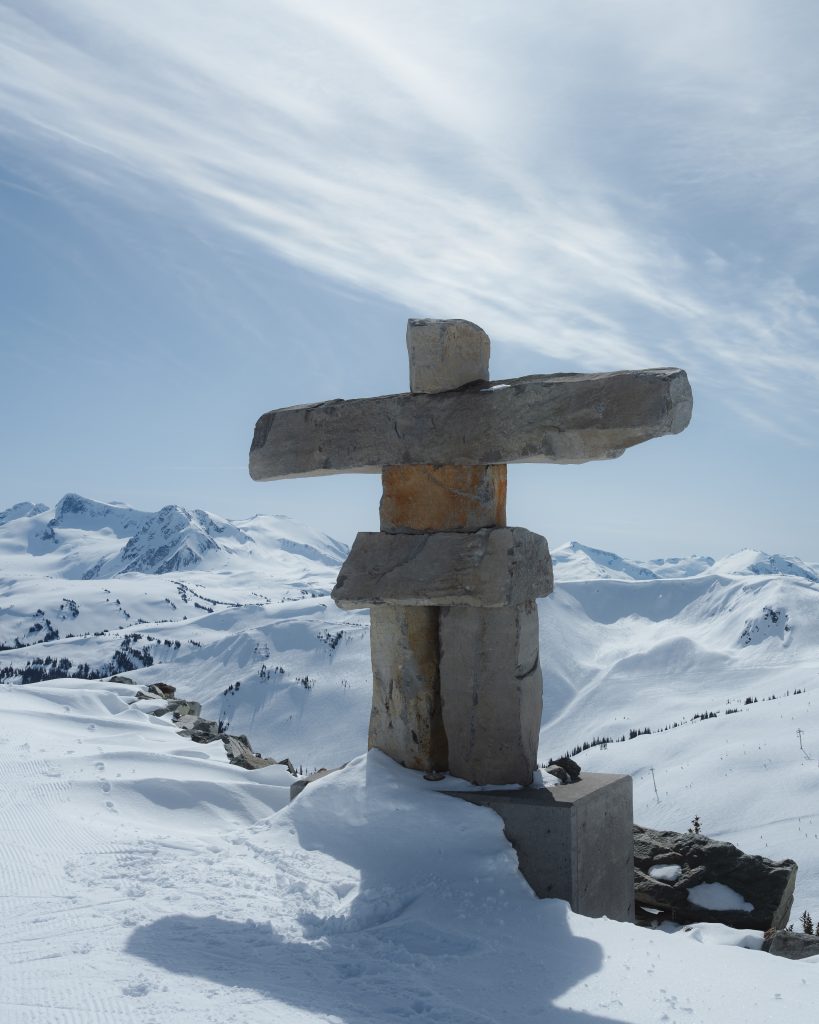
The resort highlights its roots, offering quiet invitations to reflect – like the Peak 2 Peak gondola, its cabins wrapped in Indigenous art. Dotted between Whistler Village Stroll’s thumping bars and clubs are public installations, towering carved Welcome Figures and First Nation statues depicting nature, strength and legend. More snow-covered carvings peek mythically from the slopes. “The Squamish and Lil’wat Nations have agreements with the resort,” my museum guide said. “There are programs now for revenue sharing, employment and training.”
Matt Sylvester
With a new appreciation for the land’s history, I wanted to explore. A trip highlight: Phoebe from Black Tie Ski Rentals pulling up at my friends’ place with three pairs of boots and skis. What luxury, to skip the usual queue in a stuffy rental shop. Owner Todd’s team had dubbed me “aggressive” based on my emailed stats, sparing me the embarrassing shop weigh-in. Village-level exchanges with free swaps make them worth every Canadian dollar, especially in unpredictable conditions.
Something I’d been wary of: TikTok-famous lift queues snaking through town on peak days. On weekdays in February, I found almost none. On weekends, beating the lines just meant getting out early. Pro tip: avoid “the maze” – the Whistler Gondola entrance – and head straight to the Fitz, Garb or Emerald chair route. While tourists wait, you’ll already be carving first tracks down Raven. That, plus a breakfast roll from Splitz Grill, became my daily ritual (after a quick check of Whistlerpeak.com’s webcams). I skied – and ate – like a local: $12 chicken udon at Samurai Bowl and late-night Fuji Market dashes for half-price sushi.
The biggest resort in North America, Whistler Blackcomb’s stats justify the hype. More than 200 runs, 8,050 acres of skiable terrain, 16 bowls and three glaciers for me to throw myself down. I found powder-filled chutes and bowls, tree runs spaced just right and wide-open groomers, plus terrain parks to please the pickiest of park rats.
Embracing my “aggressive” label, I took the Glacier Express to boot-hike Spanky’s Ladder, and drop into Garnet, Diamond, Ruby and Sapphire Bowls. Some of the most thrilling – and humbling – skiing I’ve done, helped by a hip flask of Baileys. A shift from three weeks of drought and sun to 20+ cm of fresh came fast, conditions swinging from wind-packed and crusty in exposed areas to buttery soft in sheltered bowls.
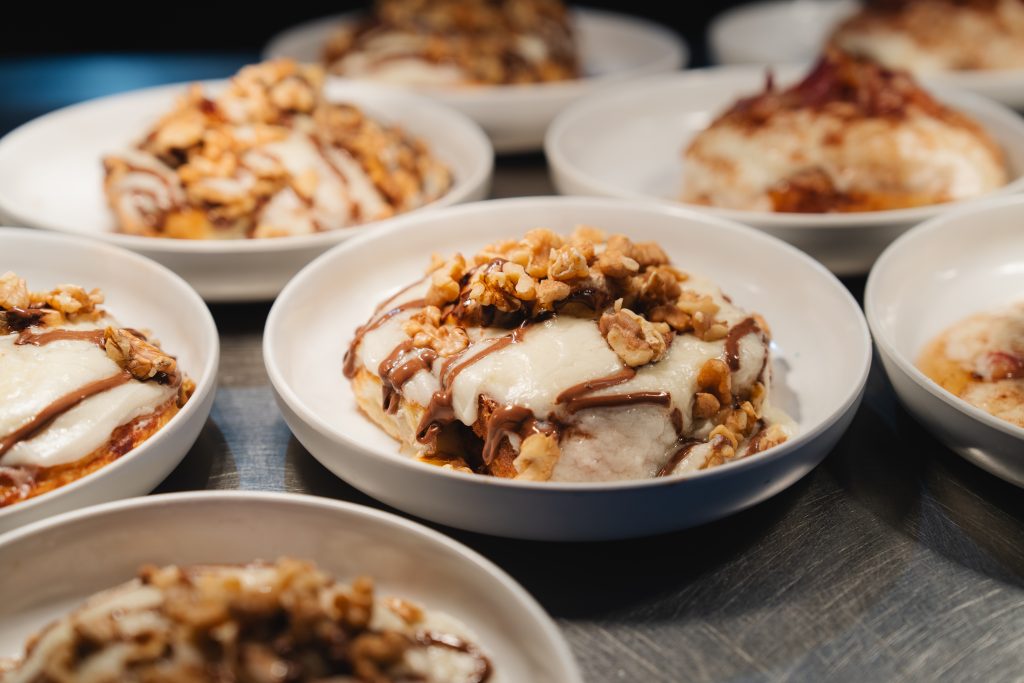
At 7:15 a.m. on a freezing Tuesday, I understood why the die-hards keep coming back (and why lock-ins at Irish bars aren’t advised on ski trips in your 30s). Two espressos down, I joined Dawn Patrol – Whistler Heli-Skiing’s grounded-flight backup. That kicked off several packed days organized by Vail, showing me lines I’d never have found solo. There’s quiet magic in slipping away before the village stirs, carving through untouched powder in total silence. My guide pointed out off-the-map runs only locals know, and by 9 a.m., I was buzzing on adrenaline and sugar. Chic Pea’s oven-fresh cinnamon buns were a fine reward for the brutally early start.
Lunch arrived at Christine’s on Blackcomb, where well-heeled skiers gather for panoramic views, charcuterie boards and rich massaman curry. A local friend jealous of my rather posh itinerary had shared a review: “Order a Bloody Caesar (vodka, clamato juice, Tabasco and celery salt). They used to make you apologize to a turtle if you asked for a plastic straw.” Now, local produce is hauled up the mountain by gondola – a logistical challenge that speaks to their commitment to high-quality sourcing.
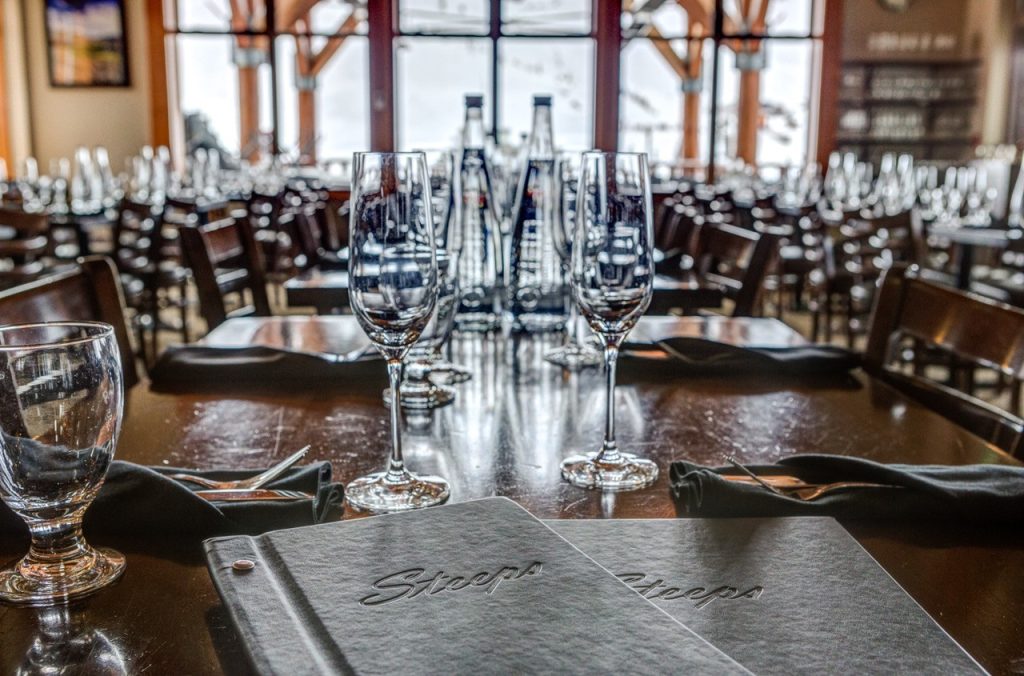
Another elevated experience came via a six-course Winemaker Lunch at Steeps Grill & Wine Bar: beautiful regional bottles, delicate plates and 1,850 vertical meters between punters and a red wine nap (the lift’s there if you lack hubris). Also delicious: Spirit Bear coffees and Ravens Brewing beers on the sunny patio at Raven’s / Sḵewḵ’ / Yecwlào7 – the first Indigenous-inspired restaurant at the Creekside Gondola summit.
The Fairmont delivers peak mountain lodge luxury – cozy fireplaces and big panoramic windows. Ski-in/ski-out access sees guests swap skis for hot chocolates by an on-slope fire. The Mallard Lounge has the buzz everyone’s looking for after a day on the hill. Vida Spa’s heated pools, jacuzzis and private barrel saunas are undeniably luxe (I kept it real with a Meadow Park membership). The Gold floor offers a hotel-within-a-hotel setup, with a private concierge and lounge designed for eating cheese in fluffy robes. Fog rolls over the pines as Blackcomb Gin is poured out, infused with cedar tips and Pemberton hops.
Tourism Whistler/Justa Jeskova
At the base of Blackcomb, staying here drops you into the center of nightlife that stretches far beyond boot-stomping and Burt Reynolds shots (those rum-and-butterscotch shooters show up everywhere). Evenings aren’t about the usual ski “scene” so much as subcultures – part fur-trim and velvet ropes, part champagne super-soakers, part open-mic night chaos. Vallea Lumina is a sort-of multimedia night walk through an old-growth forest, gently sharing ancestral stories. Fire & Ice features St’át’imc Nation hoop dancers telling the story of Spo7ez, an ancestral village buried by a massive rockslide – said to be triggered by the mythical Thunderbird to restore peace. It’s a powerful reminder of Indigenous values of coexistence.
Helicopter tours with Blackcomb Helicopters offer the perspective needed to grasp Whistler’s scale. Every hour in the air is offset by forest preservation on Quadra Island, once earmarked for development. Banking over Whistler Peak, I watched glacier walls glow electric blue. Below, skiers traced threads across vast mountainsides, heading for hidden bowls of powder caches. Our pilot pointed out the Cheakamus Community Forest, co-managed by the Lil’wat and Squamish Nations with the resort. Indigenous knowledge shapes modern conservation, ensuring the land is treated with respect.
Whistler Blackcomb delivers on every skier’s dream – but its heart lies in the land’s history and the people working hard to honor it.
Amy’s trip was supported by Vail Resorts.
Rates at the Fairmont Chateau Whistler start from $600 per night (7-night minimum) in winter, and $407 per night (2-night minimum) in summer.
Now is also the best time to lock in the Epic Pass at its lowest price of the year, with expanded access to Verbier and the 4 Vallées, plus the new Epic Friend Tickets for 2025/26 season giving friends of Epic Pass holders major discounts.
The most famous cheerleaders in the National Football League once belonged to the Dallas Cowboys. Both fans and haters of the Texas stars affectionately referred to the busty, well-coiffed, smiling gals as “America’s sweethearts.”
Today, America’s most-talked-about sweetheart is . . . a man.
This week, the Minnesota Vikings announced its new cheer squad on Instagram in a video that quickly went viral. In it, a young male cheerleader sashays in the middle of a dance group accompanying a caption that reads, “The next generation of cheer has arrived.” Shortly after, another male cheerleader said he also was joining the squad.
They sure stirred up the crowd. Twitter fingers went flying faster than a back handspring. The Minnesota Vikings immediately started trending.
Actor Kevin Sorbo wrote in a tweet, “I’ve been a Vikings fan all my life . . . sigh. I need a new team now.” It was seen 53 million times.
At the time of my writing this, the top comment on the Instagram video with almost 10,000 likes says, “we going 2-98 this season.”
The backlash grew so severe that the Vikings released a statement to media saying: “While many fans may be seeing male cheerleaders for the first time at Vikings games, male cheerleaders have been part of previous Vikings teams and have long been associated with collegiate and professional cheerleading.”
They’re not wrong. Male cheerleaders are hardly a new phenomenon to the NFL. In fact, men have joined the cheer teams since at least 2018. The Los Angeles Rams won a Super Bowl in 2022 with male cheerleaders high kicking and prancing on the sidelines of the game’s largest stage. The Baltimore Ravens have used male cheerleaders and will reportedly feature a record 19 male cheerleaders for the 2025 season. The New Orleans Saints have signed 13 male dancers.
In total, at least 12 NFL teams will feature male cheerleaders this season.
If you really want to blow a social-decorum gasket on the gridiron, the Carolina Panthers also hired the league’s first transgender cheerleader to their Top Cats squad in 2022.
Only now are people taking notice with the Instagram comment button.
As the fervor online hit a crescendo, I couldn’t help but shrug my shoulders, personally. If men help create more eye-catching stunts, then let them hit the high step and make fetch happen. Acrobatics are more appealing on the sidelines in between downs than pom-pom waves.
As I’ve covered games journalistically and watched as a fan, not once have I cared to see who is dancing in timeouts. If anything, I would be annoyed if stadium officials or fans looked at my blonde hair and asked if I was a cheerleader myself. Yes, it happened often. Soccer cleats? Sure. Tutus and hair ribbons, no.
If people want to dance, let them. It’s not like cheerleading professionally is lucrative. It took Netflix featuring a second season of the Dallas Cowboys cheerleaders in a docuseries before the squad received a 400 percent raise. Many other teams pay in the range of $150 per game. Seven football teams don’t even have cheerleaders. The cheer pageantry is not an essential part of the game’s production. But, if it is included, we should argue these individuals make a fair wage. Guy or girl, these people do it because they truly love it – not to make ends meet. The money is peanuts.
As proven by the league’s experience with former Commander’s owner Dany Snyder – whose regime was forced to settle with the cheerleaders after sexual-harassment allegations were made – we should focus more on humane treatment.
So, chill the beers, get the chicken-wing platters ready, and come the season opener, relax. Take your anger out on your fantasy team, because just like the Lambeau Leap, male cheerleaders are now – and have been – a reality in the NFL.
A new bombshell has fallen on the sports-media villa: Dana White cloaked in the glory of a whopping seven-year, $7.7 billion media-rights deal with Paramount to stream all UFC fights on Paramount+ in the United States and select simulcast events on CBS.
For the love of everyone’s wallets, goodbye Pay Per View and hello to a new right-wing cultural shift in mainstream sports coverage.
Why is this new deal so relevant? Since the UFC’s inception in 1993, mixed martial arts existed as its own niche category. Critics openly said it wasn’t a real sport. They lampooned the more brutal style of MMA as less skilled and artistic than boxing, once a more revered American pastime. Even the late Senator John McCain of Arizona famously referred to the UFC as “human cockfighting” in the nineties. The sport struggled to even hold an event in its home city of Las Vegas.
One outsider, however, did believe in it. It was a businessman who threw the UFC a life-saving bone and welcomed it to Atlantic City for a game-changing opportunity.
That lifesaver is the 45th and 47th President of the United States, Donald J. Trump.
When everyone else gave little more than a passing glance to the UFC, Trump welcomed it to his Taj Mahal hotel and casino around the same time White, Frank and Lorenzo Fertitta purchased the organization in 2001. Thus began the entrepreneurial and future presidential bromance of White, Trump and the legion of 70 million American voters who voted for him.
As the sport gradually crept onto bar televisions and churned out such stars as Ronda Rousey, Conor McGregor, Anderson Silva and Jon Jones, White’s allegiance to Trump grew too. White appeared at the 2016 Republican National Convention, a relative newbie to the political world. He once briefly campaigned for Democrat and former Senate Majority Leader Harry Reid of Nevada. But with a fiery speech at that RNC, White shed any past party affiliation for Trump.
“My name is Dana White. I am the president of the Ultimate Fighting Championship. I’m sure most you are wondering, ‘What are you doing here?’” White said to the Cleveland RNC crowd. “I am not a politician. I am a fight promoter, but I was blown away and honored to be invited here tonight, and I wanted to show up and tell you about my friend – Donald Trump – the Donald Trump that I know.”
White continued the campaign favors into the 2024 RNC as well. In turn, Trump, a fan of the UFC, showed his support to White in 2020 when he filmed a video congratulating the sport for continuing to hold live events during Covid. He has also attended several events, making one of his most famous treks through Madison Square Garden following the election at UFC 309. The crowd erupted into chants of “USA,” and a video tribute showed Trump shaking his fist after an assassination attempt in July 2024.
When the President of the United States begins hiring UFC executives into his administration, that sport stops being a niche Spike TV creation. Despite liberal sneers at the sport, its so-called manosphere audience continues to grow. And there’s been a jump in female viewership as well. Six times, women have headlined the PPV preliminaries on Fox Sports 1, earning ratings ranking within the top 20.
Simply put, more and more people are watching the UFC, and the UFC loves the Donald. Trump’s even hosting a fight at the White House next Fourth of July. The sport will be synonymous with the image of America.
The backs and eyeballs of many Trump voters landed this lucrative deal. Maybe the Democrats should take note and stop minimizing the cultural relevance of the sport and its people. Not so deplorable after all.
Fran Lebowitz, the apparently acid-tongued commentator on Manhattan manners, will leave her island next month to dazzle the easily dazzled in the UK. Though to judge by the interview she granted an earnest lady in the Observer, other verbs leap to mind. From any distance it looks suspiciously like a fog of self-regard.
According to the profiler, Megan Nolan, Lebowitz is “a poster girl for a certain kind of crusty but erudite and essentially good-natured New York archetype, intellectual and judgmental, and walking the line between rudeness and frankness with engaging grace.” Good grief! Is this a private ritual between consenting adults, or can we all join in?
“America could be more like New York,” she says, oblivious to the fact that many Americans beyond the Hudson have no desire to hold hands with people who despise them. “It is my belief that the people in the cities should make the laws.” There’s erudition for you.
As for her good nature, the wit of the West Village is clearly not the cheeriest singer in life’s bathtub. “The human being is a horrible species,” she tells Nolan, confirming Dickens in his view that those who rail most vigorously against humanity tend to rank among its most unpleasant specimens.
She’s a philosopher, too. “There are two kinds of people in the world. The kind who own Rembrandts, and the kind who are racing to get the F train.” As Lorenz Hart wrote in a lyric for Richard Rodgers: “I was reading Schopenhauer last night – and I think that Schopenhauer was right.”
Hart was Jewish, like her; homosexual, like her; a native New Yorker, like her. Unlike her, he was witty rather than clever. His songs were not “judgmental.” They were for everybody, and will continue to entertain those who value wit above flummery until the East River flows into the Gulf of Mexico.
Lebowitz does not lack company in the gallery of Manhattan pseuds. She was pally with Andy Warhol (of course), and nobody trapped the nerve of New York solipsism more painfully than that talentless berk. Robert Mapplethorpe, the trendy snapper, must also be numbered among the throng. All those penis-shaped flowers – so daring.
Yet, as the restaurateur Keith McNally has written in his recent memoir, Mapplethorpe and his lover, the ghastly Patti Smith, were quite happy to berate waiters. Little people, you see. Not interleckshuals like us. And let’s not start on that thundering bore, Susan “I’ve read everything” Sontag.
“America could be more like New York,” she says, oblivious to the fact that many Americans beyond the Hudson have no desire to hold hands with people who despise them
Some witnesses saw what lay behind the curtains of celebrity. Tom Wolfe captured the madness in The Bonfire of the Vanities. “What are we going to do with these Republicans?” a guest asked Wolfe at a dinner party. “We could vote for them,” he replied.
The man who really exposed the charlatans was Robert Hughes, the great art critic for Time magazine. Hughes, an Australian republican, was no stick-in-the-mud. He wrote The Shock of the New, that tour d’horizon of 20th-century painting, and always championed new work.
Great were the howls of rage, therefore, when he denounced Julian Schnabel, the darling of the New York art scene, in language which still stings. Nor did he care for Jean-Michel Basquiat, a well-heeled drop-out who passed himself off as a street urchin. Basquiat fooled many New York intellectuals; not Hughes, who spotted “radical chic” at a hundred paces.
What a gruesome crew they make, the salon society thinkers and drinkers who have tried to bag seats once occupied by Dorothy Parker, Edmund Wilson, Robert Benchley, Cole Porter, P.J. O’Rourke and Christopher Hitchens. But let’s be generous to Lebowitz, for she needs all the affirmation she can get.
Nolan obviously sees herself as an understudy: Anne Baxter to Lebowitz’s Bette Davis. “I will tell you all about Eve,” George Sanders says in the opening scene of that great Broadway satire. I will tell you all about Fran, Nolan seems to be saying. Sorry, but we’ve heard enough already.