Category: Europe

  • The Manchester synagogue attack should not come as a surprise

    The Manchester synagogue attack should not come as a surprise

    It is still early in the investigation, and key details remain unconfirmed. But what is already known about this morning’s attack in Manchester is horrifying. At least two people are dead, as well as the attacker. Three others are in a “serious condition.” The attack occurred outside Heaton Park Hebrew Congregation Synagogue, shortly after 9.30 a.m., as members of the Jewish community gathered for prayers on Yom Kippur, the holiest day in the Jewish calendar.

    According to Greater Manchester Police, the attacker used a vehicle to ram into pedestrians before stabbing at least one individual. Armed officers responded within minutes. The suspect was shot but, according to witnesses, appeared to rise again, prompting a second round of fire. Bomb disposal units were later seen surrounding the body. Though authorities have not confirmed whether he was wearing an explosive device, the protocol and urgency of the response strongly suggest that possibility, as do some reports from the site.

    A major incident was declared within minutes. Operation Plato, the UK’s emergency response to a suspected “marauding terror attack,” was activated. Counter-terror police and MI5 are now involved in the investigation.

    At the time of writing, police have not released the name of the attacker or officially stated a motive. But it does not take a great leap of imagination to discern the likely nature of what occurred. This attack bears the hallmark of Islamic terrorism. The method – ramming, stabbing and potential bombing – is grimly familiar. And the choice of target – a synagogue, on Yom Kippur – suggests deliberate timing, designed to cause maximum fear, disruption and symbolic harm to British Jews.

    To state what should be obvious: synagogues are not random venues. They are not theaters or shopping centers or commuter hubs, caught up in indiscriminate violence. They are specific, communal, identifiably Jewish. This was an attack on Jews because they were Jews, gathering to pray on our most sacred day.

    That in 2025 this must still be said is its own indictment. British Jews, just 0.48 percent of the population, have lived under heightened threat for years. Our synagogues, schools and community centers require guards, cameras, fences and entry protocols. The Community Security Trust (CST), a communal charity, operates a national control centre and deploys trained security volunteers across the country. These lived necessities were born of painful experience.

    Today is the brutal consequence of what so many Jews have been warning about, and living with, for years.

    Since the Hamas attacks of October 2023 and the subsequent war in Gaza, the UK has witnessed an unprecedented wave of anti-Jewish hatred. CST recorded over 4,000 anti-Semitic incidents in 2023, double the previous year, and the highest ever documented. Last year brought more of the same: verbal abuse, online threats, vandalism, assaults, intimidation of children in schools, harassment of Jewish students on campus, doctors spreading anti-Jewish rhetoric without sanction. In London, Manchester, Birmingham and beyond, Jews have felt exposed and abandoned, and have warned over and over again only to be ignored.

    The atmosphere is toxic. Many Jews have stopped wearing visible signs of identity. Some no longer speak Hebrew in public. Conversations about emigration, once marginal, have become widespread. The mood is not just anxious; it is alienated. And this will only make it worse. Many of us feel our country has abandoned us and worse encourages those who hate us, giving them license to express their hatred more openly and brazenly every day.

    All of this has happened against a backdrop of regular “anti-Israel” marches where chants spill into open hatred of Jews, sermons from mosques which have been exposed on national television spew invective, and media narratives frame Jewish safety as a political inconvenience. A climate like this does not stay rhetorical. It incubates violence.
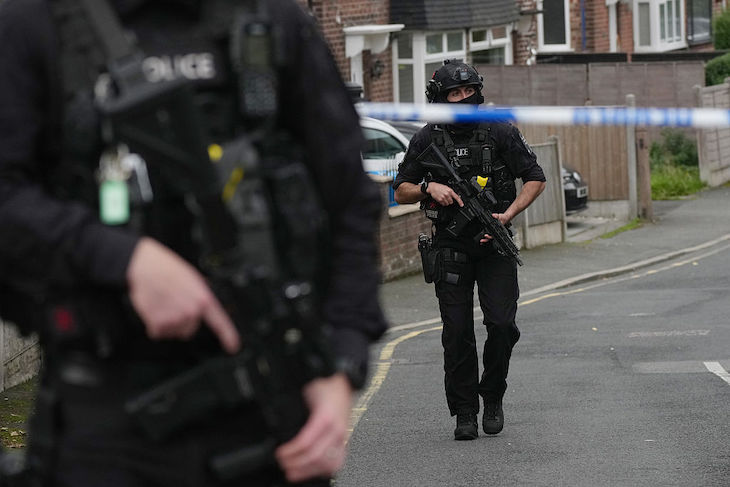
    Armed police seal off a road close to the scene of the fatal attack (Getty Images)

    This is the real climate crisis of our era, and yet “net zero” for Jew-hatred is nowhere on our government’s agenda. Instead, our Prime Minister rushed to recognize a Palestinian state days before a serious plan was unveiled by America and Israel to end the war in Gaza and start a process to encourage the Palestinians to reject extremism and violence. The UK emboldened Hamas and those who have marched against Israel and Jews week after week on our streets. The global warming we ought to be most worried about is the rising temperature of debate and news coverage when it comes to Jews and Israel, for today’s attacks like today’s is where that leads.

    Keir Starmer has said “additional police assets” will be deployed to synagogues nationwide and promised that the government “will do everything to keep our Jewish community safe.” He has expressed his horror that such an attack took place on Yom Kippur. This is hardly reassuring. Many blame him for his government’s absurd emboldening of Hamas, and constant vindictive, anti-Israel actions and statements. The fish rots from head.

    Words of sympathy are necessary, but they cannot substitute for years of ignored warnings. Repeated failures to arrest hate preachers, to discipline antisemitic professionals, to prosecute violent demonstrators, or to confront institutional media bias have left the Jewish community exposed. It is not the fault of Jews that we must secure ourselves through voluntary communal organizations – it is the fault of a society that allows hatred to fester.

    And now, on the Day of Atonement, in a city where Jews have lived for centuries, in a once great nation where Jews have contributed disproportionately in every field, we face the all too familiar spectacle of our sacred space turned into a crime scene. Jewish blood is cheap, it seems.

    Let no one pretend this came from nowhere. Let no one feign surprise. The signs have been visible. The hate has been loud. And the consequences are now bleeding into the streets.

  • Moldova has been saved from Russian influence – but at what cost?

    Moldova has been saved from Russian influence – but at what cost?

    The European Union, guardian and champion of democracy, rightly takes a dim view when ruling parties ban their opponents, refuse to open polling stations in areas likely to vote against them, censor opposition news channels and allow a large staff of foreign election monitors to police social media in the run-up. If Serbia, say, or Georgia tried systematic election rigging of this kind, Brussels would be the first to call foul and disregard the result as illegitimate. But when it’s the EU that’s running the interference, as in Moldova this week, the rules are apparently quite different.

    This week the pro-EU party of Maia Sandu, Moldova’s President and a former World Bank official, won a slim majority in a general election. Her main opponent was Igor Dodon, who led a coalition of pro-Russian parties which were heavily backed by the Kremlin (lest anyone doubt their ideological bent, the opposition’s election symbol was a hammer and sickle inside a heart inside a Soviet five-pointed star). The race was seen as a showdown between Europe and Moscow over control of a poor but strategically important ex-Soviet state – a category that also includes Georgia and Ukraine.

    “Not only did you save democracy and kept the European course, but you have also stopped Russia in its attempts to take control over the whole region,” the Polish Prime Minister Donald Tusk wrote in his public congratulations to Sandu. “Moldova, no attempt to sow fear or division could break your resolve,” wrote the European Commission president Ursula von der Leyen. “You made your choice clear: Europe. Democracy. Freedom. Our door is open. And we will stand with you every step of the way.”

    There is little doubt that Moscow opened its wallet wide – as well as its usual bag of electoral dirty tricks – in its attempt to influence Moldova’s elections. Telegram, a news and messaging app, openly hosted channels offering cash for votes. There were well-documented stories of Orthodox priests receiving bribes in order to influence their flocks. Several main opposition parties were not just pro-Moscow but provably funded by Moscow too. Pro-government Moldovan media estimate – without much proof – that the Kremlin dropped some $400 million, or 1.5 percent of Moldova’s GDP, on its failed influence operation.

    To counter the Kremlin’s campaign, the EU deployed what the foreign policy commissioner Kaja Kallas described as “a specialist team on the ground [to help] Moldova address illicit financing around the elections” as well as “a group of experts, a hybrid rapid response team, to support Moldova against the foreign interference.” Among the tasks of the EU’s team of electoral experts was to monitor online news and social media, and to use Europe’s investigative firepower to track campaign finance violations in the form of Russian money. The European Commission also dangled an irresistible €1.8 billion support package to underpin Moldova’s economic growth plan on its path to the EU.

    According to Telegram’s founder, the Russian billionaire Pavel Durov, Europe had some dirty tricks of its own to play. The day of the election, Durov announced that France’s secret services had approached him last year with a covert deal while he was detained in Paris on charges of failing to police criminal activity on Telegram. According to Durov, French spooks “reached out to… ask me to help the Moldovan government censor certain Telegram channels ahead of the presidential elections.” In exchange, the security services allegedly offered to help Durov with his legal problems – apparently a crude good cop, bad cop shakedown.

    At first, Durov claims, Telegram “identified a few [channels] that clearly violated our rules and we removed them.” But when a second list was produced that for the most part included channels that were “legitimate and fully compliant with our rules” but were simply critical of the Moldovan government, Durov refused to comply. “Telegram is committed to freedom of speech and will not remove content for political reasons,” he wrote. “I will continue to expose every attempt to pressure Telegram into censoring our platform.” France’s security services have not commented.

    Just two days before the vote, Moldova’s electoral commission banned two opposition parties – both believed to be funded by Moscow – though their names remained on the ballots, meaning that the votes of anyone who mistakenly voted for them were lost or went to other parties. President Maia Sandu had called for the large numbers of Moldovans working abroad to take an active part in elections. But just two polling stations were set up in Russia to serve the estimated 78,000-150,000 electors who live there versus more than 70 in Italy, home to some 100,000 Moldovans. In the neighboring Russian-controlled statelet of Transnistria, which lies between Moldova and Ukraine, several polling stations were moved at the last moment and two of the bridges linking the territory to Moldova were under repair, hindering people’s ability to vote.

    Do such measures amount to anti-democratic censorship and electoral interference – or are they legitimate acts of self-defense? The story of Moldova’s elections is reminiscent of Cold War Europe, when Moscow poured cash and resources into Euro-communist parties while Washington bankrolled right-wing parties such as Italy’s Christian Democrats – explaining why many Europeans are still so prone to political conspiracy theories and to seeing the secret hand of America everywhere. Moscow, for its part, has long maintained that democracy movements in the former Soviet Union, from Kyiv to Tbilisi, Minsk to Bishkek, have all been orchestrated, financed and directed by the West as a covert means of extending power through the former Soviet Empire.

    On balance it’s probably Europe, with its huge trading bloc, track record of fighting corruption in its newest member states and deep (at least by Moldovan standards) pockets that offers a brighter future for the country than Russia. Today’s Kremlin, unlike its Soviet predecessor, offers no inspiring ideological vision and can’t spare much cash to fund its overseas clients. But at the same time Russia remains a major trading partner of Moldova, and many citizens feel close cultural ties to Moscow. Forcing Russia’s neighbors to make a binary decision between East and West has proved not just divisive but has also, in the case of Ukraine and Georgia, led to bloodshed. In Georgia, recent elections have rejected former president Mikheil Saakashvili’s radical pro-EU, pro-NATO course in favor of friendship with Russia – with the result that Georgia’s economy grew a staggering 9.4 percent last year.

    Many Europeans are congratulating not just Moldova but themselves on saving the country from Russian influence. But the question remains whether Sandu’s victory makes Europe look strong or weak. On the one hand, Brussels won. On the other, just as with Boris Yeltsin’s gerrymandered election victory in 1996, democracy had to be strangled in order to save it.

  • Grow a pair, Euro cry-bullies

    Grow a pair, Euro cry-bullies

    After a weekend of bloodlust at Bethpage, the European team pulled off a stunning victory to take home the Ryder Cup. So why are they so sore about it?

    Golf is known as a gentleman’s game, with countless unwritten rules of etiquette. The Ryder Cup is a rare exception, where the 12 best golfers from Europe and America duke it out not for money, but for glory, and rowdy fans bring their national pride to bear.

    The American fury picked up as the Europeans sprinted ahead on Saturday, leading to an overall air of chaos. Forget the “golf clap” – heckling, shouting and four-letter cursing became the standard behavior as European players walked past the grandstands or lined up their shots.

    Conduct became so bad that Irishman Rory McIlroy, typically a fan favorite in America, went viral for telling a fan to “shut the fuck up” on the 15th hole. He then refused to play until course officials could calm down the crowd. Then someone even lobbed a beer can at his wife as the gallery turned into a mosh pit.

    Sure, it’s probably not the best look for the master of ceremonies, American comedian Heather McMahan, to start a “fuck you, Rory” chant into a live mic. And manners matter, no matter which side of the pond you’re on. But if this were any other sport, no one would bat an eye. And the European whining here seems to massively overstate a bit of rowdy banter.

    Is McIlroy really such a baby that he can’t play through a little heckling? He’s from Northern Ireland, one would think he’s made of tougher stuff.

    Does a comedian really deserve to lose her job for getting into the atmosphere and firing off a poor taste quip? Maybe, probably. But she apologized and stepped down from her MC role – we don’t need the whole media struggle session to boot.

    Yet that’s exactly what the media ran with over the weekend, quoting endless Europeans tut-tuting American sportsmanship. The story wasn’t the Cup itself, despite a better-than-usual tournament – but how tacky and awful the Americans are.

    “What I consider crossing the line is personal insults,” Luke Donald, the European captain, said at a news conference Saturday night.

    “Nothing was going to happen, there wasn’t going to be a physical altercation, but there was a lot of language that was unacceptable and abusive,” McIlroy said.

    “They kept talking about [McIlroy’s] wife, and I thought that was disrespectful. That’s apparently what New York does,” one self-righteous Irishman told CNN Sports.

    What New York (and America) most certainly doesn’t do is jail sports fans for “unacceptable language” that hurts no one. These Euro cry-bullies should take note for their own, much rowdier, soccer hooligans rotting in jail.

    Yet a certain kind of American liberal, particularly those in the media, still loves to scoff at the spectacle. “Look at our unsophisticated countrymen,” they sneer, seeking the European seal of approval that every would-be cosmopolitan craves.

    But they should remember that brutality is the norm when Western powers clash, and goes far beyond a few naughty words. Sport – no longer war – is the civilized man’s version of barbarity, a place for him to take out his violent proclivities within some clearly delineated boundaries. You can’t blame him for stepping ever so slightly out of line once his blood is hot.

    And a little excess rowdiness is a good thing. In America, we’ve all become a little too accustomed to therapy-speak. We lean on euphemisms and platitudes, not only in sport, but in politics and business and every place where candor is key. So we swallow outrages with approved terms like “feelings” and “harm” and “impact,” all too concerned with sensitives and perceptions, and then wonder why the temperature keeps rising.

    If you want to make a difference – and let out a little steam – some unbridled hostility goes a long way. The American Founders, after all, were more than happy to throw a few punches in the midst of otherwise polite society.

    What matters is that we can all shake hands at the end of the day, putting sportsmanship back to their rightful place without ever holding a grudge. And here, it’s the Europeans – not the Americans – who are failing to mind their manners.

  • American sports fans are an embarrassment

    American sports fans are an embarrassment

    Transatlantic tensions and heckling boiled over at the Ryder Cup Saturday, with multiple fans reportedly escorted off the property at Bethpage Black Golf Course.

    On the international stage, Americans are known for often being loud, brash and utterly uncouth. The attitude is a product of the country’s endearing patriotism and unfettered confidence. The Ryder Cup is a case in point of this. The limits of unruly behavior from American fans have known no bounds since the start of the tournament in Long Island. Chants of “U-S-A” quickly shifted to straight-up jeers at European players, notably the duo of Rory McIlory and Shane Lowry, both of whom snapped back in reaction.

    McIlroy was approaching his shot on the 16th green when several members of the crowd began shouting. One American man yelled, “freedom.”

    The Northern Irishman and recent Masters winner stepped back from his tee and said, “Guys, shut the fuck up.” Earlier in the day, McIlroy had blown kisses back at the crowd in agitation and was even caught on camera flipping off fans.

    He went on to deliver a clean shot onto the green and propel himself and Tommy Fleetwood toward a win over the U.S. pair of Harris English and Colin Morikawa. But he refused to bite his tongue in response to the day’s extracurricular activities.

    “I don’t mind them having a go at us. That’s to be expected. That’s what an away Ryder Cup is,” said McIlroy. “Whenever they are still doing it while you are over the ball and trying to hit your shot, that’s the tough thing. In between shots, say whatever you want to me. That’s totally fine. But just give us the respect to let us hit shots, and give us the same chance that the Americans have.”

    Shane Lowry’s anger also flared in the tournament. His caddie was caught on video appearing to physically restrain him before Lowry singled out an unruly fan to security.  

    Here’s the thing: In a sport similar to tennis for its supposed decorum, to the point of having a cliche gesture called the “golf clap,” this raucous behavior by fans is antithetical to the game’s nature of calm and quiet focus. This inflamed unruliness may be a byproduct of cameras and social media existing everywhere and at the touch of our fingertips – everyone wants attention, for good or for bad. Or, perhaps, Americans simply are proving their own inability to host a prestigious international event.

    Take college football, unique in its cultural imprint on American fall weekends. Friday night, the University of Virginia upset 8th-ranked Florida State University in overtime. The entire student section stormed the field, while FSU receiver Squirrel White was still laying in the corner of the end zone. Moments later, an adult Virginia fan took a picture (which has since gone viral for its crudeness) of himself flipping off a Florida State player on the field.

    Fortunately, nobody was hurt in the stampede, but the ACC fined the University of Virginia $50,000. Sure, thousands of fans joyously celebrating on a field looks cool…but at what cost to basic human decency?

    It is that same lack of dignity we all are witnessing at the Ryder Cup. Sure, McIlory is mercurial and known to let his temper get the best of him sometimes on the tour. But he and every other European player has the right to compete with fair treatment, just like the Americans.

    “Go big or go home,” we say in America. But if Americans cannot attend a top-tier professional event with manners, maybe they should simply stay home. Let the players compete without a live audience. Ryder Cup officials should consider whether these spectators deserve a viewing place on the greens. The onus is on them to make changes to ensure this kind of frat-bro behavior does not repeat itself in the coming years – on these shores, or abroad 

  • Trump takes a pass on brokering peace in Ukraine

    Trump takes a pass on brokering peace in Ukraine

    Has Donald Trump just announced the most consequential foreign policy reversal of his presidency? If so, Ukraine’s President Volodymyr Zelensky and France’s Emmanuel Macron – the last leaders to speak to Trump just before his epochal announcement – should be careful what they wish for.

    In the mother of all flip-flops, Trump on Wednesday posted on Truth Social that “Ukraine, with the support of the European Union, is in a position to fight and WIN all of Ukraine back in its original form.” That’s a position that even Biden, in his most optimistic moments, never dared to take. Trump claimed that Russians were finding it “almost impossible” to buy gasoline (by implication, as a result of Ukrainian drone strikes), that “Putin and Russia are in BIG Economic trouble.” To add insult to injury, Trump also called Russia a “paper tiger” that had been “fighting aimlessly for three and a half years a War that should have taken a Real Military Power less than a week to win.” 

    Ouch. That’s about as hard a diplomatic gut-punch that Trump could deliver, short perhaps of calling Putin a coward and a liar. Trump also went out of his way to praise Zelensky at a civil sit-down meeting at the United Nations. “Frankly, Ukraine is doing a very good job of stopping this very large army,” Trump said. “It’s pretty amazing.” That’s a very far cry from Trump’s confrontational “you have no cards” speech to Zelensky in the Oval Office in February. 

    On the face of it, Zelensky got exactly what he wanted from Trump, pushing the line that Moscow faces economic collapse and that Ukraine has a realistic chance of expelling Russian forces from its territory. But in truth Trump’s announcement is terrible news for Kyiv and the future of its war effort. 

    Trump’s statement is not a declaration of support for Ukraine, it’s Trump’s resignation from further participation in the peace process. And the sting in the tail of Trump’s announcement is a crystal-clear declaration that he now considers the Ukraine war Europe’s responsibility. A Ukrainian victory is possible “with the support of the European Union,” wrote Trump. All it will take is “time, patience, and the financial support of Europe and, in particular, NATO.” Except, crucially, that Trump clearly refers to NATO as something distinct from the US, promising that Washington “will continue to supply weapons to NATO for NATO to do what they want with them.” Note the weasel word “they.”

    To be fair to Trump, walking away from trying to make peace in Ukraine was always on the cards. Back on April 18, Trump told reporters at the White House that he wanted to get a peace deal “quickly.” But he also warned that “if for some reason one of the two parties makes it very difficult, we’re just going to say, ‘you’re foolish, you’re fools, you’re horrible people, and we’re going to just take a pass. But hopefully we won’t have to do that.”

    Turns out Trump did end up taking a pass, just like he promised – and Vladimir Putin is to blame. Despite a reputation in some quarters for being a master manipulator, Putin utterly failed to correctly read Donald Trump. Defying media criticism and resistance from parts of the Republican party, Trump took a major political risk in inviting Putin to Anchorage, Alaska, giving the Russian leader red-carpet treatment and even repeating some of Putin’s talking points. Trump gave Putin respect, face and made him a supremely generous offer essentially to freeze the front lines in Ukraine and allowing Russia to hold on to the occupied territories. 

    Instead of banking that amazing breakthrough and calling it a day in Ukraine, Putin stupidly did not give Trump an inch. Instead of stopping his missile bombardments of Ukraine – something that clearly angered Trump and prompted his angry message “VLADIMIR, STOP!” – Putin instead doubled down and intensified his attacks on Ukrainian cities to unprecedented levels. Instead of continuing talks with Kyiv, Putin high-handedly ignored Trump’s calls for him to meet Zelensky. And instead of winding down the war, the Kremlin has done the opposite, launching a series of incursions into NATO airspace. Seen from the White House, Putin’s recent behavior has not just been murderous and provocative – it’s been downright disrespectful. And Trump does not appreciate being disrespected. 

    There is possibly another, more calculating hypothesis behind Trump’s reversal. It’s been clear for a while now that the peace process with Putin is dead in the water – which means no great oil and gas deals or multi-billion dollar mineral rights that will help make America great again. So it’s time to open the shop doors wide and allow Europeans to buy hundreds of billions of high-end weapons from the US for use by Ukraine. The bill just for Patriot missiles of the kind that Ukraine says it needs to create an Iron Dome-like air defense system is $100 billion for that system alone. That way the US economy gets a different kind of boost, while Trump washes his hands of any political downside.

    If there’s one thing Trump hates more than disrespect, it’s to be seen to fail. With his peace initiative floundering on Putin’s intransigence, small wonder that Trump chose to walk away from the coming train wreck and leave European allies to sort out the mess – and foot the bill. 

    Essentially, Trump has called Europe and Zelensky’s bluff. You say you can defeat Putin? You go for it, buddy. You say you won’t allow aggression to be rewarded in Europe? Sure, guys, knock yourselves out. Trump also made it clear that he’s walking away from sanctions, too, by pointing out the painfully obvious fact that it’s Europe, not just China and India, which remains a major importer of Russian energy and therefore one of the biggest funders of the Kremlin’s war machine. Trump told the Europeans he would not sanction Russia further until they stopped importing Putin’s oil and gas – which the EU can’t and won’t do, despite all their fighting talk. 

    For the whole duration of the war European leaders have been making fine-sounding promises to Ukraine that it expects the US to pay for. That includes Macron and Sir Keir Starmer’s latest idea of creating a “coalition of the willing” which proposes a “reassurance force” on the ground in Ukraine – just as long as its backed by US air-power. With his flip-flop on Ukraine, Trump has clearly signaled that Uncle Sucker isn’t going to play that game any more. Trump may still be willing to defend its NATO allies – but when it comes to Ukraine, Europe is on its own, militarily and diplomatically.  By the same token, the White House is through with listening to any more of Putin’s bull-crap. In the rich Russian phrase, Putin “doprygalsya” – literally, jumped himself into a bunch of trouble. 

    Ukraine, Russia and Europe have nothing to celebrate and a lot to rue. Thousands more people are going to die pointlessly, with little prospect of achieving a significantly different outcome than the one Trump put on the table and Putin rejected. The dogs of war remain off their leashes, and the havoc will continue until Ukraine runs out of men – or Russia runs out of money.

  • Beware the restless, shifty liars

    Beware the restless, shifty liars

    I have only been to Alexandria once, some years ago, when Hosni Mubarak was still in power, but it struck me as a sad city. Of course the library was not the library. The lighthouse was not the lighthouse. The city was not the city. I looked around for the remnants of the Greeks who had made it their own, but there seemed little left of them.

    Alexandria was on my mind again this week while reading a new biography of the city’s most famous modern poet, Constantine Cavafy (1863-1933). He was part of that world which migrated across the Mediterranean. Born in Alexandria, Cavafy and his family spent time in Liverpool before moving back to Egypt, fleeing to Constantinople, before returning to the already fading city. His social circles included the sort of Greek families that had fled Smyrna, Chios and other massacres committed by the Turks.

    As the family trading business declined, Constantine, his siblings and finally their children lived within ever more slender means. But it was a letter from Cavafy to his most important non-Greek literary friend that struck me most. The poet and E.M. Forster became friends in the 1910s when the English writer was in Alexandria. Forster did more than anyone else to bring Cavafy’s work out to a non-Greek-speaking audience. One letter from Cavafy to Forster seems particularly notable. He wrote: “Never forget about the Greeks that we are bankrupt. That is the difference between us and the ancient Greeks and, my dear Forster, between us and yourselves. Pray, my dear Forster, that you – you English with your capacity for adventure – never lose your capital, otherwise you will resemble us, restless, shifty liars.”

    American politicians have a certain boldness in their financial aspirations. Pelosi has made hundreds of millions

    I suppose Cavafy’s warning brought to mind, among other things, the UK’s former deputy prime minister Angela Rayner, specifically the issue over her unpaid £40,000 in property taxes on a second home. But it also brought wafts of those other great scandals of recent public life, such as the Scottish National party’s Nicola Sturgeon and her husband having to answer questions a couple of years back about the use of party funds to purchase a luxury camper van worth a six-figure sum. American politicians, at least, have a certain boldness in their financial aspirations. Nancy Pelosi, for instance, has managed to acquire a wealth running into hundreds of millions during her time in office. Her investments have consistently outperformed those of even the canniest hedge funds. But Pelosi has never faced any special censure over this. Whatever the rights or wrongs of her dealings, there is a grandiosity among US lawmakers in their search for wealth.

    Britain’s politicians seem to fit into a different category, and I wonder if it doesn’t have something to do with what Cavafy was warning Forster about. According to the Office for National Statistics, the UK had to borrow £60 billion in the financial year to July – almost £7 billion more than the same time last year – and spent £41 billion to service its debt. Like most fiscal conservatives, I am slightly amazed at the financial and moral presumptions that lie behind this. Is there something we Britons are doing with our money as a nation that is so tremendous that it makes it worth running up this kind of debt? Is there a cause we are financing so considerable that it is decent to pass the bill on to the next generations?

    It is no better in France. Their government may be less stable than our own, but they have all the same problems. France is also in a debt crisis. And the French parliament, like the British parliament, remains resolutely opposed to doing the things a responsible country would do to address it, such as cutting the astronomical spending on every arm of an increasingly corrupted and incompetent welfare state.

    In France, the right, as much as the left, is given to promising an unending money-spigot to voters. In fact, right-wing parties are in some ways worse, cynically recognizing that one way to achieve success at the ballot box is to tack right on identity but left on economics. Yet it is not as though Europe’s politicians don’t realize the realities Britain faces. It is 13 years since Angela Merkel said something true to London’s Financial Times: “If Europe today accounts for just over 7 percent of the world’s population, produces around 25 percent of global GDP and has to finance 50 percent of global social spending, then it’s obvious that it will have to work very hard to maintain its prosperity and way of life.” Many people nodded sagely, but in the years that followed even Merkel made sure all those figures went in the wrong direction.

    Since 2012 we have vastly increased the numbers who have come here to the UK, Europe’s share of global GDP has gone down some 10 percentage points and we have hiked our welfare spending to such a sum that we now even extend the state’s munificence to people who have broken into our countries and never contributed anything to them. Whether people in Britain or Europe have actually spent the past 13 years working hard to maintain our way of life is a matter of opinion.

    I wanted to pull these threads together to say this: it is clear that we in Britain and Europe are indeed losing our capital. In part because we do seem to have lost our capacity for adventure – content instead to eke out what money we can in whatever time there is, with ever-lower aspirations for the future. It could be turned around, of course, but not without a Herculean desire to do so and a sincere recognition of the point we are other-wise heading toward.

    What is that point? I would say it is a time when our cities will also not be our cities. And when we too have a preponderance – not least in our political life – of the type of people that the poet warned about: restless, shifty liars.

    This article was originally published in The Spectator’s September 29, 2025 World edition.

  • Donald Trump and Keir Starmer make an interesting pair

    Donald Trump and Keir Starmer make an interesting pair

    There is just something innately funny about seeing Keir Starmer and Donald Trump together. Two men so obviously different; in character, interests, ability and shape, forced together by circumstance. Watching them at the press conference today was no exception. They put me in mind of Bialystock and Bloom from The Producers: the bombastic Broadway shyster and his hapless sinusitis-suffering goon.

    First, for their “business roundtable,” they sat together behind a comically small table inside a marquee, which made them look like an unlikely scoring partnership at a village cricket match or as if they were signing the registers at a low-budget gay wedding. Alternatively, they looked a bit like they were appearing on a British panel show. I can think of a title: Don’t Mention Mandy! Two statesmen have to get through an Anglo-American bilateral summit without mentioning the sacking of a certain ambassador just last week for high-profile nonce-adjacency!

    Sir Keir spoke first, about the substance of the deal that they were about to sign, but also gave himself a series of pats on the back for having achieved it. “It comes down to leaders who respect each other, to leaders who genuinely like each other.” At this point the Prime Minister gave the President a weird sort of tap on his shoulder which I think was meant to be affectionate. Donald smiled a smile which might have been a Cheshire Cat grin or could have been the sort of smile a Mafia boss gives when he makes a note to have someone killed for a minor slight.

    When it came to his turn, Trump repeated that it was the first time there had been a second state visit, three times, which was numerically quite confusing. Then again, so much of how the President operates comes down to his truly bizarre use of the English language. It’s almost hypnotic. Again the contrast with Sir Keir couldn’t be clearer. Starmer speaks in robotic, staccato sentences. Everything. Is. Designed. To. Sound. Like. A. Safety. Briefing. In contrast Mr Trump embarks on long sweeping sentences, beautiful sentences, often with an aside about something that a lot of people don’t realize, which is OK, before ending up on a subject completely different from where he started.

    Certain words were used by Trump again and again – “beautiful,” in particular. Things the President believed were beautiful varied from Her Majesty Queen Camilla, Sir Keir Starmer’s renovation of Chequers and the British aerospace industry. He did speak briefly about the deal before going into one of his meandering concertos of consciousness about the things that made America the “hottest country in the world.” Awkwardly for Sir Keir, one of these was getting the border under control. As he did so, the PM sat there, going both pink and grey at once, like a condemned tin of luncheon meat. Still, Donald eventually came into land with a final nod to Britain and, as if by magic, folders appeared for the men to sign, the Prime Minister with the Parker pen which he doubtless got for free for just enquiring and the President with a massive Sharpie.

    After lunch, the unlikely duo hosted a press conference in front of a Jacobean fireplace and enough national flags to make Emily Thornberry squirm. The President thanked British subjects for their condolences following Charlie Kirk’s murder, and spoke of Vladimir Putin as if he were a philandering ex: “He’s let me down. He’s really let me down.”

    Bev Turner of GB News asked the Prime Minister a question about Christianity – which in fairness is one of the few beliefs Sir Keir has never professed to hold. But perhaps not for much longer; the avowed atheist spoke of being christened and the importance of the Church of England throughout his life. Given how desperate his domestic situation is, perhaps a conversion is on the cards. To paraphrase Voltaire on his deathbed when asked to denounce the devil: “Now is not the time to be making enemies.”

    Turner also asked a question about the free speech situation in Britain – a subject which triggers palpable discomfort in the PM, who always reaches for the same identically-worded answer. “We have had free speech in Britain for a long time,” he droned, inevitably, through his nose. For what it’s worth, I don’t think this is quite the defense Sir Keir perceives it to be, especially coming from him. After all, we’ve had agriculture since probably the Bronze age and he seems pretty determined to destroy that.

    Finally a reporter invoked the Mandy-shaped elephant in the room. President Trump having denied ever knowing his former ambassador, the question passed to Sir Keir, who shuffled his notes and gave another answer that sounded like it had been dictated by a solicitor or crisis-comms team. “New information came to light,” he snapped. “It’s very straightforward!” Luckily for him, there were no supplementary questions.

    It was all smiles, but I suspect the Donald knows that next time he comes to visit his favorite foreign country, it might well be someone else meeting him off the plane.

  • Trump returns to backwater Britain

    Trump returns to backwater Britain

    President Trump returns to Britain this week for his second state visit, to a country which is much changed yet depressingly still the same. On his first, six years ago, Britain had yet to complete its departure from the EU, Elizabeth II was still on the throne and the Conservatives still in power – with three Prime Ministers to go before their eventual ejection from office. He will no doubt receive a warm and dignified welcome from King Charles, whatever is going through the monarch’s head – the impeccable neutrality of the British throne has survived the change of reign. Yet the President will find a country that is anything but transformed by Brexit or by its change of government.

    Brexit presented Britain the opportunity to take a sharply different route from the low-growth track on which socially democratic Europe is trapped. Yet neither this government nor the previous one have chosen to exercise their new-found freedoms. Britain instead has become just another brand of European social democracy. It has a few new trade deals, not least a more favorable regime with the US, which it would not otherwise have. Yet far from controlling its borders, Britain has opened them up while politicians promised to do the opposite. Illegal arrivals in boats from France (who account for a small proportion of overall migration but a very visible one) have mushroomed, the government apparently powerless in the face of human rights lawyers. Few migrants even need to complete the crossing in their rubber dinghies – they are picked up and delivered to UK shores by coastguard patrol. Many are then put up in hotels. The public seems finally to have had enough: when an Ethiopian asylum-seeker was arrested for suspected sex offenses against a 14-year-old girl in July (he was later convicted) it sparked a summer of protests outside the hotel.

    But above all else, Britain remains trapped in economic mediocrity. Keir Starmer’s Labour party came to power in July last year promising “growth, growth, growth” – the same promise made by Liz Truss in her short-lived spell as Prime Minister in 2022. The economy failed to register any growth in July, and is up a weak 1.5 percent in the past year. In terms of GDP per capita the UK economy is no larger than it was at the time of Trump’s 2019 state visit. Moreover, the government seems to have few policies which are likely to achieve growth. On the contrary, one forthcoming parliamentary bill threatens to make it far harder to fire inadequate staff and will make it easier for unions to go on strike. Having escaped from EU regulation, Britain now seems intent on outdoing the bloc on job-destroying laws. It doesn’t help that the Labour government, in one of its first acts, awarded large pay rises to doctors, train drivers and other public sector workers without attaching any conditions to improve productivity. Rising UK government bond prices are a hint as to how dispassionate global investors see Britain: a country trying to live beyond its means, and consequently where inflation is bound to run ahead of other countries. Even Greece, thought of as a basket-case until recently, has lower yields on its long-dated bonds.

    Britain’s lack of confidence is there to be seen in the sinking fortunes of its governing party. Prime Minister Keir Starmer was never as popular as his huge parliamentary majority suggested – he commanded only just over a third of the popular vote last year, in spite of his party winning a handsome majority of its seats. Yet there is a serious possibility that Starmer will not make it to fight another general election due in 2029. He is deeply unpopular even within his own party. He has been badly damaged by two recent resignations: first of deputy Prime Minister Angela Rayner, who admitted to underpaying tax on an apartment she bought on the south coats, and then that of US ambassador Peter Mandelson, after details of his close relationship with Jeffrey Epstein were revealed. Starmer, it seems knew some of the details but had chosen to appoint him to the job anyway.

    For the moment, the political future seems to belong to Reform UK and its charismatic leader Nigel Farage. The party is steadily displacing the Conservatives as the party of the right, yet is also picking up disaffected working classes in Labour-held seats. Not unlike the US, Britain is undergoing a political transformation in which the party of the right is becoming the party of the working class and the party of the left the party of educated professionals. Yet Reform UK only has five seats in the House of Commons, and has already lost two of its MPs elected last year, one of them in a very public bust-up. It is going to have its work cut out finding enough credible candidates to win an election in four years’ time.

    In the meantime, Britain faces a swing to the left. If Starmer is forced out of office his replacement will very likely be someone who favors wealth taxes and yet more regulation on business. Britain’s long economic night seems far from over.

  • The AfD’s mission to seduce West Germany is starting to pay off

    The AfD’s mission to seduce West Germany is starting to pay off

    The Alternative für Deutschland (AfD) party continued its westward march in popularity across Germany yesterday, securing third place in the local elections in the western state of North Rhine-Westphalia. Preliminary results show that, alongside the outcomes of mayoralty and district administrator elections which took place in the state, the far-right party won 14.5 percent of the vote across the 396 municipalities which went to the polls. The liberal SPD party came in second with 22.1 percent, while the CDU – the governing party in Berlin – secured a third of the vote, with 33.3 percent.

    The German Chancellor, Friedrich Merz, will be breathing a small sigh of relief at the results this morning. Although these were local elections, yesterday’s vote has been treated as a litmus test for the first four months of his chancellorship, and it seems he has just about emerged unscathed. But it would be a mistake for the CDU leader to think he is now off the hook until next year’s more significant round of state elections.

    While Merz’s Christian Democrats managed to cling on to the top spot in North Rhine-Westphalia, the party did marginally worse than at the last set of local elections in 2020, losing 1 percent of support. This is, however, the party’s worst set of local election results in the nearly 80 years since North Rhine-Westphalia was founded. More concerningly for the Chancellor, the AfD managed to nearly triple its vote share from 5.1 percent five years ago. These results are just the latest sign that, slowly but surely, it’s not just the former East Germany – traditionally the AfD’s homeland – that is falling for the siren song of the far right.

    While yesterday’s elections concerned the lowest administrative rung on the ladder of the German state, they were far from insignificant. North Rhine-Westphalia is Germany’s most populous state – about a quarter of the country’s population lives there, with over 13 million eligible to vote (including 16- and 17-year-olds). Voter turnout has been projected at nearly 57 percent – a 30-year high. A flurry of visits to the state in recent weeks by the country’s most prominent politicians, including SPD chairman Lars Klingbeil, prominent Green politician Ricarda Lang and even Merz himself, demonstrated just how important yesterday’s vote has been considered in Berlin.

    For Merz’s coalition partners, the SPD, last night was bleak. Winning just a projected 22.1 percent of the vote, the liberals are on track for their worst results in North Rhine-Westphalia’s history. Damningly, the party actually did better than polling done at the end of last month predicted by over four percentage points. That municipal elections in Germany often serve as a protest vote against the governing parties in Berlin is of little comfort to the SPD. Yesterday’s dire results led one of the party’s MPs, Ralf Stegner, to describe the SPD’s situation as “extremely dangerous – perhaps even life-threatening.”

    This set of elections was fought primarily on issues over which Merz and his colleagues in the Bundestag have little direct responsibility. Topics such as problems with traffic and the condition of infrastructure such as local roads and bridges cropped up repeatedly. Nevertheless, some themes – such as concerns over the increase in the cost of living and housing pressures in the state – tapped into a broader national discourse. 

    Predictably, the AfD took advantage of voter concerns surrounding the “integration of foreigners” into the local community as a proxy to once again form their campaign around the questions of migration. Poignantly, the town of Solingen, where three people were stabbed to death and a further eight injured at a festival by a Syrian refugee last summer, sits within the state. Tesla billionaire Elon Musk once again threw his support behind the far-right party, as he did in February’s federal election, tweeting at the end of August that “either Germany votes AfD or it is the end of Germany.”

    The local election campaign period was also not without its oddities. An unusual cluster of deaths of AfD candidates in the state in the run-up to the vote – seven in total – led to conspiracy theories, pushed by the party itself, that something nefarious may have taken place. No evidence has so far emerged, though, to suggest foul play in their deaths. 

    Ahead of the vote, Merz diplomatically promised to “draw conclusions” from the results and, more specifically, to use the lessons his party learns to take the fight to the AfD in the coming months and years. Among the many problems looming over Merz and his SPD coalition partners is a clear issue of demographics: just under 70 percent of over 60s voted for the CDU and the liberals, compared to 43 percent of those under 25. 

    If the two parties want to secure their political survival over the coming years, they will have to significantly broaden their offerings to younger voters. This won’t be easy: interestingly, it wasn’t only the AfD that scooped up a significant number of youth votes (11 percent): the left-wing Die Linke party secured support from 18 percent of 16-25 year olds. Berlin’s establishment parties are facing a political assault on both sides.

    As a microcosm of German politics, last night’s vote in North Rhein-Westphalia shows just how fractured the country is becoming. The results aren’t quite set in stone yet: with a higher than expected number of candidates failing to reach the 50 percent thresholds to win their seats, at least 147 municipalities and districts will hold runoff elections in two weeks’ time, which may yet shift the final vote shares.

    True to form, Merz has seemingly squeaked through his first electoral test as chancellor. His stuttering efforts to reset the narrative from Berlin following three largely disastrous years under his predecessor Olaf Scholz’s traffic-light coalition have yet to bear fruit – if they ever will. It is only then that the true test will come for Merz on one question alone: will he have become the chancellor who gave away power to the AfD?

  • What to expect from Trump’s UK visit

    What to expect from Trump’s UK visit

    The first time Donald Trump was on an official visit to the UK, in July 2018, he was deep in conversation with Theresa May during the state banquet at Blenheim Palace when his interview with the Sun dropped, offering a range of unwelcome thoughts about the then prime minister and her handling of Brexit. May’s communications team decided to let her enjoy the meal before dealing with the fallout.

    When the President lands in Britain next week for another two-day jamboree of pomp and politics, Keir Starmer’s aides know what to expect. “The one thing about Trump which is entirely predictable is his unpredictability,” one ventures.

    The potential landmines lie in plain sight this time – including a possible interview with GB News’s Beverley Turner. Six of Trump’s cabinet recently attended the US launch of the channel’s Washington bureau. “He likes GB News,” a British Trump whisperer explains. “But he loves Bev Turner…” As a Downing Street official observes: “He could say literally anything to GB News.”

    When Turner last interviewed Trump, she pressed him to criticize growing limits to freedom of speech in the UK, an issue which is also close to the heart of J.D. Vance, the Vice President. Starmer’s decision to recognize a Palestinian state soon after Trump’s visit, the war in Ukraine and the conflict in Gaza are all areas where Downing Street and the White House are not quite on the same page.

    Yet the striking thing is that British officials involved in the preparations for the visit seem sanguine about what will follow. They believe the substance and upside will far outweigh passing media squalls. They think the public is now used to Trump’s off-piste verbal excursions, which they say are “known unknowns.” Those who want Trump to join their attacks du jour on the government may be disappointed.

    More fundamental to Trump than ideology is his abiding love of the deal. Recent British visitors to the White House noted with approval that on the wall of the staircase between the ground and first floors of the West Wing there now hangs a picture of Trump at the G7 summit, with Starmer peering over his shoulder, as he signed the executive order which implemented the recent trade deal with Britain. When Turner asked Trump about freedom of speech during his recent visit to Scotland, the President agreed it was an important issue but added: “I like your Prime Minister… He is a good man who got a trade deal done… It is a good deal.”

    It is not the first time the online right has been disappointed by Trump’s pragmatism and periodic politeness. Claims that he would block the Chagos Islands deal and Peter Mandelson’s appointment as ambassador in Washington were both wrong. Vance’s holiday in the Cotswolds passed without incident. “We think we have an agreement to politely disagree on Palestine before the state visit,” a diplomat reveals, “which I very much hope lasts after the state visit.”

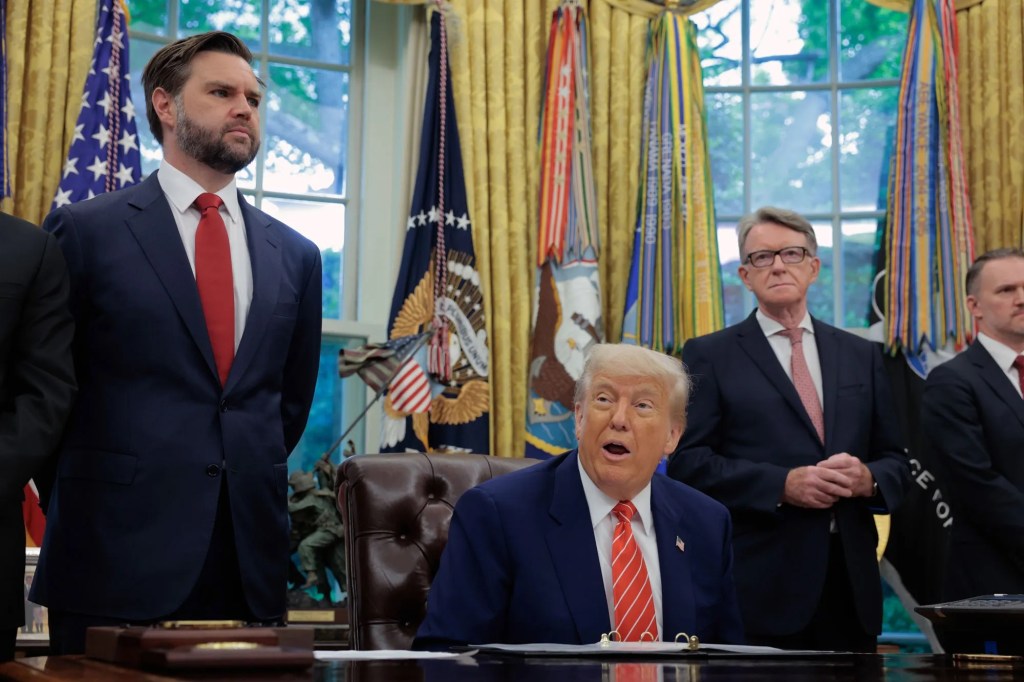
    J.D. Vance, Donald Trump and Peter Mandelson in the Oval Office, May 8, 2025 (Getty)

    It helps that Britishness is now fashionable in Washington (where Irish origins used to be the thing to trumpet). Vance, along with other MAGA tech bros, has had his DNA tested, and discussed the results with British politicians who met him over the summer, including David Lammy, the outgoing foreign secretary, when he hosted him at Chevening. “Vance has discovered he is English,” says one of those who took part in these conversations. “He talked a lot about his roots and his ancestry. The tech-right has got very into genetic tests and Americans are discovering they’re all English.”

    The big announcement next week will be a new Anglo-American tech deal which will be worth “billions of pounds of investment” to Britain at a time when the Treasury is crying out for anything which can boost growth. The deal will see more joint research and co-investment in three crucial areas: AI, quantum computing, which will hugely increase the power of AI, and nuclear fusion, which will create near limitless energy to fuel the supercomputers.

    Progress has been aided by the fact that the White House is not just going through the motions. “The administration has been genuinely committed,” explains one of those involved in the negotiations. “They usually drag their feet on everything.” Insiders say that on arriving in DC, Mandelson, a prominent cheerleader for a tech deal, asked Vance to “lean into it,” which the Vice President did with gusto. After a row over encryption was resolved, Vance declared: “OK, let’s go!”

    When Vance met Lammy at Chevening he spoke with passion about the possibilities. “I’ve been in lots of meetings with the Americans over the years, in which people like Vance and Jake Sullivan [Joe Biden’s national security advisor] refer to AI, quantum, biotech and fusion as millennia-defining technologies,” says one senior official. “If we can crack the computing power that will let AI transform medicine and the limitless energy needed to run it, you and I might live to 150.” Lammy, who was appointed Deputy Prime Minister in last week’s reshuffle, will deputize for Starmer at international events such as the UN General Assembly, and having developed a rapport with Vance is expected to keep talking to him weekly.

    Peter Kyle, who as science minister was heavily involved in the negotiations, flew to DC this week in his new brief in charge of business and trade to try to finalize some of the details. Attempts are also under way to get some tweaks to US tariffs on Britain, something Kyle took up in his first meetings with Howard Lutnick, the commerce secretary, and Jamieson Greer, the US trade representative.

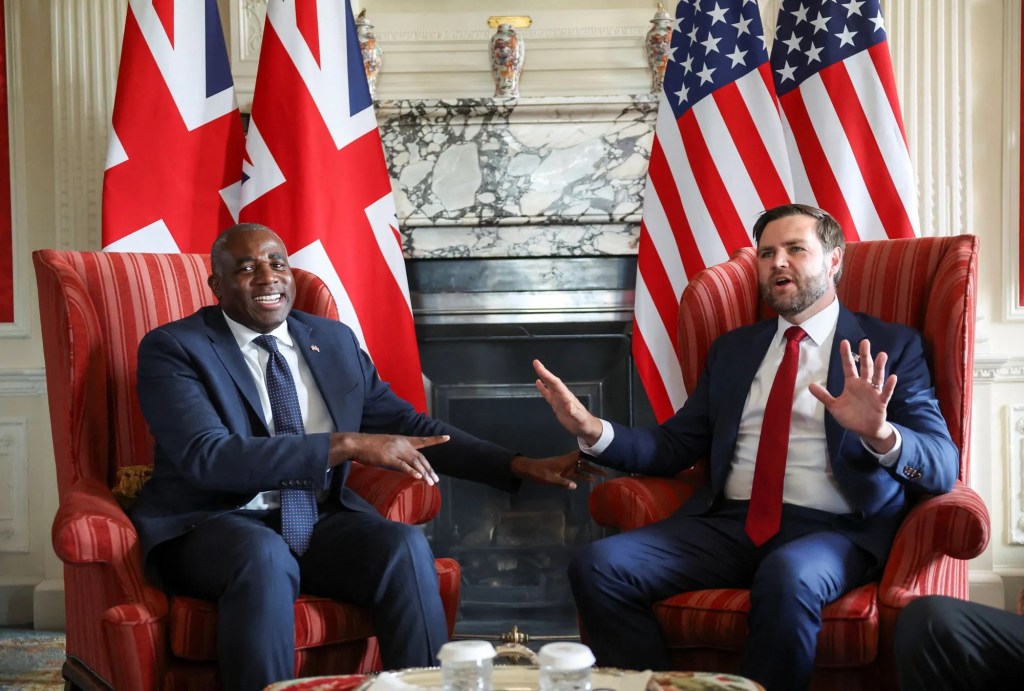
    David Lammy hosts J.D. Vance at Chevening House, August 8, 2025 (Getty)

    The case for the deal was outlined in a speech by the omnipresent (until this week) Mandelson at Ditchley Park last week. He pitched it as a way for the western allies to fight a global power struggle with China and its autocratic allies. “China is racing to dominate artificial intelligence, quantum computing and biotechnology,” he warned, arguing that a “full spectrum US-UK technology partnership” was crucial for “mutual defense” and “to lift us out of the economic stagnation we have experienced over the last decade.”

    The need for better cyber-security, another plank of the deal, was clearly illustrated this week with the publication of thousands of leaked documents from the office of Boris Johnson, revealing further details of his enthusiastic quest for cash. The revelations were not hugely surprising (one former cabinet colleague joked: “They hacked the wrong hard drive!”) but there is a serious point. The security services believe Johnson was hacked by Kremlin proxies as part of an attack on western politicians. “It is Russian in origin,” a senior security source reveals. The firebomb attack on Starmer’s constituency home earlier this year was also considered to have been a Russian operation.

    Johnson was approached last summer by the National Cyber Security Centre, part of GCHQ, and told that his documents had been placed on a public website, but it was only this week that they made it to the media. “He’s notoriously lax about his own phone and cybersecurity,” says one security source, who’s scarred by the way in which Johnson ignored requests by intelligence chiefs and mandarins to take the issue more seriously when he was PM. Insiders say Johnson was hit by a phishing malware attack, unleashed when a female aide opened an attachment to an email.

    Beyond the tech deal, the reason there is an attitude of “what will be, will be” in Downing Street about the state visit is because officials are confident that Trump is sincerely well disposed to the UK and to Starmer and is keen to show that Brexit has brought rewards to Britain (not that No. 10 will be caught spouting that line). When Nigel Farage met Trump in the Oval Office a week ago, after testifying to Congress about free speech, he concluded (somewhat to his distress) that the President “genuinely likes Starmer.” Farage also found Trump relaxed and upbeat. “He’s in a very good mood because he’s got no opposition,” the Reform leader told one associate. “The Democrats are in such a mess.”

    Trump and Melania, the First Lady, are “very excited” about staying at Windsor Castle, where the state banquet will be held on Wednesday evening in St. George’s Hall and Trump will be greeted by a guard of honor. When Farage last saw Trump he gave him a history lesson on Windsor Castle, the residence most beloved by senior royals.

    Wednesday will be all style while Thursday brings the substance. Trump will travel to Chequers for a working lunch and a mid-afternoon press conference – another moment which could be love-in or landmine. “Private time,” when Starmer and his wife Victoria will entertain Trump and Melania, has also been worked in. In 2018, Trump was feted at Blenheim, Winston Churchill’s birthplace. This time, the President will visit the Hawtrey Room at Chequers, where Churchill recorded many of his wartime radio speeches. A senior No. 10 source says: “Winston Churchill’s legacy will feature prominently – not as nostalgia, but as a reminder of leadership during uncertain times. We want this visit to set a new standard for how modern diplomacy looks: respectful of tradition, but relentlessly focused on outcomes.”

    Starmer will privately stress the UK’s continuing viability as a military partner for the US, emphasizing the worth of the Aukus defense deal with Australia, which has been questioned in Washington. There is talk of a military flypast to reinforce this image for Trump. Also up for discussion will be the future of western support for Ukraine, following the failure of Trump’s push for peace with Vladimir Putin. Starmer will talk to Trump about introducing further sanctions on Moscow and how to pressure the Europeans into releasing frozen Russian assets to fund Ukraine’s war effort, though aides caution against any major announcement next week.

    The only thing missing from the visit will be a round of golf. (Trump claims to have a handicap of two, but a regular British golfing partner says: “He plays off eight or nine.”) Starmer has no ability at, or interest in, the sport, and the best golfer in the cabinet is the very un-Trump-like Lord Hermer, the attorney general (though colleagues say the recent arrival in No. 10 of Tim Allan as communications director means Hermer is no longer the best golfer in the government). Remarkably, chatter on the Foreign Office grapevine reveals that Hermer once (presumably jokingly) volunteered his services to Mandelson as a “potential golfing partner” to butter up the President.

    It is this column’s loss that the offer was not taken up, but probably Britain’s gain. Whatever Trump says this week, Starmer intends to focus on the positives. If the tech deal helps to kickstart the economy, it won’t matter if the President’s apparent tendresse for Beverley Turner coaxes him into being indiscreet about other subjects.